

What is ERP, and how does it impact the running costs of your central heating and hot water? Understanding the ERP can help you make wiser choices when buying an appliance, so you save money on running costs and reduce your carbon footprint.
Government data shows that energy-related products account for around 55% of the UK’s total non-transport energy use and are a significant contributor to carbon emissions. A few percentage points of boiler efficiency might not sound dramatic on paper, but they can create a noticeable difference once winter arrives and the heating runs daily.
Two boilers may warm your home equally well, yet one could quietly burn more gas, cost more to run, and produce higher emissions over time. That is where ERP ratings come into play. They give homeowners a quick way to compare how efficiently a boiler converts fuel into usable heat, turning technical figures into something far easier to understand.
If you’re replacing an ageing boiler, comparing heating systems, or trying to cut household bills, ERP offers more than a letter on a label. It can provide a clearer picture of long-term costs, yearly savings, and how your heating choices fit into the UK’s wider move toward lower emissions.
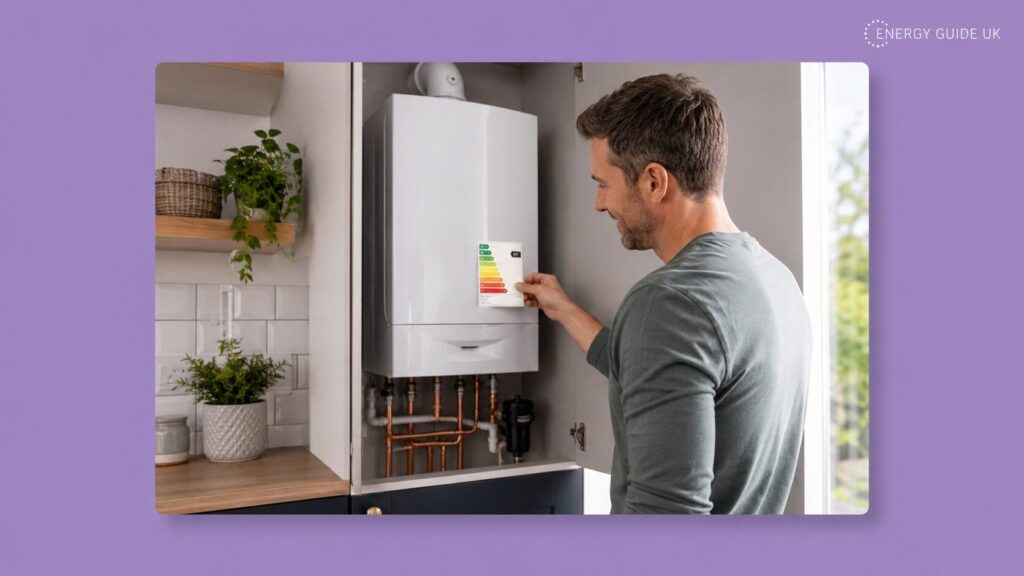
Key Takeaways on What is ERP:
- ERP stands for Energy Related Products and is the regulatory framework that sets minimum efficiency and environmental standards for every boiler sold in Great Britain.
- The ERP label scale was simplified in 2021 from G to A+++, down to G to A. A boiler previously rated A+++ now shows A, but its efficiency hasn’t changed; only the label format has. If you’ve seen A+++ referenced elsewhere, it refers to the old scale.
- All new and replacement gas boilers installed in the UK must achieve a minimum ERP rating of A, equivalent to at least 92% seasonal efficiency. You cannot legally install a lower-rated boiler as a new installation.
- Upgrading from a G-rated boiler at 65% efficiency to an A-rated model can save you over £300 per year for a typical three-bedroom home, based on the current gas rate prices. Over a 12-year boiler lifespan, that adds up to over £3,700.
- You can find your boiler’s ERP rating on the front panel sticker, in the installation manual, or by searching your model on the Products Characteristics Database (PCDB). A Gas Safe engineer can also carry out a combustion test during a service for a real-world efficiency figure.
- Lowering your boiler’s flow temperature to 55–60°C is the single fastest, cheapest improvement you can make to real-world ERP performance.
Why Does ERP Matter for Your Boiler?
ERP isn’t simply a sticker attached to a boiler or a technical rating buried in product specifications. It creates the standards manufacturers must meet and gives buyers a consistent way to compare efficiency before choosing a heating system. ERP can help you identify products that are likely to use less fuel and cost less over time.
What Does ERP Stand For?
ERP stands for Energy Related Products. It’s a framework that sets minimum efficiency and environmental standards for boilers and other heating products sold in Great Britain.
Introduced across Europe and later retained under UK regulations after Brexit, ERP aims to reduce energy consumption and lower emissions from products used in homes and businesses. For heating systems, ERP created a standardised way to measure seasonal performance rather than relying on basic efficiency figures taken under laboratory conditions.
Instead of asking, “How efficient is this boiler during one test?”, ERP asks a more useful question: “How efficient will this boiler perform across a full heating season in everyday use?” The result is a simple letter grade, which helps buyers compare products quickly.
What Products Does it Cover?
ERP applies to a wide range of products that either consume energy directly or influence how much energy a household uses. Examples include:
- Gas boilers
- Oil boilers
- Heat pumps
- Water heaters
- Hot water cylinders
- Smart heating controls
- Refrigerators
- Washing machines
- Lighting products
The system covers products that run on electricity, gas, and other fuels. It reaches beyond heating appliances alone and targets equipment responsible for substantial energy use across UK homes, making product efficiency standards an important part of reducing national energy demand.
Is ERP Still an EU Law in the UK?
The ERP framework originated in EU legislation, though Brexit didn’t remove the standards that affect boilers in Great Britain. Existing EU-derived product rules were retained and adapted for UK use after EU Exit, with the changes mainly addressing administrative areas such as conformity assessment and market regulation rather than introducing an entirely new efficiency system.
For homeowners, the practical outcome changed very little. Boiler manufacturers still need to meet minimum standards before selling products, and efficiency labels continue to appear on heating appliances. In simple terms, the logo and legislation behind ERP changed, though the standards affecting your boiler remained largely the same.
What Is the ERP Label and How Do You Read It?
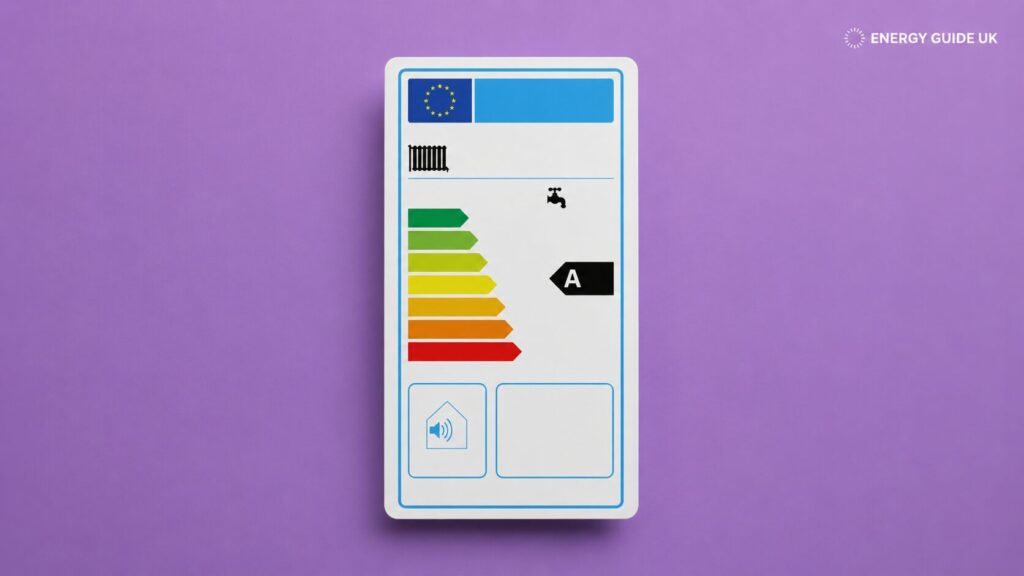
The ERP label was created to make comparing boilers much easier. Rather than digging through technical specifications or trying to decode efficiency percentages, homeowners can use a single label to compare performance at a glance. The letter grade provides a quick shortcut, though there is more information on the label than many people realise.
What Does the ERP Label Show?
A boiler ERP label contains several pieces of information:
- Seasonal space heating efficiency — the main efficiency rating shown as a letter grade
- Water heating efficiency — particularly relevant for combi boilers producing hot water on demand
- Scale bar position — shows where the product sits on the efficiency scale
- Heat output — measured in kilowatts (kW)
- Sound power level — indicates operating noise in decibels
- Combined package rating — shows how efficiency changes when compatible heating controls are installed
Some boilers can achieve a stronger package rating when paired with weather compensation controls, load compensation, or smart thermostats. This is why two boilers with similar specifications can produce different package results.
Why Does My New Boiler Show A and Not A+++?
Before 2021, ERP labels used a broader scale running from G to A+++. Boilers, appliances and heating systems often displayed A+, A++ or A+++ grades.
According to the Energy Saving Trust, the energy rating label system was simplified and returned to a cleaner G-to-A scale to better reflect a product’s performance at home. A boiler once labelled A+++ doesn’t suddenly perform worse today. The actual efficiency remains the same. Only the labelling system changed.
The purpose of the rescale was to create room for future efficiency improvements and make labels easier to understand. Without it, products had gradually clustered at the top of the ratings system, making comparison harder. Today, if you see a boiler with an A rating, you’re seeing the highest available band under the current scale.
What Are the Two Parts of the ERP System?
ERP operates through two connected systems that answer different questions.
EcoDesign requirements set minimum standards that manufacturers must meet before products can enter the market. Before a boiler can be legally sold in Great Britain, it must meet specific design standards covering energy efficiency, emissions, noise levels, and environmental impact throughout its lifecycle, from manufacturing through to end-of-life disposal. These are the standards that pushed the minimum boiler efficiency threshold and made condensing boilers mandatory.
Energy Labelling requirements provide information that consumers see when comparing products. It requires manufacturers to display efficiency information in a standardised, comparable format so that buyers can assess and compare products at the point of purchase. The coloured label on your boiler is the output of this requirement. Its purpose is to make efficiency differences visible and comparable, giving you the information you need to factor into a purchase decision, not just the upfront price.
In simple terms:
- EcoDesign asks: Can manufacturers sell this product?
- Energy Labelling asks: How efficiently does this product perform?
Together, they create a system that raises product standards while helping homeowners compare options more easily before purchase.
What Do the ERP Rating Letters Mean?
The letter on your boiler’s ERP label tells you how efficiently it converts fuel into usable heat across a full heating season. Every letter corresponds to a band of seasonal efficiency. The higher the letter, the less gas your boiler wastes, and the lower your heating bills.
| ERP Rating | Seasonal Efficiency | What It Means |
| A | 92% or above | The standard for all modern UK boilers. Every new condensing boiler sold in the UK achieves this rating. |
| B | 86% to 92% | Older condensing boilers installed before stricter standards took effect. Still reasonably efficient. |
| C | 82% to 86% | Ageing condensing boilers or early-generation models. Running costs are noticeably higher than A-rated. |
| D | 78% to 82% | Transitional boilers from the late 1990s to early 2000s. Consider replacement if repair costs are rising. |
| E | 74% to 78% | Old non-condensing boilers. Significantly more expensive to run than a modern replacement. |
| F | 70% to 74% | Inefficient non-condensing boilers. Replacement will pay back quickly at current gas prices. |
| G | Below 70% | The least efficient category. Heating bills from a G-rated boiler can be hundreds of pounds more per year than from an A-rated alternative. |
What Is the Minimum ERP Rating Required by UK Law?
UK regulations require all new and replacement gas boilers installed in existing dwellings in England to achieve a minimum ERP efficiency of 92% under Boiler Plus standards. Boiler Plus was introduced in April 2018 and strengthened existing Building Regulations for domestic heating systems.
The rules apply to both new gas boiler installations and replacement boilers in existing homes. Boiler Plus also introduced wider heating system requirements designed to improve real-world performance. These include:
- Time and temperature controls
- Boiler interlock
- Minimum 92% ERP efficiency
- Additional efficiency measures for combi boilers installed in existing dwellings
What Does ERP Seasonal Efficiency Mean?
Seasonal efficiency isn’t a single combustion test reading. It’s a calculated figure that accounts for how efficiently the boiler operates across a range of conditions throughout a full heating season, including part-load operation, start-up and shut-down cycles, and standby losses.
This is why two boilers from different manufacturers, both quoted at 94% efficiency in their marketing materials, can sit in slightly different positions within the A band when their seasonal ERP figures are compared.
A boiler that performs well under laboratory conditions but loses efficiency due to the frequent on-off cycling typical of a UK heating system will have a lower seasonal efficiency than its peak rating suggests. When you’re comparing boilers, always use the seasonal efficiency percentage on the ERP label rather than any peak efficiency figure quoted in marketing materials.
What Does a Better Rating Actually Save You?
A higher ERP rating does more than improve a label on your boiler paperwork. It can have a noticeable impact on annual running costs, fuel use and household emissions. A difference of 20–30% in efficiency may not sound dramatic, but the gap becomes much more expensive once heating runs daily through autumn and winter. For older boilers still operating at lower efficiency levels, the numbers can add up surprisingly quickly.
What is the Cost Difference Between a G-Rated and an A-rated boiler?
To heat a typical three-bedroom semi-detached home, you need approximately 12,000 kWh of useful heat per year. How much gas your boiler burns to deliver that heat depends entirely on how efficiently it converts fuel to warmth.
A G-rated boiler operating at 65% efficiency wastes 35% of every unit of gas it burns. To deliver 12,000 kWh of useful heat, it needs to burn (12,000 ÷ 0.65) = 18,461 kWh of gas. At the current Ofgem price cap gas rate of 5.74p/kWh, that costs (18,462 × £0.0574) = £1,059 per year.
An A-rated boiler operating at 92% efficiency wastes only 8% of every unit. To deliver the same 12,000 kWh of useful heat, it needs only 13,043 kWh of gas. That costs £749 per year at the same Ofgem rate.
The annual saving from switching from a G-rated to an A-rated boiler is approximately £310 per year for a typical three-bedroom home. Larger homes with higher heat demands will save proportionally more.
| Boiler Rating | Efficiency | Gas Required (kWh) | Annual Cost | Annual Saving vs A-Rated |
| A-rated | 92% | 13,043 | £749 | — |
| B-rated | 89% | 13,483 | £774 | £25 |
| C-rated | 84% | 14,285 | £820 | £71 |
| D-rated | 80% | 15,000 | £861 | £112 |
| E-rated | 76% | 15,789 | £906 | £157 |
| F-rated | 72% | 16,667 | £957 | £208 |
| G-rated | 65% | 18,461 | £1,059 | £310 |
What Is the Long-Term Financial Case for a Better Rating?
£310 per year compounded over a typical 12-year boiler lifespan adds up to approximately £3,720 in cumulative savings before accounting for gas price changes. If you qualify for government grant schemes, a full boiler replacement may cost you nothing. Even paying the full cost of a mid-range boiler replacement, the running cost saving alone typically pays back the investment within 5 to 8 years at current gas prices.
Minimum energy performance standards are one of the most cost-effective ways to reduce emissions and energy bills. For a homeowner with an E, F, or G-rated boiler, the savings make the case in concrete terms. Every year you delay replacing an inefficient boiler is a year of paying for fuel that your heating system converts to waste rather than warmth.
Check out our video on how to vet boiler brands/models in the UK:
What Is the Difference Between ERP and SEDBUK?
If your boiler was installed before September 2015, it may carry a SEDBUK rating rather than an ERP label. Understanding both helps you interpret your boiler’s rating correctly, regardless of which system applies.
What Is SEDBUK and Is It Still Used?
SEDBUK stands for Seasonal Efficiency of Domestic Boilers in the UK. The UK government and boiler manufacturers introduced it in 1999 as an industry benchmark to enable fair comparison of boiler energy performance. It was updated in 2005 and 2009, and in September 2015, it was replaced by the ERP directive.
SEDBUK used a letter scale from G to A, the same as the ERP system, and rated boilers based on their performance across a full heating season rather than under peak laboratory conditions. It accounted for standby losses, cycling losses, and flue heat losses, all of which are relevant to real-world performance.
SEDBUK may still appear on some products alongside an ERP rating because it offers greater granularity, providing a percentage performance figure rather than just a letter grade. SEDBUK is also still used for EPC calculations and for boilers in new-build properties under current building regulations, where the Standard Assessment Procedure (SAP) still references SEDBUK figures. So while ERP is the labelling standard for replacement boilers, SEDBUK hasn’t disappeared entirely.
What Does ERP Measure That SEDBUK Doesn’t?
The core difference between ERP and SEDBUK is scope. SEDBUK focused specifically on combustion efficiency, or how much of the fuel burned was converted to heat. ERP takes a broader view of the product’s total environmental impact.
| SEDBUK | ERP | |
| Introduced | 1999 (updated 2005, 2009) | September 2015 |
| Replaced by | ERP | Current UK standard |
| Scale | G to A | G to A (rescaled from A+++ in 2021) |
| What it measures | Combustion and seasonal efficiency | Efficiency, noise, CO2, water heating, environmental impact |
| Output format | Letter grade + percentage | Letter grade only |
| Still in use? | Yes — EPC calculations and new builds | Yes — all replacement boiler installations |
| Percentage shown? | Yes | No — letter only |
The absence of a percentage from the ERP label is one reason some manufacturers and heating engineers still reference SEDBUK figures alongside the ERP rating. If you want to compare two A-rated boilers, which are, by definition, both in the same ERP band, the SEDBUK percentage is one way to distinguish between them within that band. A boiler at 94% SEDBUK performs better than one at 89.5%, even though both carry an A on the ERP label.
How Do You Convert a SEDBUK Rating to ERP?
If your boiler shows a SEDBUK letter grade, it roughly corresponds to the equivalent ERP letter grade. An A-rated SEDBUK boiler is an A-rated ERP boiler. A C-rated SEDBUK boiler sits in the C band on the ERP scale.
If your boiler shows a SEDBUK percentage rather than a letter, you can map it roughly as follows: 92% and above = ERP A-rated; 86–92% = ERP B-rated; 82–86% = ERP C-rated; 78–82% = ERP D-rated. Below 78% falls in the E, F, or G bands, depending on the specific figure.
How to Find Out What ERP Rating Your Boiler Has
Knowing your boiler’s ERP rating gives you a clear starting point for deciding whether to improve, service, or replace it. There are four ways to find the information, ranging from a quick visual check to a professional test that gives you the real-world efficiency of your specific unit.
Where Is the ERP Label on a Boiler?
The quickest place to look is the boiler’s front panel. Every boiler installed after September 2015 should carry the coloured ERP label either on the front casing or inside the front panel door. The label is standardised in format: a horizontal colour bar from red at the bottom to green at the top, with a letter indicating where your boiler sits on the G-A scale.
If the label has been painted over, removed, or is no longer legible, don’t worry. Three further methods allow you to find the rating without the physical sticker.
How to Find Your ERP Rating in the Installation Manual
Your boiler’s installation manual lists full technical specifications, including the seasonal efficiency figure and the corresponding ERP letter grade.
If you don’t have the physical manual, most manufacturers publish current and archived manuals on their websites. Search for your boiler’s make and model name, followed by “installation manual”, and the manufacturer’s site will typically return a downloadable PDF. The efficiency data appears under the technical data or product specifications section.
What Is the PCDB, and How Do You Use It to Find an ERP Rating?
You can search for boilers listed in the Product Characteristics Database (PCDB).Top of FormBottom of Form This is the authoritative UK database holding both SEDBUK and ERP ratings for every boiler model sold in Great Britain, including models that are decades old and no longer in production.
To use it, you’ll need your boiler’s make and model number. You’ll find these on the small metal or printed label fixed to the inside of the front panel or on the boiler casing. The database returns the seasonal efficiency percentage and ERP letter grade for your specific model, giving you an accurate rating even if the physical label is missing, faded, or was never fitted.
This is the most reliable method for older boilers installed between the late 1990s and 2015, which carry SEDBUK rather than ERP ratings. The database holds both, so you can look up your model and see both the SEDBUK percentage and the equivalent ERP letter in a single search.
Can a Gas Safe Engineer Test Your Boiler’s ERP Performance?
Yes, and this is the only method that gives you your boiler’s real-world efficiency rather than its manufacturer-rated efficiency. A Gas Safe registered engineer can carry out a combustion efficiency test during an annual boiler service. The test measures the actual flue gas composition and temperature to calculate the percentage of fuel being converted to usable heat at that moment, under your specific conditions.
This real-world figure frequently differs from the manufacturer’s rated ERP efficiency, particularly on older boilers. Boiler efficiency degrades over time and is affected by flow temperature settings, system condition, and installation quality. A boiler rated at 92% when new may be performing at 80% or below after a decade without servicing.
The combustion test gives you the current figure, not the label figure, which is far more useful for calculating your actual running costs and deciding whether replacement is financially justified. If you’re unsure whether your boiler is performing close to its rated efficiency or significantly below it, ask your Gas Safe engineer to carry out a combustion test at the next service. Most will do so as part of a thorough annual check, and some will include it as standard.
What Affects Your Boiler’s Real-World ERP Performance?
The ERP rating on your boiler’s label reflects its performance when new, under standardised test conditions. Your boiler’s actual efficiency in your home, right now, is almost certainly different, and in most cases, lower.
Boiler Age
A boiler’s efficiency degrades gradually over time. Heat exchangers accumulate scale and deposits, reducing heat transfer. Seals and gaskets deteriorate, and combustion components wear and drift from their optimal settings. A boiler rated at 92% when installed a decade ago may be operating at 80-85% today if it hasn’t received consistent annual servicing.
The ERP label on the front of your boiler tells you what it achieved when it left the factory. It doesn’t tell you what it’s achieving today. If you want a current figure, the combustion test is the only way to find out.
How old is your boiler? Should you consider repairing the boiler or looking at the latest boiler prices?
Your Boiler’s Flow Temperature
Condensing boilers only operate in condensing mode, or the mode in which they achieve their rated ERP efficiency, when the return water temperature from the heating system falls below approximately 55°C. In condensing mode, the boiler captures latent heat from the flue gases that would otherwise be vented to the outside, recovering energy that a non-condensing boiler would waste entirely. This is where the efficiency advantage of a modern condensing boiler comes from.
The problem is that most condensing boilers leave the factory with the boiler flow temperature set at 70 to 80°C. At that setting, the return water rarely drops low enough to trigger consistent condensing mode, meaning the boiler runs at significantly below its rated efficiency for much of the heating season.
Reducing the flow temperature to 55-60°C, or lower if your radiators and pipework can support it, pushes the boiler into sustained condensing mode. The Energy Saving Trust notes that turning down the flow temperature improves your boiler’s efficiency by nearly 4%.
This single adjustment is the fastest, cheapest efficiency improvement available to most homeowners with a modern condensing boiler.
Magnetite
Magnetite is the black sludge that forms in central heating systems as iron components in pipework and radiators corrode over time. It circulates through the system and gradually accumulates at the base of the boiler’s heat exchanger and in the lower sections of radiators.
As magnetite builds up in the heat exchanger, it acts as an insulating layer between the burner and the water being heated. The boiler has to work harder and burn more gas to transfer the same amount of heat. It also causes the boiler to cycle more frequently as the heat exchanger struggles to maintain temperature, and frequent cycling is one of the most energy-wasteful operating patterns a boiler can exhibit.
A whole-system chemical cleanse followed by the installation of a magnetic filter on the return pipe captures magnetite before it re-enters the heat exchanger. Annual cleaning of the magnetic filter during the boiler service keeps the system clean and the boiler operating efficiently.
Poor Installation Quality
Even a new, A-rated boiler can operate significantly below its rated ERP efficiency if it’s incorrectly sized or poorly commissioned. An oversized boiler short-cycles, switching on and off frequently because it heats the system too quickly, which is inefficient regardless of the boiler’s rated efficiency.
A well-sized boiler should be able to run at a low modulation rate for extended periods rather than switching on and off repeatedly. Your Gas Safe engineer should size the boiler correctly for your home’s heat demand and commission it at the appropriate settings before leaving. If your boiler is noisier than expected, heats the home unevenly, or runs in short, frequent bursts, it may be oversized or poorly installed.
Got a common boiler problem? Check out our quick-fix guide on boiler lockout, boiler ignition faults, boiler PCB faults, faulty diverter valves, and boiler timer issues.
How to Improve Your ERP Rating Without Replacing Your Boiler
- Bleed and balance your radiators. Trapped air in radiators reduces circulation and forces your boiler to work harder to distribute heat evenly around the home. Bleeding releases the trapped air. Balancing, or adjusting the lockshield valves on each radiator to ensure even heat distribution, reduces cycling and improves overall system efficiency. Both tasks are straightforward DIY jobs, though balancing takes more time and patience than bleeding.
- Fit a magnetic filter and inhibitor. A magnetic filter fitted to the return pipe captures magnetite particles before they re-enter the boiler. An inhibitor added to the system water slows future corrosion. Together, these two measures protect your boiler’s performance and satisfy most manufacturers’ warranty conditions. Annual cleaning of the filter during the boiler service keeps it effective.
- Book an annual Gas Safe service. A thorough annual service cleans combustion components, checks and adjusts the flue gas composition, inspects the heat exchanger for scaling, and identifies any parts that are drifting from optimal settings. Regular servicing extends the boiler’s operational life, delays the need for replacement, and is a condition of most manufacturer warranties.
- Add Controls. Heating controls can improve efficiency without replacing the boiler itself. Boilers often waste energy through unnecessary heating cycles or heating empty rooms. Smarter controls reduce wasted operation and improve system response. Controls that can improve performance include thermostatic radiator valves (TRVs), programmable room thermostats, weather-compensation controls, load-compensation controls, and smart heating systems.
What Does a Low ERP Rating Mean for Your Next Steps?
Knowing your boiler’s ERP rating is only useful if it leads to a decision. For most homeowners, the question after finding the rating is a practical one: is it worth improving what you have, or is replacement the financially smarter move?
What ERP Rating Should Trigger a Boiler Replacement?
A boiler rated C or D is losing between 14% and 22% of every unit of gas it burns as waste heat. That’s a meaningful inefficiency, but it doesn’t automatically justify the cost of replacement. A C or D-rated boiler that’s well maintained, relatively young, and not requiring frequent repairs is a candidate for efficiency improvements such as lower flow temperature, a magnetic filter, and annual service, rather than immediate replacement.
A boiler rated E, F, or G tells a different story. A G-rated boiler at 65% efficiency costs approximately £310 more per year to run than an equivalent A-rated replacement. An E-rated boiler costs around £157 more per year. At those levels, the running cost savings from replacement begin to make a serious financial case, particularly when combined with the reliability risk of an older, less efficient unit requiring increasingly expensive repairs.
Situations where replacement is most clearly justified include:
- Your boiler is rated E, F, or G on the ERP scale
- Your boiler is over 15 years old
- You’re spending money on repeated repairs year after year
- Your boiler was installed before September 2015 and carries a SEDBUK rather than an ERP label
- It struggles to maintain temperature on cold days or takes noticeably longer to heat the home than it used to
- Your Gas Safe engineer’s combustion test shows real-world efficiency significantly below the rated figure
Any combination of two or more of these is a strong case for getting a replacement quote and comparing the running cost savings against the upfront investment.
What Is ERP? The Verdict
ERP isn’t complicated once you understand what it’s telling you. It’s a measure of how much of the fuel your boiler burns actually becomes usable heat in your home, and how much escapes through the flue as waste. The letter on your boiler’s label, G at the worst end, A at the best, translates directly into pounds on your gas bill every single month.
For most UK homeowners, the ERP rating is most useful as a diagnostic tool. If your boiler is A or B-rated and relatively young, the priority is maintaining that performance through annual servicing, correct flow temperature settings, and a clean system. Efficiency improvements can close a meaningful part of the gap without any capital outlay if it’s C or D-rated. If it’s E, F, or G-rated, or if it was installed before 2015 without an ERP label, the savings make the financial case for replacement clear and concrete.
Whether you’re checking the label on your current boiler, researching replacement costs or weighing up future heating options, understanding ERP gives you a clearer picture of long-term performance rather than relying on headline claims alone. A single letter may seem small, though over the lifespan of a heating system, it can carry much more weight than many homeowners realise.
FAQs on What Is ERP
What Is ERP?
ERP stands for Energy Related Products. It’s a regulatory framework that sets minimum efficiency and environmental standards for boilers and other heating products sold in Great Britain. It was introduced in 2010, replacing the narrower EuP directive, which covered only products that use energy directly. Under ERP, every boiler sold in the UK must meet minimum seasonal efficiency requirements and display a standardised energy label showing its rating on a scale from G to A.
What Does ERP Mean on a Boiler?
On a boiler, ERP refers to the efficiency rating displayed on the coloured label on the front of the unit, ranging from G (least efficient) to A (most efficient), showing how well your boiler converts gas into usable heat over a full heating season. The label also shows a separate water heating efficiency grade and a scale bar indicating where your specific model sits within the current range.
What Is the Minimum ERP Rating for a New Boiler in the UK?
All new and replacement gas boilers installed in the UK must achieve a minimum ERP rating of A, equivalent to at least 92% seasonal efficiency. A boiler rated below this cannot legally be installed as a new or replacement installation. UK law also requires all new gas boilers to be condensing boilers. Every condensing boiler achieves A-rated ERP efficiency, making the two requirements two ways of describing the same regulatory outcome.
What Is the ERP A+++ Rating and Is It Still Used?
A+++ was the top band on the old ERP label scale before 2021. In 2021, the label was rescaled and simplified from G to A, removing the A+, A++, and A+++ categories entirely. A boiler that previously carried an A+++ rating now shows A on its current label. Its actual efficiency hasn’t changed; only the label format has.
What Is the Difference Between ERP and SEDBUK?
SEDBUK, or Seasonal Efficiency of Domestic Boilers in the UK, was the predecessor UK rating scheme, introduced in 1999 and replaced by ERP in September 2015. Both use a G to A letter scale, but ERP is broader in scope, covering noise pollution, CO2 emissions, water-heating efficiency, and overall environmental impact, alongside combustion efficiency.
What Is a Good ERP Rating for a Boiler?
A-rated is the standard for all modern UK boilers. It means a seasonal efficiency of 92% or higher. Every new boiler you can legally buy and install in the UK is A-rated, so the letter grade alone doesn’t differentiate between new models. To compare two A-rated boilers, look at their specific seasonal efficiency percentages. A boiler at 94% outperforms one at 92% even though both carry the same letter. For an existing boiler, any rating of C or below means the boiler is losing a meaningful proportion of your gas as waste heat, and ratings E, F, or G mean replacement is likely to pay back within a few years at current gas prices.
Sources and References
- GOV.UK – Energy-Related Products Policy Framework
- Energy Saving Trust – Home appliances and energy efficiency ratings
- GOV.UK – Boiler Plus (2018) Initial Policy Review
- Ofgem – Changes to energy price cap between 1 April and 30 June 2026
- PCDB – Search for ‘Boilers’ listed within the Product Characteristics Database (PCDB)
- Energy Saving Trust – Should I turn my boiler’s flow temperature down?