

The UK government plans to make a decision in 2026 on whether, and if so, how hydrogen boilers will contribute to heating decarbonisation. For now, hydrogen heating remains a live policy question rather than a settled route for most households.
In its March 2024 response to the Improving Boiler Standards and Efficiency consultation, ministers confirmed they had dropped an earlier proposal to require every newly installed domestic gas boiler to be hydrogen-ready from 2026. They argued it would be disproportionate to push the market in that direction before deciding whether hydrogen should play a substantive role in decarbonising heat.
This signals that hydrogen is still being assessed, not rolled out. Heat pumps and heat networks remain the primary route for decarbonising heating for the foreseeable future. Hydrogen is viewed as a possible longer-term option in some locations rather than the default replacement for gas boilers nationwide.
If you’re replacing a boiler today, the real question is not whether hydrogen is “coming soon,” but whether hydrogen boilers are available in the UK today, what “hydrogen-ready” means in practical terms, and whether it’s wise to plan around a technology that remains under review rather than fully approved for widespread domestic heating.
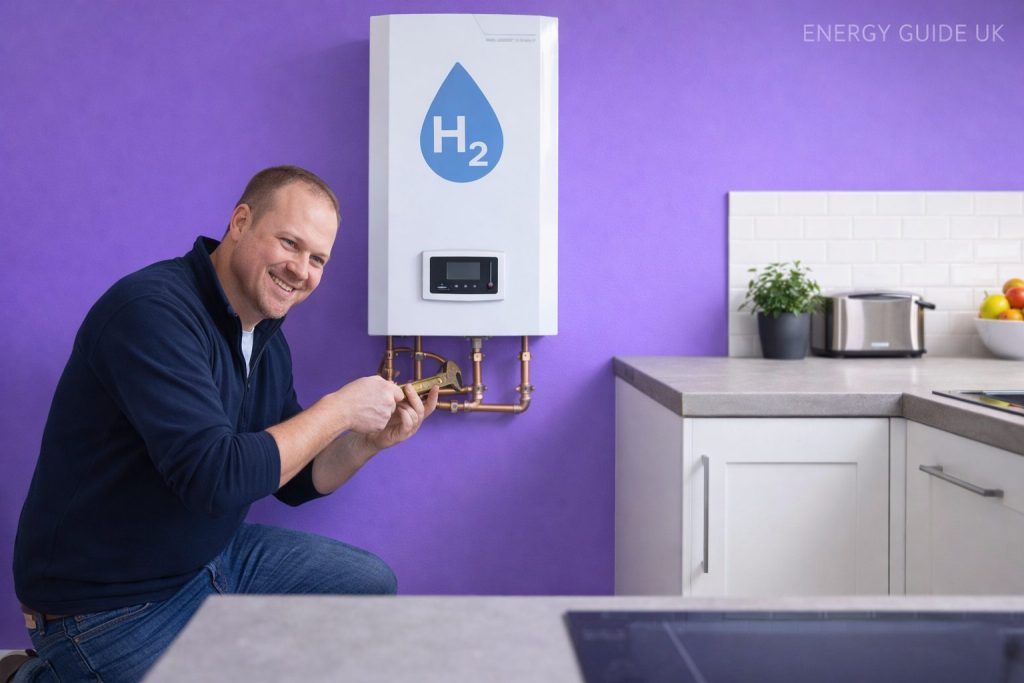
Key Takeaways on Hydrogen Boilers in the UK:
- Hydrogen boilers remain an emerging technology and are not widely available in the UK.
- Current deployment is limited to pilot projects and trials.
- Hydrogen-ready boilers may handle low hydrogen blends, but full conversion is complex, costly, and requires infrastructure upgrades.
- Heat pumps, hybrid systems, and heat networks are the most practical low-carbon alternatives today.
- Hydrogen has low-carbon potential, but rollout is constrained by production costs, storage, and safety considerations.
- The UK government’s 2026 decision will clarify the future role of hydrogen in domestic heating.
- Most homeowners should prioritise proven solutions rather than waiting for hydrogen availability.
- Hydrogen is likely to play a targeted role in specific locations or new developments, rather than replacing gas boilers nationwide.
What Is a Hydrogen Boiler?
A hydrogen boiler is a heating appliance designed to warm your home and provide hot water using hydrogen gas. A standard gas boiler burns methane-rich natural gas, whereas a true hydrogen boiler is built to burn 100% hydrogen.
On paper, hydrogen boilers could let households keep a familiar wet central heating system without switching to an entirely different setup. You would still have a boiler, use radiators, and heat water in a way most UK homes already understand. For many homeowners, that sounds far less disruptive than a full system change.
But there is a catch. In 2026, very few households can actually access 100% hydrogen for home heating. Therefore, the idea remains far more advanced in theory than in everyday practice.
How Does a Hydrogen Boiler Work?
At a basic level, a hydrogen boiler works much like a gas boiler. It ignites fuel in a combustion chamber, uses the heat created to warm water, and sends that heated water through your central heating system. If your home already uses radiators and a combi, system or regular boiler setup, the overall heating experience would be broadly familiar.
The key engineering difference is that hydrogen burns differently from natural gas, so components such as the burner, controls, valves and safety systems need to be designed or adapted for hydrogen use. That is why a standard gas boiler cannot simply be treated as a hydrogen boiler without the right design and certification.
One reason hydrogen gets so much attention is its emissions profile at the point of use. When hydrogen burns, it does not produce carbon dioxide at the boiler itself in the same way natural gas does. That doesn’t automatically make hydrogen heating low-carbon in every case. The carbon impact depends heavily on how the hydrogen is produced, how it is transported, and whether the wider supply chain is genuinely low carbon. That is one reason the UK government has been careful not to classify hydrogen-ready boilers as low-carbon appliances today.
Hydrogen Boiler vs Hydrogen-Ready Boiler
A hydrogen boiler is a boiler designed to run on 100% hydrogen. A hydrogen-ready boiler is usually a natural gas boiler installed today that may be capable of being converted in the future if a hydrogen network is introduced in your area.
That distinction matters a lot. If you buy a hydrogen-ready boiler in 2026, you’re not buying a boiler that heats your home with hydrogen right now. You’re still buying a gas boiler for present-day use, with the possibility of a future conversion if the UK eventually approves hydrogen heating in a meaningful way and if your local network is ever converted. This is one of the most misunderstood parts of the market, and it is exactly why the government has pushed for clearer definitions around what can and cannot be marketed as “hydrogen-ready.”
Why Hydrogen Boilers are Still a Long Way Off
Hydrogen boilers sound like the least disruptive future. Keep the boiler, radiators, and the way your home already heats. For a lot of households, that is a much easier sell than changing how a property is heated from the ground up. However, the current UK position is far more cautious than the marketing language often suggests.
In reality, hydrogen boilers are still tied to a much bigger question: where would the hydrogen come from, how would it be supplied, and which areas would actually get it? Until there is a clear national decision on hydrogen’s role in domestic heating, plus the infrastructure to support it, a hydrogen boiler remains more of a future-facing concept than a mainstream home upgrade.
Can You Buy a Hydrogen Boiler in the UK Today?
If you’re searching for a hydrogen boiler in the UK right now, you’re unlikely to find a normal retail setup where you can book an installer, connect it to a live hydrogen supply, and heat your home on 100% hydrogen in the same way you would with a standard gas boiler. That market doesn’t really exist for ordinary households yet. In 2026, hydrogen boilers remain a niche, policy-led technology tied far more closely to trials, manufacturer development and future planning than mainstream domestic installations.
The biggest issue isn’t the boiler unit itself but the fuel supply. The UK doesn’t have a widespread domestic hydrogen network for homes. Most properties are still connected to the natural gas grid, and that means there is no everyday route for the average homeowner to switch from methane-rich gas to 100% hydrogen for home heating.
Without a hydrogen supply, a true hydrogen boiler has no practical use in most UK homes right now, even if the appliance exists in a technical sense. The government maintains that hydrogen for home heating is still under review, and the major policy decision on its role in domestic heating is due in 2026. Until that decision is made and until infrastructure follows, hydrogen boilers are not a mainstream purchase for the public.
What Is Available: Hydrogen-Ready Boilers
What you can find in the UK market is a discussion around hydrogen-ready boilers.
These are not the same as fully hydrogen-powered boilers in day-to-day domestic use. A hydrogen-ready boiler is usually a gas boiler designed to run on natural gas now, with the potential for a future conversion if a local gas network is ever switched to hydrogen.
In practical terms, if you bought one today, your home would still be heated by natural gas, not hydrogen. Any future requirement for hydrogen-ready boilers will only be considered from 2030 if hydrogen is given a substantive role in home heating after the 2026 decision.
Which Hydrogen Boilers Are Available in the UK?
Currently, the UK market offers hydrogen-ready boilers, not true hydrogen boilers for everyday domestic use. These boilers are designed to run on natural gas today, with the potential to convert to hydrogen if a supply network becomes available. There are no models that can heat a home with 100% hydrogen in most UK households right now.
Major Brands and Options
- Worcester Bosch – Offers hydrogen-ready versions of its Greenstar and other popular boilers. These units are fully functional on gas today, with internal components designed to allow future conversion.
- Baxi – Markets hydrogen-ready models such as the Baxi EcoBlue and Baxi Duo-tec series. Currently, they operate on natural gas and include some features that could accommodate hydrogen in trials or demonstration projects.
- Ideal Heating – Promotes hydrogen-ready models in its Vogue Max range. Like others, these boilers are natural gas appliances today, with design adjustments for potential future hydrogen use.
Key Limitations
- Hydrogen supply is absent: All “hydrogen-ready” boilers sold today still rely entirely on the existing gas grid.
- Conversion is theoretical: There is no confirmed national plan to convert domestic gas networks to hydrogen by 2026, so the potential to switch is purely conditional.
- Small-scale trials only: Some installations are part of pilot projects in controlled environments, not full domestic rollouts.
Wondering which boiler manufacturers performed best? Check out our best boiler brands guide for the full rundown, and if you are trying to determine who the best boiler installation company is, check out our Warmzilla and Boxt reviews.
Check out our video on how to vet boiler brands/models in the UK:
Hydrogen-Ready vs Hydrogen-Blend Boilers
Hydrogen-ready and hydrogen-blend boilers are fundamentally different, and understanding the distinction is critical for UK homeowners. The hydrogen-ready boilers operate entirely on natural gas today but are designed so that, in theory, they could handle 100% hydrogen if a local hydrogen network becomes available.
However, hydrogen’s domestic role remains uncertain. Any future conversion depends on infrastructure that does not yet exist, meaning these boilers provide no immediate environmental benefit.
Hydrogen-blend boilers, on the other hand, are built to run on small hydrogen/natural gas mixtures, typically up to 20%. This allows for incremental emissions reductions without requiring a full system upgrade. However, because the majority of the fuel remains methane, the carbon impact is limited. These models offer flexibility in areas where minor hydrogen blending is possible but don’t represent a full low-carbon heating solution.
Evidence also suggests that whilst most applications are capable of handling a hydrogen blend of up to 20% hydrogen by volume, the majority of end users will require some degree of modifications or upgrades. These involve equipment and processes, which become more significant, complex and costly as the level of hydrogen blend increases.
The distinction between hydrogen-ready and hydrogen-blend boilers matters because it directly affects what homeowners are actually buying. A hydrogen-ready boiler may be marketed as “future-proof,” but today it functions entirely as a gas boiler. A hydrogen-blend boiler can use some hydrogen now, but its emissions savings are small and location-dependent.
Pros and Cons of Hydrogen Boilers
Pros
- Could work with familiar heating systems
If hydrogen ever becomes widely available, these boilers could let households keep a boiler-led setup with radiators, hot water cylinders, and existing pipework, rather than moving to a completely different heating format. The UK government has noted that hydrogen may offer a less disruptive decarbonisation route for some homes compared with wider system changes. - Potentially lower carbon at the point of use
A true hydrogen boiler running on 100% low-carbon hydrogen would not produce carbon dioxide at the point of combustion in the same way a natural gas boiler does. This is one reason hydrogen heating continues to attract policy and industry attention. - Could suit harder-to-retrofit homes in future
Older properties or homes where a heat pump installation is difficult may see hydrogen presented as a possible future alternative, especially where major insulation or system changes are less practical.
Cons
- No widespread hydrogen supply for homes
The biggest drawback is simple: most UK homes cannot access 100% hydrogen for heating. Without a domestic hydrogen network, a true hydrogen boiler is not a realistic mainstream option today. - Hydrogen’s role in home heating is still undecided
The UK government is due to make a strategic decision in 2026 on whether hydrogen will have a meaningful role in domestic heating. Until that happens, hydrogen boilers remain tied to trials and future policy, not normal consumer demand. - Hydrogen-ready boilers do not cut emissions today
A hydrogen-ready boiler still runs on natural gas when installed. It may be designed for future conversion, but it does not provide an immediate low-carbon benefit. - You could pay more for an uncertain future value
A hydrogen-ready boiler may carry a premium without offering a practical benefit now. If hydrogen never reaches your area, any extra spend may never translate into real value. - Future conversion is not guaranteed
Even if a boiler is labelled hydrogen-ready, conversion would still depend on local infrastructure, national policy, and technical rollout in your area. There is no promise that your home will ever switch. - Hydrogen-blend compatibility can be misunderstood
Government evidence suggests many applications may be capable of handling blends of up to 20% hydrogen by volume, but many end users would still need modifications or upgrades. Those changes become more complex and costly as the hydrogen percentage increases. So “blend-ready” does not mean seamless future-proofing. - Environmental benefits depend on how hydrogen is made
Hydrogen is not automatically low-carbon. The climate impact depends on production method, transport, and supply chain emissions, not simply the fuel name.
Comparison of the Pros and Cons of Hydrogen Boilers:
| Pros | Cons |
| Could keep a familiar boiler-and-radiator setup | No widespread 100% hydrogen supply for UK homes |
| Less disruptive in theory than some heating alternatives | Government has not yet confirmed a full domestic role for hydrogen |
| No direct CO2 at the point of combustion with 100% low-carbon hydrogen | Hydrogen-ready boilers still run on natural gas today |
| Could appeal to harder-to-retrofit homes if networks are built | You may pay more now for a benefit you never use |
| Fits existing wet central heating in principle | Conversion depends on future policy and local infrastructure |
| Hydrogen blends may still require upgrades or modifications | |
| Environmental gains vary depending on how hydrogen is produced |
How Much Does a Hydrogen Boiler Cost in the UK?
There is still no settled, official UK price for a true domestic hydrogen boiler, largely because the market is not operating at scale. Most homeowners are not buying 100% hydrogen boilers for normal home installation, so there is no mature retail pricing in the way there is for standard gas combis.
Most Cost Estimates Are Based on Hydrogen-Ready Boilers
The clearest working assumption in the market is that a hydrogen-ready boiler would be priced broadly in line with a standard modern gas boiler, at least at the unit level. Industry sources have repeatedly suggested hydrogen-ready models should cost no more than an equivalent gas boiler, though exact prices still vary by brand, size, output, and boiler type.
As a rough guide, consumer boiler pricing sites currently place hydrogen-ready boiler units at around £500 to £3,000 before installation, with installed costs often landing between roughly £1,000 and £3,750, depending on whether you choose a combi, system, or regular boiler.
Real-World Boiler Costs Still Follow Standard UK Boiler Pricing
Right now, the most practical way to estimate hydrogen-ready boiler costs is to use standard boiler replacement pricing. For example, Worcester Bosch’s own pricing pages show that a modern installed gas boiler can sit comfortably in the roughly £1,795 to £3,500+ range for straightforward replacements, with more complex swaps going beyond £4,000, depending on boiler type, relocation, and system changes.
Worcester Bosch’s current example pricing includes a Greenstar 2000 30kW package at £2,475 including VAT and installation, which gives a useful real-world benchmark for what many homeowners already pay for a mainstream modern boiler.
Installation Costs Matter More Than the “Hydrogen” Label
For most homes, installation complexity will have more impact on price than the hydrogen-ready label itself. A straight combi-to-combi swap is usually the cheapest route. Costs rise if you move the boiler, switch from a regular or system setup to a combi, upgrade pipework, alter the flue, or need extra controls and system balancing. If a hydrogen-ready model is priced similarly to a normal boiler, the final bill will still be driven by the same factors that affect any UK boiler replacement.
The Bigger Cost Risk Is Future Conversion
Buying a hydrogen-ready boiler doesn’t mean you’re paying for a complete hydrogen heating solution today. If the UK ever rolls out hydrogen heating in certain areas, there could still be future costs linked to conversion, local network changes, appliance checks, or related upgrades.
The government has already acknowledged the risk of consumers paying a premium too early for a technology with an uncertain future, which was one reason it dropped the proposed 2026 hydrogen-ready boiler mandate. So the real financial question is not only what the boiler costs now, but whether paying extra for “future readiness” ever produces a return.
How much may a new boiler cost? Are you considering converting from a conventional to a combi boiler? Use our boiler installation cost calculator to get an estimation.
Hydrogen Boilers vs Heat Pumps
Hydrogen boilers sound appealing because they preserve the boiler-style heating system many homes already use. In practice, heat pumps are the technology the UK is actively deploying now, with live grants, established installation pathways, and a much firmer policy footing.
Efficiency Differences
A hydrogen boiler would work in a similar way to a gas boiler, but a heat pump works differently. Rather than generating heat by burning fuel, it moves heat from the air or ground into the home. This is why heat pumps can deliver much more usable heat per unit of energy consumed than a combustion boiler.
According to the Energy Saving Trust, you can get three to four times as much heat (300 to 400%) in return for every unit of electricity you use with a heat pump, making it a much more efficient way of turning purchased energy into home heating.
Installation Differences
If hydrogen heating ever reaches large-scale domestic use, one of its biggest selling points will be familiarity. A hydrogen-ready or hydrogen-compatible boiler would still resemble a boiler installation, using radiators and hot water cylinders or combi-style layouts, depending on the system design. For many households, the day-to-day experience could remain fairly close to what they already know.
A heat pump installation can be more involved. Air source heat pumps need an external unit, internal controls, and often a review of emitter sizing, pipework, and hot water storage. Some homes may need larger radiators or improved insulation to get the best results. Ground source systems need loop installation, which is a much bigger project.
Which Works Best for Your Home?
If you need a low-carbon heating system now, the practical UK answer is usually a heat pump. It’s supported by policy, eligible for grants in England and Wales through the Boiler Upgrade Scheme, and they’re already being installed at scale. The scheme currently offers £7,500 towards an air source heat pump and £7,500 towards a ground source heat pump.
If your home is reasonably well insulated, has outdoor space for an external unit, and you’re planning a long-term decarbonisation upgrade, a heat pump is the more grounded option in today’s market.
A hydrogen boiler would only make sense in a future scenario where three things happen at once: the gas network in your area is converted or supplied with hydrogen, government policy supports domestic deployment, and supply costs become acceptable for households. Until those pieces are in place, hydrogen remains more of a future possibility than a live buying decision.
Quick comparison: Hydrogen boilers vs heat pumps
| Factor | Hydrogen Boiler | Heat Pump |
| Technology status in UK | Still under review for domestic use | Established and actively supported |
| Government position | Not yet an established home heating technology | Primary route for home heat decarbonisation |
| Efficiency | Boiler-style combustion efficiency | Much higher real-world efficiency |
| Installation disruption | Potentially familiar if hydrogen network exists | Often more involved upfront |
| Running costs | No settled domestic tariff data | Real-world data exists, but tariff-sensitive |
| Best fit today | Future-facing / speculative | Practical low-carbon option now |
Did you know the efficiency of your boiler can impact the amount of energy it uses and ultimately impact your heating bill costs? Check out our guide to the best condensing boilers to learn more. You may also find our review of the best eco-friendly boilers of interest.
Will Hydrogen Boilers Replace Gas Boilers in the UK?
Hydrogen is not currently expected to replace gas boilers across most UK homes, but the government has kept the door open to a limited future role.
The Climate Change Committee (CCC), which advises the UK government on climate policy, has repeatedly treated hydrogen as a more constrained resource that should be prioritised where electrification is much harder. It notes that hydrogen use should be focused on sectors where it is best suited, such as industry and dispatchable power, rather than being spread thinly across applications where electric alternatives already exist. It also notes that heat pumps are the main low-carbon technology for residential buildings.
Alternatives to Hydrogen Boilers
For households aiming to reduce carbon emissions today, several low-carbon heating options are available that don’t rely on hydrogen infrastructure. The UK government continues to promote these alternatives as the primary route to decarbonising heat, given their wider availability and established deployment pathways.
Heat Pumps
Heat pumps, either air-source or ground-source, extract heat from the air or ground and transfer it into homes. They operate efficiently even in moderate UK climates and are increasingly supported by incentives such as the Boiler Upgrade Scheme. Unlike hydrogen, heat pumps can be installed in most homes without major changes to gas networks.
Heat Networks
District or communal heat networks distribute heat from a central low-carbon source to multiple homes. They are particularly effective in urban or high-density areas, reducing individual installation costs and enabling integration with renewable energy sources. The government has identified heat networks as a key strategy for decarbonising densely populated areas.
Hybrid Heating Systems
Hybrid systems combine a conventional gas boiler with a heat pump, allowing homes to switch between fuels depending on efficiency and demand. These systems provide low-carbon operation while maintaining familiarity with existing infrastructure. They are particularly useful in homes where full electrification via a heat pump may be technically challenging or cost-prohibitive.
| Alternative | How it Works | Pros | Considerations |
| Heat Pump | Extracts heat from air or ground | Low-carbon, government incentives | May require larger radiators or underfloor heating |
| Heat Network | Centralised low-carbon heat to multiple homes | Efficient for dense areas, scalable | Limited to connected communities |
| Hybrid Heating | Combines heat pump and gas boiler | Flexible, reduces emissions | Still partially reliant on gas infrastructure |
These alternatives represent practical, immediate solutions for reducing household emissions while hydrogen heating remains in trial phases. For most homeowners, investing in these technologies today provides measurable carbon savings and aligns with government policy.
Final Thoughts on Hydrogen Boilers in the UK 2026
Hydrogen heating in the UK remains an emerging technology with potential, not a mainstream solution. Trials are providing valuable insights into how hydrogen could work in homes, but nationwide adoption faces significant hurdles, including network upgrades, boiler modifications, storage challenges, and high production costs. These practical limitations mean hydrogen is not yet a viable option for the majority of households.
For most homeowners, heat pumps, hybrid systems, and heat networks remain the most practical low-carbon alternatives. These technologies are widely available, supported by government incentives, and can deliver immediate carbon reductions without waiting for hydrogen infrastructure. Investing in proven solutions now ensures both efficiency and compliance with decarbonisation goals.
The UK government’s 2026 decision will clarify hydrogen’s future role, but until then, households should prioritise deployable, established technologies. Hydrogen may eventually complement electrification efforts in specific locations or new developments, but broader decarbonisation will continue to rely on solutions that are ready, scalable, and effective today.
FAQs on Hydrogen Boilers in the UK 2026
Are Hydrogen Boilers Available Now?
Hydrogen boilers are not yet widely available for domestic use in the UK. Current deployment is limited to pilot projects and trials, which supply hydrogen to selected homes in controlled environments. For most households, hydrogen boilers remain a long-term option rather than an immediately accessible solution.
How Much Does a Hydrogen Boiler Cost?
There is no standard market price for hydrogen boilers yet, as they are largely experimental and trial-based. Costs will depend on whether a boiler is newly built as hydrogen-ready or requires modification for hydrogen blends. Early estimates suggest that installation and infrastructure upgrades could make hydrogen-ready systems significantly more expensive than conventional gas boilers.
Is a Hydrogen Boiler Better Than a Heat Pump?
Hydrogen boilers and heat pumps serve different purposes. Heat pumps are more efficient for decarbonising heating today, widely available, and supported by government incentives. Hydrogen boilers could offer a familiar heating system and lower carbon potential if hydrogen supply becomes mainstream, but currently, heat pumps are the practical choice for most homes.
Does the UK Have Natural Hydrogen?
The UK does not have commercially exploitable natural hydrogen reserves for domestic heating. Hydrogen is typically produced through electrolysis using renewable electricity or from natural gas with carbon capture. Most hydrogen heating trials rely on locally produced hydrogen rather than naturally occurring sources.
How Much Is a Hydrogen-Ready Boiler?
Hydrogen-ready boilers, designed to handle up to a 20% hydrogen blend initially and potentially convert to higher concentrations later, do not have a widely established price, as few models are on the market. Costs will generally exceed those of standard high-efficiency gas boilers due to specialised burners, sensors, and control systems required for hydrogen compatibility.
What Is the Biggest Drawback of Using Hydrogen Boilers?
The main drawback of hydrogen boilers is the limited infrastructure and high costs associated with using hydrogen as a fuel. Homes would require boiler modifications, upgraded gas networks, and safe hydrogen storage, while hydrogen itself is expensive to produce and distribute at scale. These challenges make hydrogen boilers less practical for widespread adoption compared with heat pumps or hybrid systems at present.
Sources and References
- Department for Energy Security & Net Zero – Improving Boiler Standards and Efficiency
- GOV.UK – Hydrogen blending into the GB gas transmission network: consultation document
- Energy Saving Trust – Heat pumps: how they work, costs and savings
- Climate Change Committee – The Seventh Carbon Budget