

Microwave boilers are set to revolutionise home heating by providing an energy-efficient and sustainable alternative to the traditional gas boilers that heat most homes in the UK.
Government data show that emissions from residential buildings account for a fifth (20%) of the UK’s greenhouse gas emissions. Meeting the country’s net zero target may not be possible without near-complete decarbonisation of the housing stock. That challenge has forced engineers, manufacturers, and policymakers to rethink homes heating
Gas boilers still dominate British households, yet rising carbon targets, tighter building standards, and the gradual move away from fossil fuels mean their long-term future is uncertain. Heat pumps are currently the main low-carbon replacement, but they are not always easy to install in older properties, and the upfront cost can be difficult for many households to manage.
This has created growing interest in alternative technologies such as microwave boilers, which promise cleaner heating without requiring major changes to existing radiators and pipework. Understanding how they work, how much they could cost to run, and how they compare with heat pumps, electric boilers, and modern gas systems in 2026 can help you make an informed decision.
Key Takeaways on Microwave Boilers UK:
- Microwave boilers heat water using electricity instead of burning gas.
- The system works with existing radiators and pipework in most UK homes.
- Efficiency may reach around 96%, based on manufacturer data.
- Electricity costs more per kWh than gas in the UK, which affects the running cost.
- Heat pumps often cost less to run because they produce more heat per unit of electricity.
- The availability of microwave boilers remains limited, and they’re not widely installed.
- Current UK grants support heat pumps, not microwave boilers.
- Some homes may need electrical upgrades before installation.
- Early price examples suggest installation may cost around £3,000–£5,000.
- The technology is developing, but it is not yet a mainstream replacement for gas boilers.
What are Microwave Boilers?
A microwave boiler is an electric heating system designed to replace traditional gas boilers, heating water without burning fuel. Instead of using a flame, the boiler generates microwave energy, which transfers heat directly to the water inside the unit. The heated water then circulates through the home’s radiators and hot-water system in the same way as a conventional central-heating boiler.
A microwave boiler heats water using electrical energy rather than gas. The hot water is then sent through radiators just like a normal boiler. No fuel is burned, and no flue is required.
The technology is a potential low-carbon alternative to gas heating, aimed at reducing direct emissions from homes without requiring a full redesign of existing heating systems.
Because the system runs on electricity rather than combustion, it does not require a gas supply or a flue, and, in theory, it suits many properties that already have wet central heating. The idea behind the design is to make switching away from gas simpler for households that may not be suitable for a heat pump or other low-carbon heating systems.
Quick Facts on Microwave Boilers:
| Feature | Details |
| Energy source | Electricity |
| Heating method | Microwave energy heats water directly inside the unit |
| Fuel combustion | None |
| Flue required | No flue needed because no gas is burned |
| Works with radiators | Designed to work with standard wet central-heating systems |
| Hot water supply | Can provide central heating and domestic hot water |
| Installation type | Intended as a replacement for a gas or electric boiler |
| Electrical supply needed | Yes, runs fully on electricity |
| UK availability | Limited, still an emerging technology |
| Example manufacturer | Boilerwave |
| Typical efficiency | Around 96% (manufacturer figure) |
| Typical install cost | About £3,000–£5,000 based on early listings |
Wondering which boiler manufacturers performed best? Check out our best boiler brands guide for the full rundown, and if you are trying to determine who the best boiler installation company is, check out our Warmzilla and Boxt reviews.
How Do Microwave Boilers Work?
A microwave boiler heats water using electricity instead of burning gas. The system produces microwave energy inside the unit, which transfers heat directly to the water in a sealed chamber. Once heated, the boiler pumps the hot water through the home’s radiators and hot-water outlets in the same way as a normal central-heating system.
Unlike a gas boiler, the unit does not use a flame, burner, or heat exchanger connected to combustion gases. The heating process takes place inside an enclosed metal chamber designed to absorb microwave energy safely and convert it into heat. This design removes the need for a flue and reduces heat loss during operation.
Manufacturers in the UK combine microwave heating with thermal storage. The system heats water quickly and stores it at a high temperature inside an insulated tank. When the home needs heating or hot water, the stored heat moves through the pipework without delay. This allows the boiler to deliver fast response times without running continuously.
Step-By-Step Process
- Electricity powers the microwave generator inside the boiler
- Microwave energy heats water inside a sealed chamber
- Heated water is stored in an insulated tank
- The pump sends hot water to radiators or taps
- The system reheats water when the temperature drops
This process allows the boiler to provide central heating without combustion, which is why manufacturers describe microwave boilers as a possible low-carbon replacement for gas systems.
Want to learn how to use your boiler better? Read our complete guide on boiler flow temperature, how to optimise your boiler settings, and find out how much gas a boiler uses here.
Can You Buy Microwave Boilers in the UK in 2026?
Microwave boilers are no longer limited to prototypes, but they are still not widely available across the UK. A small number of manufacturers now advertise working systems, although installation remains limited to certain regions and specialist installers rather than a nationwide supply.
One of the main examples is the Boilerwave microwave boiler, which can directly replace electric thermal stores and gas boilers. Product pages show full central-heating models with outputs suitable for typical homes, along with pricing and installation packages, suggesting the technology has moved beyond the concept stage.
Installers like PulsaCoil state that you can fit microwave boilers in multiple counties across England, mainly in areas where replacement thermal stores or electric heating systems are common. Availability still depends on installer coverage, the property’s electrical capacity, and whether the system suits the existing heating layout.
Why are microwave boilers not widely sold yet?
Several factors are slowing down the rollout:
- Manufacturing is still small-scale
- Limited installer networks
- Electricity costs remain higher than gas costs
- Government grants do not currently include microwave boilers
- Heat pumps already dominate low-carbon installations
- Many properties need electrical upgrades before installation
For now, microwave boilers remain an emerging option rather than a mainstream replacement for gas heating, even though development is clearly progressing.
Types of Microwave Boilers
Microwave boilers are not yet sold in large numbers, but manufacturers already have various models to meet different heating needs. Current designs follow the same idea as traditional systems, with some units providing hot water only and others supplying both heating and hot water.
Boilerwave currently lists two main microwave boiler types: Helios and Hestia. Each model uses microwave heating and thermal-storage technology, but they serve different purposes.
Helios — Hot Water Only Microwave Boiler
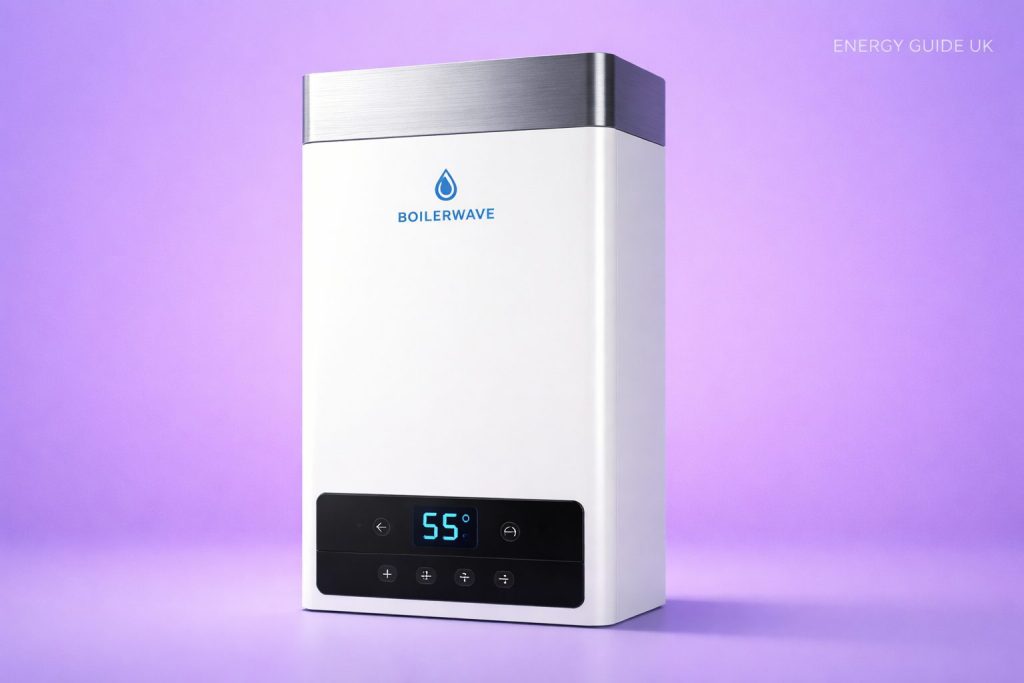
The Helios model supplies domestic hot water without running central heating. It works in a similar way to a hot-water cylinder or thermal store but uses microwave energy instead of an immersion heater or gas burner.
The system heats mains water through a plate heat exchanger as it passes through the unit. This allows hot water production on demand without storing large volumes at high pressure. The design removes the need for discharge pipework and reduces the risk of bacterial growth in stored water.
Helios is suitable for homes that already have a separate heating system or for properties that only need hot-water production from the boiler.
Hestia — Central Heating and Hot Water Microwave Boiler
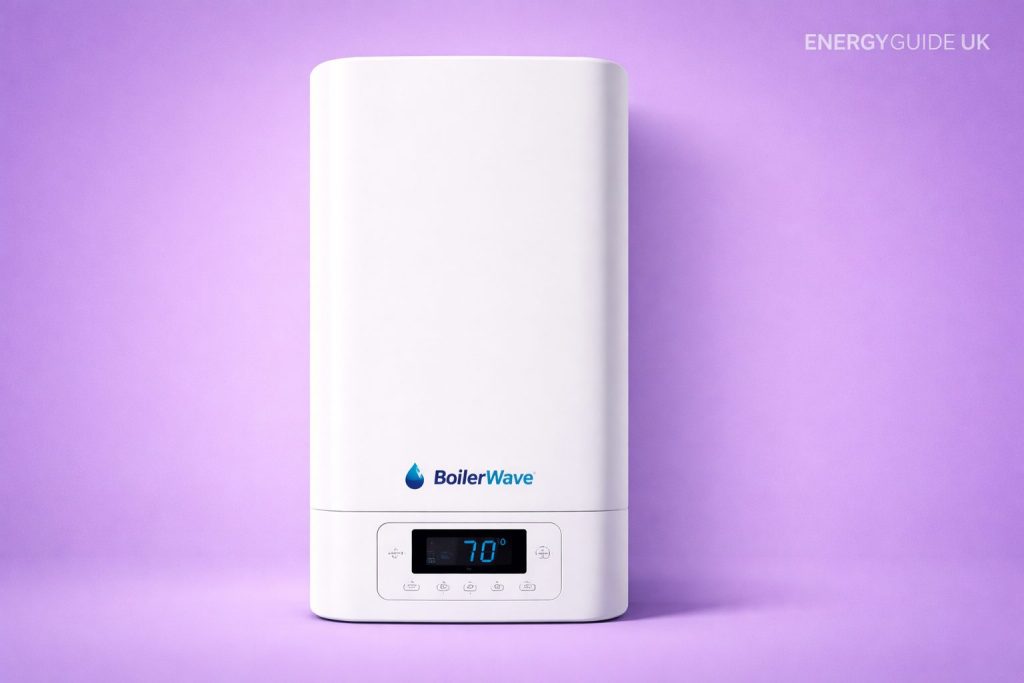
The Hestia model provides both central heating and domestic hot water from a single unit. It uses microwave heating together with thermal storage to keep water at a temperature and deliver it when needed.
Cold mains water passes through a heat exchanger to instantly produce hot water, while stored heat supplies the radiators through the central-heating circuit. The system connects to standard pipework and operates like a normal boiler.
Hestia can replace a gas combi or system boiler, allowing the home to retain existing radiators while switching to electric heating.
Key Differences between Helios and Hestia
| Model | Main use | Heating support | Hot water | Typical role |
| Helios | Hot water only | No | Yes | Cylinder / water heater replacement |
| Hestia | Heating + hot water | Yes | Yes | Gas boiler replacement |
Learn all about the different types of boilers, including condensing boilers, LPG boilers, oil boilers, Opentherm boilers , and calculating boiler size in our guide.
What are the Benefits of Microwave Boilers?
Microwave boilers allow you to heat your home without using gas, oil, or other fossil fuels. The technology keeps the layout of a wet central-heating system but removes the need for combustion. This makes the system appealing for households that want lower emissions without major changes to pipework or radiators.
| Benefit | What it means for homeowners |
| No combustion | The system heats water with electricity, so it does not burn gas inside the home |
| No flue required | The boiler does not produce exhaust gases, so it does not need a flue pipe |
| Works with existing radiators | Most designs connect to standard pipework and central-heating systems |
| Compact size | Units are designed to fit in a similar space to a normal boiler |
| Fast heating response | Microwave heating can raise water temperature quickly |
| Fewer moving parts | No burner or gas valve, which may reduce servicing needs |
| No direct emissions in the home | The boiler does not release carbon monoxide or combustion gases |
Most benefits come from manufacturer data and early demonstrations. Real performance will depend on electricity prices, insulation levels, and system design.
What Is Still Unproven About Microwave Boilers?
Microwave boilers remain a new heating technology, so real-world evidence is limited. Most of the information comes from development testing rather than from long-term use in large numbers of homes. Several key areas still need wider data before firm conclusions can be made.
Long-Term Reliability
Independent lifespan data is not yet widely available. Gas boilers and heat pumps have many years of field experience, but microwave boilers do not. Until more systems run in homes, durability figures will remain uncertain.
Performance In Different Types of Homes
Heating systems behave differently depending on property size, insulation, and heat demand. Early demonstrations cannot cover every situation. Larger trials across flats, older houses, and new builds will give a clearer picture of performance.
Servicing and Repair Requirements
Service schedules are not fully established. New heating designs often require specialist knowledge, and installer training takes time to spread across the industry. Repair costs may vary until more engineers gain experience with the technology.
Electrical Supply Requirements
High-power electric heating can place a heavy load on household wiring. Some properties may need electrical upgrades before installation. Clear guidance for typical UK homes is still developing as the technology moves closer to wider use.
Real-World Efficiency
Controlled testing can show strong results, but daily heating demand changes from home to home. Outside temperature, insulation level, and hot-water use all affect performance. Larger real-world trials will be needed before the technology can be compared properly with existing heating systems.
Running Costs of Microwave Boilers in the UK (2026)
Running costs are one of the biggest factors when evaluating microwave boilers. The system can achieve high efficiency, yet it runs on electricity, which costs far more per unit than gas in the UK. Current Ofgem figures make this difference clear, so it is possible to show realistic yearly costs with simple calculations.
Electricity vs Gas Unit Cost
Under the current Ofgem price cap from 1 April to 30 June 2026, typical unit rates are about:
- Electricity: 24.67p per kWh
- Gas: 5.74p per kWh
This means electricity costs more than four times as much per unit of energy as gas. A heating system powered only by electricity must be extremely efficient to match gas running costs.
Average Energy Use for a Medium UK Home
Ofgem states that a typical medium household uses about:
- 2,700 kWh of electricity per year
- 11,500 kWh of gas per year
Gas use is much higher because most homes rely on it for heating and hot water. A microwave boiler would move that heating demand onto electricity.
Example Running-Cost Calculation
If a home needed around 11,500 kWh of heat per year, the cost would be roughly:
- Gas boiler
11,500 kWh × £0.0574 = £660 per year
- Microwave boiler (electricity)
11,500 kWh × £0.2467 = £2,837 per year
Even with high efficiency, the microwave boiler still uses electricity for every unit of heat, so a higher price per kWh results in a higher yearly bill.
Why Does Direct Electric Heating Cost More?
Microwave boilers convert electricity directly into heat. The process can reach about 96% efficiency, but it cannot multiply heat output.
Gas boilers burn fuel, which is cheaper per unit of energy. Heat pumps move heat from outside air, so they can produce several units of heat from one unit of electricity. Direct electric systems lack that advantage, which keeps running costs higher.
When Running Costs Could Be Lower
Some homes may see smaller cost differences:
- Very well-insulated properties use less heat
- Off-peak tariffs reduce the electricity price
- Solar panels supply part of the power
- Small flats need less heating
- Homes without gas avoid standing charges
In these situations, microwave boilers may become more practical, but electricity prices will still have the greatest impact on the final bill.
Yearly Running Costs Comparison:
| System | Energy used | Unit price | Example yearly cost |
| Gas boiler | Gas | 5.74p/kWh | ~£660 |
| Microwave boiler | Electricity | 24.67p/kWh | ~£2,837 |
| Electric boiler | Electricity | 24.67p/kWh | ~£2,837 |
| Heat pump | Electricity (more efficient) | 24.67p/kWh | lower than direct electric |
Microwave Boilers vs Heat Pumps vs Electric Boilers vs Gas Boilers
Different heating systems vary in cost, efficiency, and installation difficulty. Microwave boilers sit between electric boilers and heat pumps in most comparisons. The sections below compare the main differences using current UK energy data and published efficiency figures.
Running Costs
Gas usually remains the cheapest fuel in the UK. Ofgem price-cap figures show that electricity costs several times as much per kWh as gas on standard tariffs. This affects any heating system that runs directly on electricity.
Microwave boilers may reach high efficiency, but they still use electricity as the energy source. Heat pumps often cost less to run because they produce more heat than the electricity they use.
Installation Costs
Gas boilers usually cost less to install if the home already has a gas supply. Electric boilers can be cheaper to fit because they need fewer components.
Microwave boilers aim to replace gas boilers without major pipework changes, which could keep installation costs moderate once the technology becomes widely available. Heat pumps often cost more to install. They may need outdoor units, larger radiators, or insulation upgrades.
Efficiency
Modern gas boilers usually reach about 90% efficiency. Electric boilers convert almost all electricity into heat. Manufacturers like Boilerwave note that microwave boilers can reach about 96% efficiency by heating water directly with microwave energy.
Heat pumps can deliver several units of heat for each unit of electricity. Energy Saving Trust explains that you can get three to four times as much heat (300 to 400%) in return for every unit of electricity you use. This higher output makes them more efficient than direct electric heating in many homes.
Emissions
Gas boilers produce carbon dioxide when they burn fuel. Electric boilers and microwave boilers do not produce combustion emissions inside the home.
Total emissions depend on how electricity is generated. Heat pumps usually produce the lowest overall emissions because they use less electricity to create the same amount of heat.
Availability
Gas boilers and electric boilers are widely available across the UK. Heat pumps are becoming more common each year.
Microwave boilers are still an emerging technology. Only a small number of manufacturers are developing them, and large-scale rollout has not happened yet.
Suitability for Old Homes
Gas boilers often work well in older houses because they can produce high water temperatures. Electric boilers can also run existing radiators without major changes.
Microwave boilers are designed to work with standard central-heating systems, which may make them suitable for retrofit use.
Heat pumps can work in older homes, but they sometimes need larger radiators or better insulation to perform well.
Heating System Comparison
| Heating system | Typical efficiency | Energy source | Running cost level | Current UK availability |
| Gas boiler | ~90% | Gas | Low | Very common |
| Microwave boiler | ~96% (manufacturer data) | Electricity | Medium to high | Limited |
| Electric boiler | ~99% | Electricity | High | Common |
| Heat pump | 300–400% effective output | Electricity | Low to medium | Increasing |
Do Microwave Boilers Work With Existing Radiators and Pipework?
One of the main goals of microwave boiler design is to allow installation without replacing the whole heating system. Many homes in the UK use wet central heating with radiators, pumps, and pipework connected to a gas boiler. Manufacturers say microwave boilers are built to connect to this type of system in the same way.
This approach could make installation simpler than fitting a heat pump, which often needs larger radiators or lower water temperatures. A microwave boiler still heats water and sends it through the same pipes, so the overall layout of the heating system stays familiar.
Compatibility with Standard Radiators
Most designs aim to produce hot water at temperatures comparable to those of a gas boiler. This means existing radiators should work without needing replacement. Homes that already heat well with a gas boiler are more likely to work with a microwave system.
Older properties often rely on higher water temperatures to keep rooms warm. Systems that can reach those temperatures may be better suited to retrofit installations than low-temperature heating.
Pipework and Central-Heating Layout
Microwave boilers are intended to connect to normal flow and return pipes. The circulation pump, valves, and controls can usually stay the same. This reduces the amount of building work compared with some low-carbon heating systems.
Homes that already have a combi or system boiler may be able to swap the unit without changing the full layout, although final requirements depend on the model.
Electrical Supply Requirements
Unlike gas boilers, microwave boilers run entirely on electricity. The home must have enough electrical capacity to power the unit safely. Some properties may require a consumer unit upgrade or a higher supply rating before installation.
High-power electric heating systems can draw much more current than standard appliances. An installer must check the supply before fitting any new electric boiler.
Space and Installation Location
Manufacturers say microwave boilers are designed to fit in a space similar to that of a normal wall-mounted boiler. This makes them easier to place in kitchens, cupboards, or utility rooms. Units with thermal storage may require more space than a combi boiler. Installation space will depend on the tank size and the system’s output.
In most cases, microwave boilers aim to reduce disruption during installation, but the final setup will still depend on the home’s wiring, heating demand, and available space.
Grants, Rules, and the Future of Gas Boilers in the UK
Heating rules in the UK are changing as the government tries to reduce emissions from homes. New policies focus on lowering carbon emissions, improving efficiency, and reducing fossil fuel use in buildings. These changes affect which heating systems receive support and which ones are expected to decline over time.
Future Homes Standard
The Future Homes Standard will require new houses to produce far less carbon than older properties. New-build homes are expected to use low-carbon heating instead of traditional gas boilers. This change pushes builders toward heat pumps and other electric systems.
The rule does not force existing homes to remove gas boilers, but it shows the direction of travel for future heating. Technologies that operate without combustion are more likely to comply with long-term regulations.
Boiler Upgrade Scheme
The Boiler Upgrade Scheme provides grants for approved low-carbon heating systems. In England and Wales, households can receive support for installing an air-source heat pump, a ground-source heat pump, or a biomass boiler.
Microwave boilers do not currently appear in the scheme. The technology has not yet reached the level of market use required for grant approval.
Grant support makes heat pumps more attractive financially, which is one reason they remain the main alternative to gas heating today.
Energy Efficiency Rules for Homes
Government policy now links heating changes with insulation and efficiency improvements. Homes that lose less heat need smaller heating systems and use less energy overall.
Low-carbon heating works best in properties with good insulation, modern controls, and efficient radiators. These requirements apply to all types of electric heating, not just microwave boilers.
Are Gas Boilers Being Banned?
Gas boilers are not banned in existing homes, but rules for new buildings are becoming stricter. New housing developments are expected to use low-carbon heating instead of gas.
Over time, tighter emissions targets may reduce the use of fossil-fuel heating, especially as electricity becomes cleaner. The change will happen gradually, not all at once.
What this Means for Microwave Boilers
Microwave boilers align with current policy because they run on electricity and do not burn fuel in the home. Even so, the technology does not yet qualify for grant schemes, and large-scale use has not started. Until that changes, heat pumps remain the main supported option for households moving away from gas.
Final Thoughts on Microwave Boilers
Microwave boilers show how home heating could change over the next decade. The technology keeps the familiar layout of radiators and pipework but removes the need to burn fuel inside the home. This makes it an interesting option for households that want lower emissions without rebuilding their heating system.
Current models suggest high efficiency and simple installation, yet the technology has not achieved widespread use. Availability remains limited, and long-term performance data is still growing. Electricity prices in the UK also affect running costs, meaning microwave boilers must compete with heat pumps that use electricity more efficiently.
Heating rules in the UK are moving toward low-carbon systems, and electric heating will likely play a larger role in the future. Microwave boilers fit that direction, but they are still at an early stage compared with heat pumps and modern gas boilers. Wider production, installer training, and real-world testing will decide how quickly the technology becomes common.
For now, microwave boilers should be seen as a developing option rather than a standard replacement. They may suit some homes once availability improves, especially where heat pumps are difficult to install. Until then, most households will continue choosing proven systems while watching how microwave heating develops.
FAQs on Microwave Boilers in the UK
How Efficient Is a Microwave Boiler?
Manufacturers say microwave boilers can reach an efficiency of around 96% because the system heats water directly, with very little heat wasted. This is similar to modern condensing gas boilers and electric boilers. Real-world performance data is still limited, so actual efficiency may vary by home and usage.
What Is the Most Efficient Heating System in the UK?
Heat pumps are usually the most efficient heating system available in the UK. They can produce several units of heat per unit of electricity used, making them more efficient than gas, electric, and microwave boilers. Efficiency depends on insulation, radiator size, and outdoor temperature.
What Are Three Disadvantages of Using a Microwave Boiler?
- Electricity costs more than gas in the UK, which may increase the running costs
- The technology is still new, so long-term reliability data is limited
- Availability is restricted, with only a small number of manufacturers producing units
What Is the Cheapest Way to Heat Your Home in the UK?
For most homes, gas central heating remains the cheapest option at current energy prices. Gas costs much less per kWh than electricity, which keeps running costs lower. In well-insulated homes, heat pumps can compete with gas because they use electricity more efficiently.
Is the UK Phasing Out Gas Boilers?
Gas boilers are not banned in existing homes, but new rules encourage low-carbon heating. New-build houses are expected to use electric or renewable heating instead of gas. Over time, tighter emissions targets may reduce the use of fossil-fuel boilers, but the change will happen gradually.
How Much Does It Cost To Install A Microwave Boiler In The UK?
Early pricing suggests microwave boilers may cost a few thousand pounds to install. One listed example for a Boilerwave hot-water system shows a total price of about £3,500, including parts and labour, with labour around £568.80. Prices will vary depending on the model, required electrical work, and installation complexity, and costs may change as the technology becomes more widely available.
Sources and References
- UK Parliament – Housing and net zero
- Ofgem – Energy price cap explained
- Energy Saving Trust – Heat pumps: how they work, costs and savings