
Choosing the right heater for a conservatory often decides whether the room becomes part of daily life or sits unused for much of the year. A poor choice affects comfort and drives up running costs without delivering consistent warmth.
Conservatories remain one of the UK’s most common home additions. Government data indicates that around 18% of households in England have a conservatory, yet a significant share of them go largely unheated, even in winter. In many cases, the issue is a mismatch between the space and the heating approach.
The structure of a conservatory creates a unique challenge. Large glazed surfaces lose heat quickly, roofs trap cold air, and temperature swings are sharper than in the rest of the home. A standard radiator or a low-powered portable heater often struggles in these conditions. As a result, many households switch heating on briefly, see little impact, and abandon the room during colder months.
Choosing the right heater for a conservatory comes down to matching heat output, efficiency, and usage patterns to the space itself. Understanding heater types, realistic running costs, and practical recommendations makes it easier to find an option that keeps the room warm and usable throughout the year.
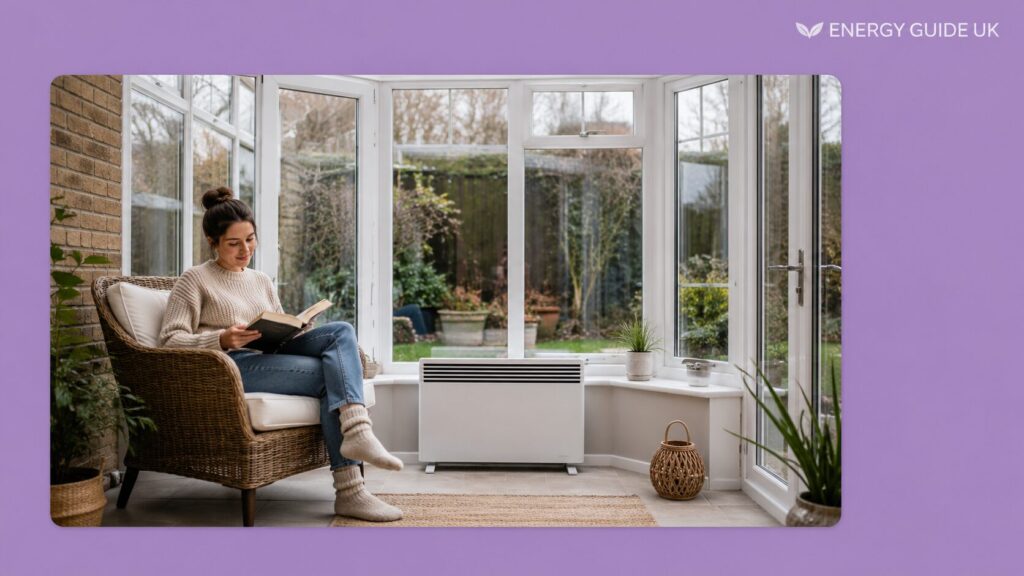
The Best Heater for a Conservatory at a Glance:
- Best fixed infrared heater: Herschel Summit 2.6kW
- Best portable infrared heater: Herschel Select S3 1kW
- Best electric panel heater: Adax Neo Electric Panel Heater
- Best smart Wi-Fi panel heater: Rointe Belize Electric Radiator
- Best portable oil-filled radiator: De’Longhi Dragon 4 TRD40820T
- Best budget portable radiator: PureMate 2,500W Oil-Filled Radiator
Why Heating a Conservatory Is Different from Heating Any Other Room
Conservatories lose heat at a rate no standard room in the house comes close to matching.
The Glass Problem
The primary reason conservatories are so difficult to heat is the ratio of glass to insulation. Heat escapes through the glass of a double-glazed conservatory faster than through the insulated walls of the room next door. A polycarbonate roof performs even worse.
Any heat generated inside a conservatory is working against a structure specifically designed to let light in, which is the same property that lets heat out.
Roof Type and Its Effect on Heating Demand
Three common roof types create significantly different heating challenges:
- Polycarbonate roofs are the most common on older conservatories and the poorest insulators. They trap solar heat in summer, making the space unbearably hot, and offer minimal resistance to heat loss in winter. A conservatory with a polycarbonate roof will require more heating output for the same floor area than one with a better-insulated alternative.
- Glass roofs perform better than polycarbonate but still lose heat rapidly, particularly at night. Double or triple-glazed glass roof panels represent a meaningful improvement.
- Solid or tiled roofs are increasingly popular on modern conservatories and orangeries and perform closest to a standard room ceiling. A conservatory with a solid, insulated roof can be heated with considerably less energy than one with glass or polycarbonate.
Conservatory Orientation
Where your conservatory faces also affects how much supplementary heating it needs. A south-facing conservatory receives direct sunlight for most of the day and can retain significant natural warmth even in winter, reducing the demand on any heater. A north-facing conservatory receives little direct sun and will feel cold almost year-round without adequate heating. East and west-facing conservatories follow the sun through the morning and afternoon.
Orientation isn’t something you can change, but knowing which direction your conservatory faces helps you size a heater correctly. A north-facing conservatory with a polycarbonate roof will need more heating output than a south-facing one with a tiled roof of the same floor area.
Daily Use vs Occasional Use
How often you use the conservatory is the final critical variable, and it directly affects which heater type makes sense. A conservatory used daily benefits from a heater that can maintain a steady background temperature efficiently over long periods. A conservatory used occasionally, perhaps at weekends or for evening entertaining, benefits from a heater that can raise the temperature quickly on demand and costs nothing when the space is empty.
Types of Heaters for a Conservatory
Infrared Heaters
- Strengths: Instant heat, efficient in draughty or poorly insulated spaces, reduces condensation
- Limitations: Does not maintain ambient air temperature, directional heat may not cover a large space evenly
- Best for: Occasional use, poorly insulated conservatories
Infrared heaters can suit you if your conservatory has high heat loss. Instead of warming the air, they heat surfaces and people directly, which means you feel the warmth immediately.
This makes them effective in spaces where heated air would otherwise escape through the roof. They’re particularly useful in north-facing conservatories or those with polycarbonate roofs. They can also help reduce condensation by warming cold surfaces rather than producing warm, moist air.
Many models can be wall or ceiling-mounted, helping preserve the limited floor and wall space most conservatories have. Ceiling mounting also directs heat downward toward the people in the room rather than upward toward the glass.
Electric Panel Heaters
- Strengths: Programmable, silent, maintains steady temperature, space-saving when wall-mounted
- Limitations: Slower to raise temperature than infrared, less efficient in poorly insulated spaces
- Best for: Daily use, conservatories with glass or tiled roofs
Electric heaters are a good choice if you use your conservatory daily instead of occasionally. They work by gradually warming the air through convection. This makes them more effective at maintaining a steady background temperature over several hours than at delivering instant warmth in a cold room.
Most modern models are programmable, so the conservatory can be preheated before use. Open-window detection is useful in a conservatory where doors and windows are frequently opened, as it switches the heater off automatically to prevent energy waste.
Wall-mounted models work well in conservatories with dwarf walls, sitting neatly beneath the glazing without taking up floor space. Wi-Fi-enabled models allow remote preheating from a phone, which suits a space typically used at specific times of day.
Oil-Filled Radiators
- Strengths: Portable, no installation required, heat retention reduces running time, frost-stat setting
- Limitations: Slow warm-up, not suited to on-demand or spontaneous use
- Best for: Sustained warmth over several hours, smaller conservatories, and conservatories with plants
Oil-filled radiators suit conservatories that need warmth maintained over several hours without a permanent installation. The sealed oil heats up slowly but retains warmth after the unit has been switched off. This extends the effective heating period beyond the time electricity is being consumed.
They are portable on castors, require no installation, and can be stored away during the warmer months. Most models include a frost-protection setting, which maintains a minimum temperature of around 5°C without running at full output. This makes them a practical option for conservatories containing plants that cannot tolerate freezing temperatures.
The main drawback is warm-up time. In a cold conservatory in January, an oil-filled radiator can take thirty minutes or more to raise the temperature to a comfortable level, making it less suitable for spontaneous use.
Ceramic Fan Heaters
- Strengths: Instant heat, very portable, low upfront cost
- Limitations: Inefficient in poorly insulated spaces, no residual heat, not suitable as a sole heat source in winter
- Best for: Small conservatories, spring and autumn use, supplementary heat
Ceramic fan heaters are the most portable and lowest-cost entry point for conservatory heating. They deliver heat almost instantly by blowing air across a ceramic element, which can quickly take the chill off a room on a mild autumn or spring day.
In a conservatory with a polycarbonate roof in midwinter, however, even a 2kW ceramic fan heater will struggle to maintain a comfortable temperature. The warm air it produces rises and escapes through the glass almost as fast as it is generated. They’re most effective as a supplementary heat source alongside a primary heater, or as a budget solution for smaller conservatories used briefly and infrequently.
Running costs can add up quickly on the highest setting, and unlike oil-filled radiators, there is no residual warmth once the unit is switched off.
Electric Underfloor Heating
- Strengths: Even heat distribution, invisible, no wall or floor space required, silent
- Limitations: Only practical when the floor is being replaced, with a higher installation cost
- Best for: New-build or fully renovated conservatories
Electric underfloor heating is the most comfortable and space-efficient option for a conservatory, but it is only practical where the floor is being replaced as part of a renovation or new build. The heating element sits beneath the floor covering, produces even warmth across the entire floor area, and operates silently without occupying any wall or floor space.
Natural stone and ceramic tiles, both common in conservatories, are ideal companions for underfloor heating as they conduct and radiate heat effectively upward into the room. The installation cost at the build or renovation stage is relatively modest compared to retrofitting later, when the disruption of lifting a finished floor makes it a far more expensive proposition.
Extending the Central Heating System
- Strengths: Consistent warmth, integrated with existing heating controls, no separate running costs to track
- Limitations: Subject to building regulations, requires adequate boiler capacity, and is disruptive to install
- Best for: Well-insulated conservatories in permanent daily use, owners already extending or renovating
Extending the main household central heating system into a conservatory is powerful and consistent, but it is the most complex and regulated option. Under the UK’s Approved Document L building regulations, a conservatory retains its exemption from standard energy efficiency requirements only if its heating is independent of the main system and separately controlled. Connecting a radiator to the main system without independent control removes that exemption and requires building regulations approval.
In practice, fitting a thermostatic radiator valve to a conservatory radiator usually satisfies the independent control requirement. However, the existing boiler must have sufficient capacity to heat the additional volume, and extending the pipework is disruptive.
For most homeowners, an electric heater of the right type is a simpler, faster, and more regulation-friendly solution.
Conservatory Heater Types Compared
| Heater Type | Best Suited To | Warm-Up Time | Cost Per Hour (1kW) | Portable or Fixed |
| Infrared panel | Occasional use, poorly insulated | Instant | 12p | Either |
| Electric panel heater | Daily use, better insulated | 10–20 mins | 25p | Either |
| Oil-filled radiator | Sustained warmth, smaller spaces | 20–30 mins | 25p | Portable |
| Ceramic fan heater | Instant burst heat, small spaces | Instant | 25p | Portable |
| Electric underfloor heating | New build or full renovation | 30–60 mins | 25p | Fixed |
| Central heating extension | Well-insulated, permanent use | 20–40 mins | 6p (gas rate) | Fixed |
The Best Infrared Heater for a Conservatory
Best Fixed Infrared Heater: Herschel Summit 2.6kW
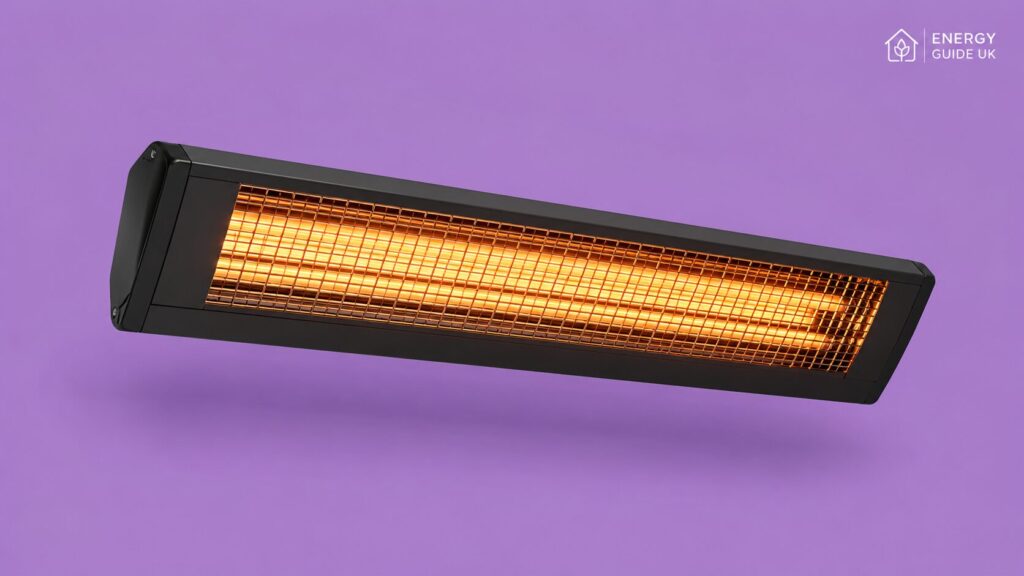
Output: 2.6kW
Mounting: Wall or ceiling
Controls: Remote (two power settings and timer) or non-remote with external thermostat
Warranty: 2 years
The Herschel Summit is the most widely recommended infrared heater specifically for conservatories. At 2.6kW, it has sufficient output to heat a typical medium-sized conservatory directly, and its zero-light element means it produces no visible glow when it’s operating, which matters in a space you’ve designed primarily around natural light.
You can wall or ceiling-mount it, and ceiling mounting works particularly well in conservatories where dwarf walls limit usable wall space. Mounted overhead, the heat travels downward toward you rather than upward toward the glass. This is where infrared heating works most efficiently. The remote-control version gives you two power settings and a one to twenty-four hour timer, so you can switch it to a lower output setting while the space is warming up and bring it to full power when you’re ready.
The Summit operates at a surface temperature exceeding 350°C, and you must install it at least 1.8m above floor level, which suits most conservatories with standard ceiling heights but is worth confirming before you buy. It comes with a two-year manufacturer’s warranty, and you can choose white or black to suit your conservatory interior.
Best Portable Infrared Heater: Herschel Select S3 1kW
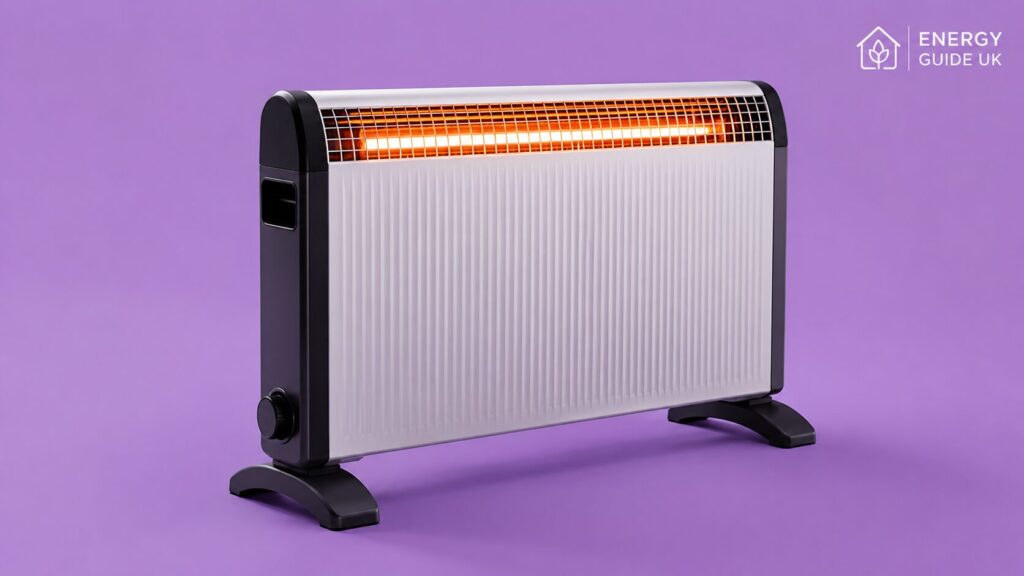
Output: 1kW
Mounting: Freestanding
Controls: Built-in touch controls, Wi-Fi app, and voice control, in-built thermostat
Warranty: 5 years
The Herschel Select S3 is the strongest portable infrared option if you don’t want a permanent installation. At 1kW, it heats up to 15m², and its freestanding tower design heats from three sides simultaneously, giving you a wider spread of radiant warmth than a single-face panel delivers.
It plugs directly into a standard UK socket with no installation required, and you can move it into the conservatory when you need it and store it away in warmer months. Built-in Wi-Fi lets you control it via the Smart Life App, Alexa, or Google Assistant, and the built-in thermostat automatically regulates temperature, so you don’t have to constantly adjust it.
If your conservatory has a polycarbonate roof and you’re using it in the coldest months, pairing two Select S3 units to cover the full floor area works better than moving up to a single high-wattage convection heater, as you keep the infrared advantage in a draughty space. The five-year warranty makes it one of the best-covered portable heaters at its price point.
The Best Electric Panel Heater for a Conservatory
Best Overall: Adax Neo Electric Panel Heater
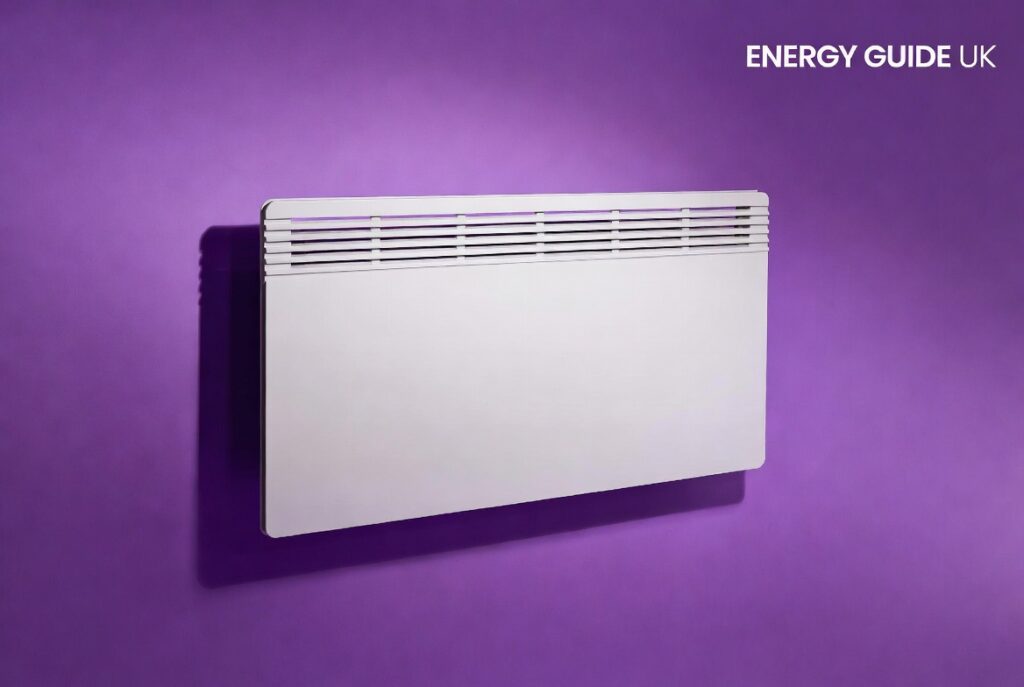
Output: 400W to 2,000W
Mounting: Wall-mounted
Controls: 7-day programmable timer, digital thermostat, open-window detection, anti-frost mode
Warranty: 2 years
The Adax Neo consistently ranks among the best electric panel heaters for conservatory use. Its slim design protrudes just 9cm from the wall, making it well-suited to the shallow dwarf walls you’ll find beneath most conservatory glazing. It’s available from 400W to 2,000W, so you can size it precisely to your conservatory rather than defaulting to the largest available model.
The seven-day, twenty-four-hour programmable timer lets you set a different heating schedule for each day of the week. If you’re using the conservatory as a home office on weekdays and for entertaining at weekends, those two uses call for very different temperature profiles, and the Adax Neo handles that without any manual intervention on your part.
Open-window detection automatically reduces output when it senses a rapid temperature drop, so you’re not wasting electricity every time you open the conservatory doors in spring or summer. The anti-frost mode holds a minimum temperature for any plants you’re overwintering, so the space stays protected on nights you’re not using it.
Best Smart Wi-Fi Option: Rointe Belize Electric Radiator
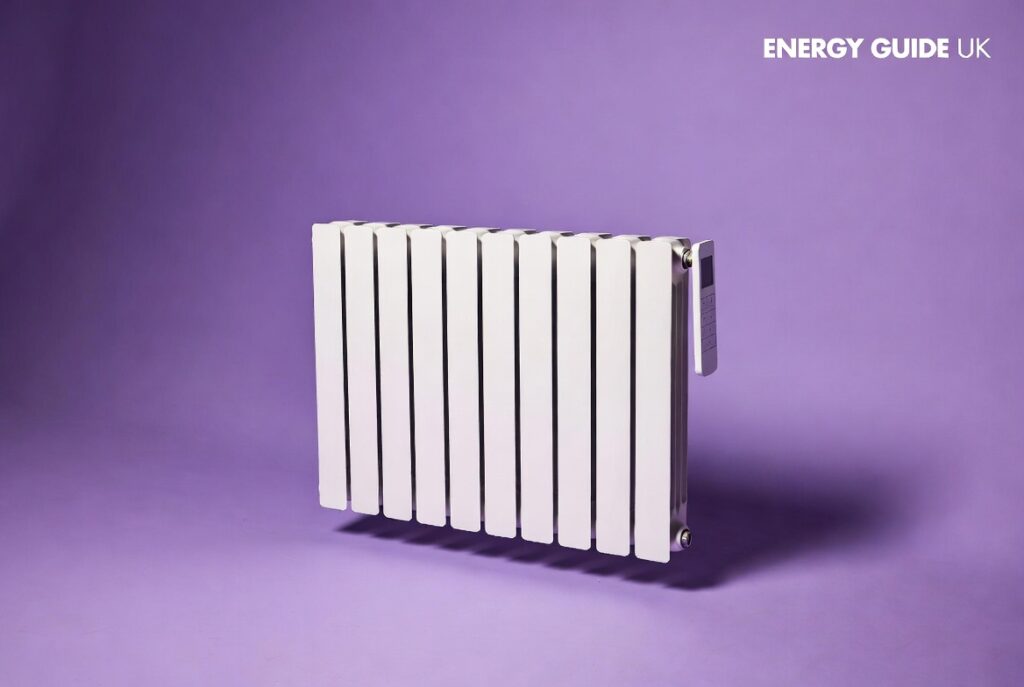
Output: 500W to 2,000W
Mounting: Wall-mounted, low-height profile for dwarf walls
Controls: Built-in Wi-Fi, full app control, 24/7 programming, energy monitoring, Alexa and Google Assistant compatible
Warranty: Confirm at point of purchase
The Rointe Belize is the strongest Wi-Fi-enabled conservatory electric radiator currently available in the UK. Its low- profile sits neatly beneath your glazing, and its built-in Wi-Fi lets you control it from anywhere on your smartphone, including temperature adjustment, scheduling, and real-time energy monitoring.
The oil-filled thermal fluid element retains heat after the unit cycles off, reducing the runtime needed to maintain a comfortable temperature compared to dry-element alternatives. Real-time energy consumption monitoring through the app shows you exactly what you’re spending, which is useful in a space where heating demand changes considerably between seasons.
If you use your conservatory at irregular times that don’t suit a fixed daily schedule, remote app control is a genuine practical advantage rather than a feature you’ll rarely use. It’s available in white and anthracite finishes, the latter being an option few conservatory-specific electric radiators offer if you want to complement a contemporary interior.
The Best Portable Heater for a Conservatory
Best Portable Oil-Filled Radiator: De’Longhi Dragon 4 TRD40820T
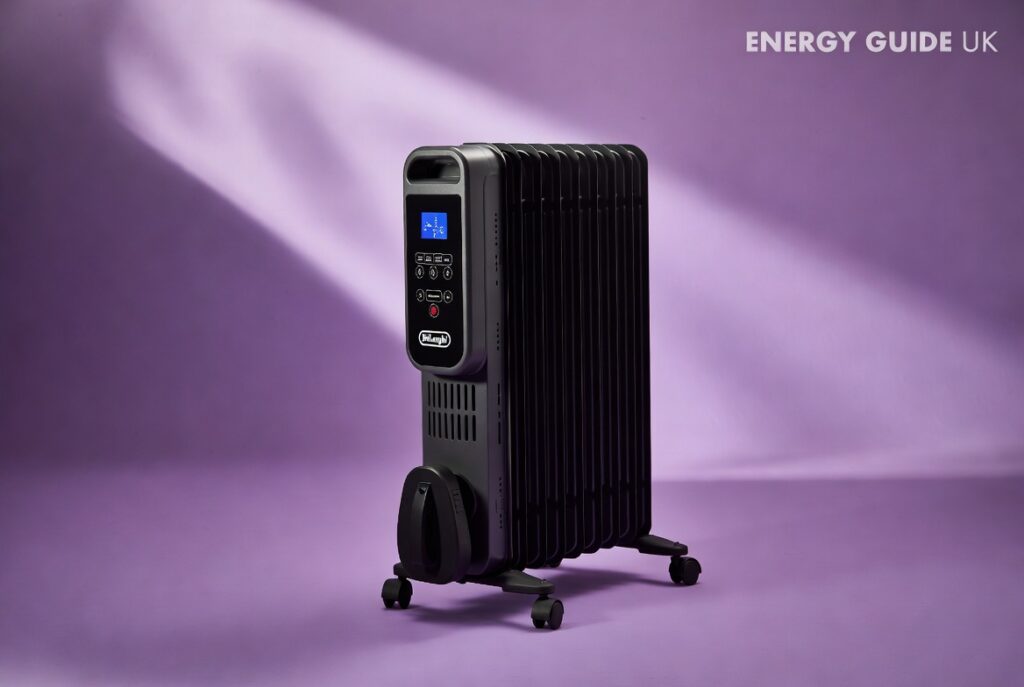
Output: 2kW (three settings: 900W, 1,100W, 2,000W)
Mounting: Freestanding on wheels
Controls: 24-hour mechanical timer, adjustable thermostat, anti-frost function
Warranty: 2 years
The De’Longhi Dragon 4 is one of the most consistently recommended oil-filled radiators for conservatory use. Its chimney effect design accelerates heat circulation around the column fins, reducing the warm-up lag that’s the primary drawback of portable oil-filled heating.
The three heat settings let you match output to conditions rather than running at full power throughout. On a mild autumn day, a 900W setting is typically all you need, saving electricity while keeping the space comfortable. A 24-hour mechanical timer lets you pre-set it to warm the conservatory before you arrive and switch off automatically afterward. The anti-frost function protects any plants you’re overwintering without running at full output overnight.
Built-in wheels and a carry handle make it easy to move between the conservatory and storage, and the integrated cable tidy keeps everything neat when not in use. It operates silently, which matters if you’re using the conservatory as a reading room or home office. The Dragon 4 performs reliably for planned sessions and retains heat long after the unit cycles off.
Best Budget Portable Option: PureMate 2,500W Oil-Filled Radiator
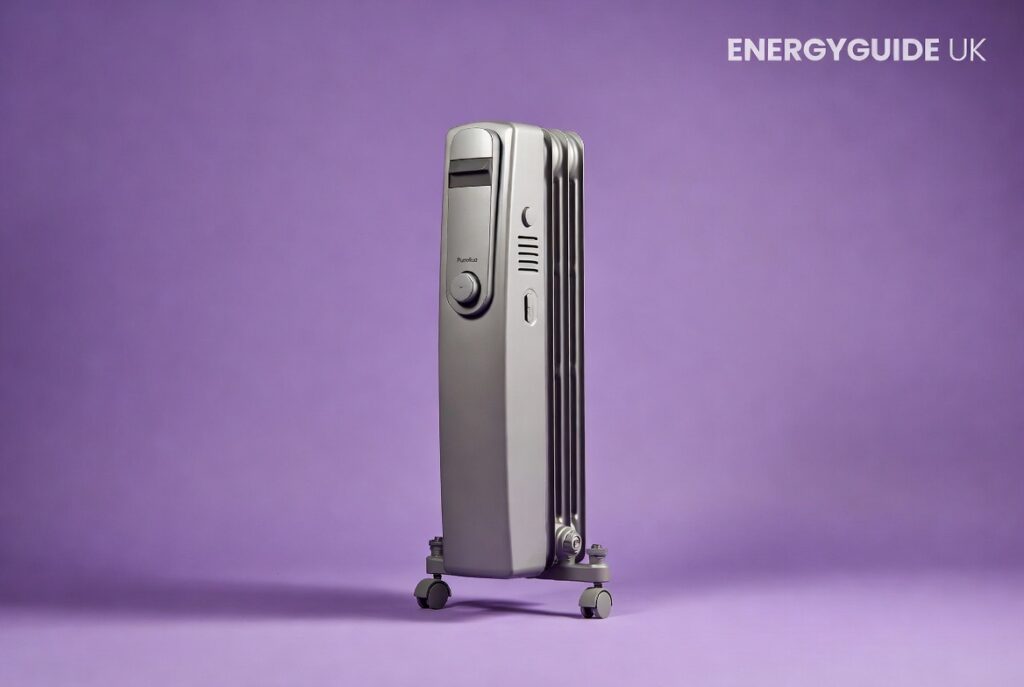
Output: 2,500W (three heat settings)
Mounting: Freestanding on wheels
Controls: 24-hour mechanical timer, adjustable thermostat, anti-frost function
Warranty: Confirm at point of purchase
The PureMate 2,500W is the strongest budget portable option for conservatory use. With 11 fins and a maximum output of 2,500W, it heats rooms up to 26m², covering larger conservatories that a standard 2kW model might struggle with on the coldest days.
A 24-hour programmable timer and adjustable thermostat let you set a heating schedule without constantly adjusting the unit. The compact build includes a 1.5m cable and integrated cable tidy, and it runs at near-silent levels across all three heat settings. At its price point, it’s a strong starting point if you want to test portable oil heating in your conservatory before committing to something more permanent.
The trade-off relative to the De’Longhi is primarily in timer precision. The mechanical timer can be less intuitive to program than a digital alternative, and you may notice minor clicking sounds during heating cycles as the oil expands. This is completely normal, but worth knowing in advance if you’re planning quiet work or relaxation in the space.
How Much Does a Heater for a Conservatory Cost to Run?
Running costs are the most important practical consideration when you’re choosing a heater for a conservatory, because a poorly insulated space will always demand more energy than a standard room of the same size. Understanding what you’ll actually spend before you commit to a heater type helps you avoid choosing something that’s cheap to buy but expensive to run throughout the winter.
Running Costs by Heater Type and Wattage
Every electric heater converts electricity to heat at 100% efficiency, meaning a 1kW heater always costs the same per hour to run as any other 1kW heater, regardless of the technology. What differs between heater types is how long they need to run to make the space feel comfortable, which is where the real cost difference lies.
| Heater | Wattage | Cost Per Hour | Cost Per Day (2hrs) | Cost Per Week (2hrs/day) |
| Infrared panel (low) | 500W | 12p | 25p | £1.73 |
| Infrared panel (high) | 1,000W | 25p | 49p | £3.45 |
| Electric panel heater | 1,500W | 37p | 74p | £5.17 |
| Electric panel heater | 2,000W | 49p | 99p | £6.91 |
| Oil-filled radiator | 1,500W | 37p | 74p | £5.17 |
| Oil-filled radiator | 2,000W | 49p | 99p | £6.91 |
| Ceramic fan heater | 2,000W | 49p | 99p | £6.91 |
All figures use the current Ofgem price cap electricity rate of 24.67p/kWh, which applies from April to June 2026. Daily and weekly costs assume 2 hours of use per day, which is typical for an occasionally used conservatory. If you’re using the space daily for longer periods, multiply the hourly cost by your actual daily hours to get an accurate weekly figure.
How Thermostat Control Reduces Running Costs
Every heater on this list, except a basic ceramic fan heater without a thermostat, cycles on and off automatically once it reaches the target temperature you’ve set. This means your actual running cost is always lower than the maximum hourly rate because the heater isn’t drawing full power continuously.
A well-programmed electric panel heater in a medium-sized conservatory with a glass roof might cycle at around 60-70% duty, meaning it runs at full power for roughly two-thirds of the time and is switched off for the rest. In that scenario, a 1,500W heater’s effective hourly cost drops from 37p to around 22p to 26p.
The better your conservatory’s insulation, the less frequently the heater cycles on to maintain temperature, and the lower your actual running cost becomes relative to the maximum.
Daily and Monthly Cost Examples
To put these figures in a practical context, here’s what you’d expect to pay for three common conservatory heating scenarios at the current Ofgem rate:
| Scenario | Heater | Daily Use | Est. Daily Cost | Est. Monthly Cost |
| Occasional weekend use | 500W infrared panel | 3 hrs | 37p | £6.40 |
| Daily home office | 1,500W panel heater | 6 hrs | £1.33 (at 60% duty) | £39.90 |
| Daily living space | 2,000W panel heater | 8 hrs | £2.37 (at 60% duty) | £71.10 |
These are estimates based on average cycling rates in a moderately insulated conservatory. Your actual costs will be higher in a poorly insulated polycarbonate-roofed conservatory and lower in a well-insulated one with a tiled roof.
Tips for Reducing Your Conservatory Heating Bill
You don’t need to spend more on the heater itself to reduce your running costs. These steps all reduce the demand on your heater and bring costs down without compromising comfort:
- Use a timer or smart control. A heater that comes on thirty minutes before you use the conservatory and switches off when you leave costs far less than one left running all day. Most electric panel heaters include a programmable timer as standard.
- Set the thermostat accurately. Every degree above what you actually need costs roughly 3% more to maintain. Setting the thermostat to 19°C rather than 22°C makes a measurable difference over a full winter season.
- Use the frost-stat setting overnight. If you don’t need the conservatory warm after you’ve left for the evening, dropping to frost-protection mode at 5°C costs a fraction of maintaining a comfortable temperature.
- Address the obvious draughts first. A worn door seal on the conservatory door or a gap around a roof panel can undo much of what your heater is working to achieve. Draught-proofing is inexpensive and reduces the load on any heater.
- Use thermal blinds on the roof. Closing thermal blinds over a polycarbonate or glass roof after dark significantly reduces overnight heat loss and reduces the work the heater has to do to maintain a minimum temperature.
Which Heater for a Conservatory Is Right for You?
The right heater for a conservatory is determined by how you use the space, what the roof’s made of, and whether you want a permanent fixture or something you can move and store.
If You Use the Conservatory Occasionally
Occasional use means a few evenings a week, weekend afternoons, or seasonal entertaining. Your conservatory sits empty for most of the day, and you need it to warm up quickly when you want to use it.
An infrared heater is your strongest choice here. It delivers warmth immediately, without raising the whole room’s air temperature first, so you’re not paying to heat an empty space on the off chance you might use it later. A ceiling or wall-mounted infrared panel in the 750W to 1,500W range suits most average-sized conservatories used this way. In a larger space, two smaller panels, positioned to cover the full floor area, will outperform a single large unit.
A portable oil-filled radiator is a reasonable budget alternative if you plan to use the conservatory for at least 30 minutes beforehand. Switch it on before you head into the space, and it’ll maintain a comfortable temperature throughout an evening session.
If You Use the Conservatory Daily
Daily use means working from home in the mornings, having regular meals, or needing a children’s play space that stays reliably warm throughout the day. Your conservatory functions as a proper room rather than an occasional retreat.
A wall-mounted electric panel heater with a programmable timer is your most practical choice. Set it to warm the space thirty minutes before you plan to use it, and it’ll be at the desired temperature when you arrive, maintaining that warmth throughout the session without you needing to adjust it manually. Look for a model with open-window detection if your conservatory has doors or windows you open regularly during warmer periods, and Wi-Fi control if you want to adjust it remotely while you’re still in bed or on your way home.
For a conservatory with a polycarbonate roof that you use daily in winter, combining a wall-mounted electric panel heater for background warmth with a ceiling-mounted infrared panel for supplementary targeted heat is often more energy-efficient than running a single large heater continuously.
If You’re on a Tight Budget
A ceramic fan heater or a modest oil-filled radiator offers the lowest entry cost and requires no installation. Both plug into a standard socket and can be moved between rooms as needed. For a conservatory you use briefly and infrequently, particularly in the milder months, either option can be entirely adequate.
The trade-off is running efficiency. A fan heater in a cold, poorly insulated conservatory in January will run almost continuously to maintain any comfort, and that continuous running can make it more expensive over a season than a more targeted infrared solution would have been. If budget is your primary concern, a low-wattage infrared tower heater such as the Herschel Select S3 gives you a portable, plug-in infrared option at a lower upfront cost than a fixed panel, and you can store it away in summer.
If Your Conservatory Contains Plants
A heater with a frost-stat or frost-protection mode is suitable when overwintering plants. This setting maintains a minimum temperature of around 5°C without running at full output, protecting frost-sensitive plants through cold nights without you paying to heat the space to a comfortable human temperature when nobody’s using it.
Most wall-mounted electric panel heaters and oil-filled radiators include a frost-protection mode as standard. Check that the model you choose specifies a minimum temperature setting of 5°C or lower, as some models set the frost threshold at 7°C or 8°C, which is warmer than necessary for most overwintering situations and therefore more expensive to maintain.
If You’re Building or Renovating
If you’re replacing the conservatory floor as part of a renovation, it’s worth including electric underfloor heating at the build stage. The additional cost of laying the heating element before the floor covering goes down is modest compared to retrofitting it later, and you’ll end up with the most comfortable, even, and space-efficient heating solution available for a conservatory.
If you’re extending central heating into the conservatory, fit a thermostatic radiator valve on the conservatory radiator to satisfy the independent control requirement under UK building regulations and avoid the need for a full building regulations application. Confirm with your installer that your existing boiler has sufficient output capacity before committing to the pipework extension.
What Size Heater Does a Conservatory Need?
Choosing the right heater type is only half the decision. If you choose the correct type but the wrong output, you’ll either spend money on more power than you need or end up with a heater that runs continuously and still doesn’t keep the space comfortable. Getting the sizing right before you buy saves both money and frustration.
The Standard Rule of Thumb and Why Conservatories Are Different
For a well-insulated standard room, the general rule is 100W of heating output per square meter of floor space. A 15m² living room needs around 1,500W. A 20m² bedroom needs around 2,000W.
Conservatories don’t follow that rule. Because of the glass-to-wall ratio and the poor insulating properties of most conservatory roofs, you need to allow significantly more output per square metre than you would for a standard room. A conservatory with a polycarbonate roof typically needs 150-200W per square metre, while one with a double-glazed roof needs around 120-150W per square metre. A solid or tiled roof performs closest to a standard room and needs around 100-120W per square metre.
Ceiling height adds a further variable. A conservatory with a pitched or vaulted glass roof has considerably more air volume than a flat-roofed one of the same floor area. More air volume means more energy is needed to raise the temperature, so size toward the upper end of the range if your roof rises significantly above a standard 2.4m ceiling height.
Conservatory Heater Size Guide
The table below shows the minimum recommended heater output for your conservatory, based on floor area and roof type. These figures assume a conservatory used in winter in the UK Midlands or the North, with standard window glazing. If your conservatory is south-facing and well-glazed, you can size it toward the lower end of the range.
| Floor Area | Polycarbonate Roof | Glass Roof | Solid / Tiled Roof |
| Up to 8m² | 1,200W – 1,600W | 960W – 1,200W | 800W – 960W |
| 8m² to 12m² | 1,600W – 2,400W | 1,200W – 1,800W | 960W – 1,440W |
| 12m² to 16m² | 2,400W – 3,200W | 1,800W – 2,400W | 1,440W – 1,920W |
| 16m² to 20m² | 3,200W – 4,000W | 2,400W – 3,000W | 1,920W – 2,400W |
| Over 20m² | 4,000W+ | 3,000W+ | 2,400W+ |
For conservatories over 16m² with a polycarbonate roof, a single portable heater is unlikely to be sufficient on its own in midwinter. You’ll get better results from two heaters working together, for example, a wall-mounted electric panel heater providing background warmth combined with a ceiling-mounted infrared panel for targeted heat when the space is in use.
How to Calculate Your Own Figure
If your conservatory falls between the sizes in the table, or you want a more precise figure, use this simple calculation:
Floor area (m²) × watts per m² = minimum recommended output
Choose your watts per m² from the following based on your roof type and usage pattern:
- Polycarbonate roof, occasional use: 175W per m²
- Polycarbonate roof, daily use: 200W per m²
- Glass roof, occasional use: 130W per m²
- Glass roof, daily use: 150W per m²
- Solid or tiled roof, occasional use: 100W per m²
- Solid or tiled roof, daily use: 120W per m²
For example, a 14 m² conservatory with a glass roof used daily requires at least 14 × 150 = 2,100W of output. A 10 m² conservatory with a polycarbonate roof, used occasionally, needs 10 × 175 = 1,750W.
These figures give you the minimum you need to maintain a comfortable temperature in cold weather. If you’re using infrared heating, you can apply a slight reduction of 15-20% to this figure, because infrared heats you directly rather than warming the entire room volume first.
A Note on Oversizing
It’s tempting to buy a larger heater than you need on the basis that more power means more warmth. In practice, oversizing a heater in a small conservatory causes it to reach the target temperature quickly and then cycle off repeatedly, which is less efficient and less comfortable than a correctly sized heater running smoothly.
Building Regulations for Conservatory Heating: What You Need to Know
According to the Planning Portal, a conservatory is normally exempt from building regulations where it’s built at ground level, has a floor area of no more than 30 square metres, is separated from the house by external quality walls, doors or windows, and has an independent heating system with separate temperature and on/off controls.
That last condition is the one that directly affects your heating choice. The 2026 edition of Approved Document L confirms that the energy efficiency exemption applies only where the conservatory doesn’t extend the dwelling’s heating system. The moment you connect a radiator directly to your main boiler circuit without independent controls, the conservatory loses its exempt status and building regulations approval is required.
This is the practical reason why standalone electric heaters dominate conservatory heating. Every plug-in electric heater, wall-mounted panel heater, infrared panel, and oil-filled radiator you operate independently of your main thermostat automatically satisfies the independent control requirement. You don’t need to think about it, apply for anything, or involve building control. The heater is self-contained, and the exemption holds.
What Happens If You Don’t Comply
If your conservatory loses its exempt status because the heating isn’t independently controlled, you technically need building regulations approval for the work. In practice, many homeowners extend their central heating without realising this, and many installers carry out the work without flagging the regulatory position.
The consequence most likely to affect you directly is at the point of selling your home. Solicitors and buyers’ surveyors routinely ask about building regulations compliance for conservatories, and unauthorised work can cause complications with a sale or require retrospective approval before it can proceed. It’s far simpler and cheaper to get it right when the work is done than to deal with it under time pressure during a sale.
If you’ve already extended your central heating into a conservatory and aren’t sure whether it was done compliantly, your local authority building control department can advise, and in some cases, a retrospective regularisation certificate can be obtained to document the position.
Get More from Your Heater: Conservatory Insulation Tips
Even the best conservatory heater will underperform in a poorly insulated space. Every improvement you make to your conservatory’s insulation directly reduces the output and running time your heater needs, which means lower running costs and a more comfortable space without upgrading to a more powerful unit.
Roof
The roof is where the majority of your conservatory’s heat escapes. If you have a polycarbonate roof, fitted thermal blinds closed from late afternoon onwards significantly slow overnight heat loss at a fraction of the cost of a roof replacement. If you’re ready for a permanent fix, replacing polycarbonate with a solid insulated roof panel is the single most impactful upgrade you can make, reducing the heating load enough that a smaller, cheaper heater becomes adequate.
Doors, Windows and Seals
Worn door and window seals allow cold air to infiltrate continuously, forcing your heater to run longer to compensate. Replacing seals costs very little and can make an immediate, noticeable difference to how quickly your heater reaches the desired temperature. Check the roof vents, too, because a vent that doesn’t fully close lets warm air escape from directly above the heater.
Floor and Separation Door
A large rug over a cold tile or stone floor reduces the heat your body loses by conduction, making the space feel warmer at a lower air temperature. Keeping the door between the conservatory and the main house closed when your conservatory heater is running prevents it from heating a far larger space than it was sized for.
Final Thoughts on the Best Heater for a Conservatory
Heating a conservatory well isn’t complicated, but it requires matching the heater to the space rather than picking the most powerful or cheapest option available. Get that match right, and your conservatory becomes a genuinely usable room for most of the year. Get it wrong, and you’ll spend money running a heater that never quite makes the space comfortable.
For most UK conservatories, the decision comes down to one question: how often do you use the space? If your answer is occasionally, an infrared heater is your starting point. It delivers warmth immediately, doesn’t waste energy heating air that escapes through the roof, and costs less to run per session than any convection alternative in a poorly insulated space. If your answer is daily, a wall-mounted electric panel heater with a programmable timer and open-window detection is the more practical long-term solution, maintaining a steady background temperature without constant manual adjustment.
The insulation improvements you make to your conservatory will do as much for your comfort and running costs as upgrading the heater’s output. Thermal roof blinds, replaced door seals, a rug over a cold floor, and a closed separation door all reduce the demand on your heater, letting a correctly sized unit do its job without working harder than it needs to. Whatever heater you choose, a programmable timer and an accurate thermostat are the two features that will have the biggest impact on what you actually spend across a full winter season.
FAQs on the Best Heater for a Conservatory
What Type of Heater Is Best for a Conservatory?
For most UK conservatories, an infrared heater is the best starting point. Infrared heats you and the surfaces in the room directly rather than warming the air, so you feel the benefit immediately without waiting for a cold, draughty space to reach a comfortable temperature. For conservatories you use daily as a home office, or as a regular living space, a wall-mounted electric panel heater with a programmable timer is the better choice.
What Is the Cheapest Form of Heating for a Conservatory?
An infrared panel is the cheapest type of heater to run in a conservatory. A ceramic fan heater costs no more per kWh, but it needs to run continuously in a poorly insulated conservatory to maintain warmth, making it considerably more expensive in practice over a full session.
What Is the Best Way to Keep a Conservatory Warm in Winter?
The most effective approach combines the right heater with basic insulation improvements. Choose a heater matched to your usage pattern, such as an infrared heater for occasional use or an electric panel for daily use. Size it correctly for your floor area and roof type, and put it on a programmable timer so it warms the space before you use it rather than running continuously. You can also reduce heat loss and help your heater work less hard.
How to Heat a Small Conservatory?
A single 500W to 1,000W infrared panel mounted on the wall or ceiling is sufficient for occasional use in a well-positioned small conservatory. If you use the space daily, a compact wall-mounted electric panel heater in the 600W to 1,200W range with a built-in thermostat and timer gives you precise control at a low running cost. A portable oil-filled radiator is the simplest no-installation option if you want flexibility, though you’ll need to switch it on thirty minutes before you use the space to allow it to reach the desired temperature.
Where is the Most Heat Loss in a Conservatory?
The roof is where the majority of your conservatory’s heat escapes. Heat rises, and conservatory roofs are composed almost entirely of glass or polycarbonate, both of which are poor insulators. The walls come second, particularly where single glazing is present, followed by draughts through door and window seals. Addressing the roof first, whether through thermal blinds, insulated linings, or a full roof replacement, delivers the greatest reduction in heating demand of any improvement you can make to a conservatory.
Is It Worth Putting a Radiator in a Conservatory?
It’s worth it in the right circumstances, but it’s more complicated than adding a radiator to any other room. Connecting a radiator to your main central heating circuit without independent temperature and on/off controls removes your conservatory’s exempt status under UK building regulations, meaning you’d need building regulations approval for the work. If you fit a thermostatic radiator valve on the conservatory radiator to provide independent control, the regulatory requirement is satisfied in most cases, and the radiator can be a practical, cost-effective long-term heating solution.
Sources and References
- Department of Energy and Climate Change – Report 6: Conservatories
- GOV.UK – Approved Document L
- Ofgem – Energy price cap unit rates and standing charges
- Planning Portal – Conservatories