

A thermostatic radiator valve (TRV) and a lockshield valve both control water flow through a radiator, but they have different purposes. A TRV automatically regulates room temperature, while a lockshield valve helps balance the flow of water around your central-heating system.
You normally adjust the TRV to make a room warmer or cooler. The lockshield is usually set during installation or radiator balancing and then left alone.
Most radiators have both types of valve, but older installations may use a manual radiator valve instead of a TRV.
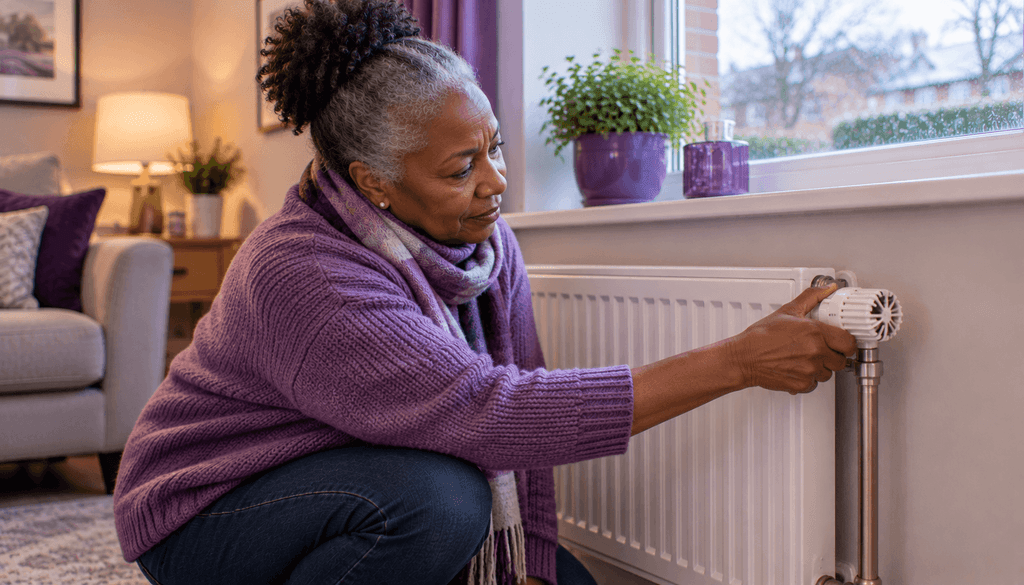
TRV vs lockshield valve: comparison
| Feature | Thermostatic radiator valve (TRV) | Lockshield valve |
| Main purpose | Controls room temperature | Balances water flow |
| Typical appearance | Larger, numbered dial | Smaller, plain cap |
| How it works | Automatically responds to room temperature | Maintains a manually adjusted setting |
| Everyday adjustment | Yes | Usually no |
| Typical position | One end of the radiator | Opposite end |
| Can stop a radiator heating? | Yes | Yes |
| Used during balancing? | Usually fully opened | Adjusted to regulate flow |
The easiest way to remember the difference is that the TRV controls how warm you want a room, while the lockshield helps determine how much water can circulate through that radiator.
How can you identify a TRV and lockshield valve?
The easiest way to distinguish the valves is by looking at their controls.
What does a TRV look like?
A traditional TRV usually has a relatively large plastic or metal head with numbers around its circumference.
Most have settings between 1 and 5, although some use a different scale. You may also notice a snowflake symbol representing a frost-protection setting.
The control is designed to be adjusted by hand, allowing you to choose how warm the room should become.
Some modern TRVs have digital displays or electronic controls instead of a numbered dial.
What does a lockshield valve look like?
A lockshield valve typically has a smaller, plain plastic cap without temperature numbers.
Unlike a TRV, its cap isn’t normally designed for regular adjustment. The valve setting is generally located beneath the cap.
Lockshields are commonly fitted at the opposite end of the radiator from the TRV.
However, you shouldn’t rely solely on which side of the radiator a valve occupies. The layout can vary between installations.
What if neither valve has numbers?
Some older radiators have a manual radiator valve rather than a TRV.
A manual valve works more like a tap. You turn it to increase or decrease the water flow, but it doesn’t automatically respond to room temperature.
A plain control that turns easily by hand may therefore be a manual valve rather than a lockshield.
What does a thermostatic radiator valve do?
A TRV controls the amount of heated water flowing through a radiator according to the temperature of the surrounding air.
Inside the valve head is a temperature-sensitive mechanism. When the room warms up, this mechanism gradually reduces the water flow.
As the room cools, the valve opens further, allowing more heated water to enter.
This helps maintain a more consistent room temperature without requiring you to adjust the valve throughout the day.
For example, you might set a bedroom to a lower temperature than your living room. The TRV will then reduce heating in the bedroom once its selected temperature is reached.
You should use the lowest TRV setting that maintains a comfortable temperature.
What do the numbers on a TRV mean?
The numbers represent approximate room-temperature settings, not the temperature of the water flowing through the radiator.
Higher numbers generally mean a warmer room, while lower numbers mean a cooler room.
However, the exact temperatures associated with each setting vary between manufacturers.
Setting a TRV to 5 also doesn’t make the room heat up faster than setting it to 3. It simply tells the valve to remain open until a higher room temperature is reached.
If you’re unsure which setting to use, start somewhere in the middle and adjust it gradually until the room feels comfortable.
Can a TRV turn the heating on?
A conventional TRV cannot independently switch on the boiler.
It controls how much heated water enters its radiator when the central-heating system is operating.
If the main room thermostat has already switched the heating off, turning up the TRV won’t make the radiator heat up.
Some smart radiator control systems offer additional functions, including requesting heat from a compatible central controller, but this depends on the equipment installed.
What does a lockshield valve do?
A lockshield valve helps control how much water flows through an individual radiator.
Its main purpose is to balance the heating system so that some radiators don’t receive too much water while others receive too little.
Without proper balancing, radiators near the boiler or circulation pump may heat quickly while others take considerably longer.
The lockshield creates a controlled restriction to help distribute water more evenly throughout the system.
Unlike a TRV, it doesn’t automatically respond to room temperature.
Once an appropriate setting has been established, the valve is normally left in that position.
Why shouldn’t you adjust the lockshield regularly?
Changing a lockshield setting affects the flow of water through its radiator and can influence the distribution of heat elsewhere in the system.
Opening several lockshields fully, for example, may allow too much water through certain radiators and reduce the flow available to others.
This can undo previous balancing work.
Although lockshields can be adjusted when necessary, they shouldn’t be used as everyday room-temperature controls.
Why do radiators need both valves?
The two valves perform complementary jobs.
The lockshield establishes a suitable flow restriction for the radiator within the wider heating system.
The TRV then adjusts the flow automatically as the room temperature changes.
Together, they allow the radiator to receive an appropriate share of circulating water while helping prevent the room from becoming unnecessarily warm.
A radiator can still function with a manual valve instead of a TRV, but the homeowner then needs to adjust that control manually.
Which radiator valve should you adjust?
The correct valve depends on what you’re trying to achieve.
| What you want to do | Which valve matters? |
| Make a room warmer or cooler | TRV |
| Keep a spare bedroom cooler | TRV |
| Prevent a room from overheating | TRV |
| Balance heat distribution across radiators | Lockshield |
| Investigate a completely cold radiator | Both may need checking |
| Correct a radiator that’s slow to heat | Check for faults before considering balancing |
For normal temperature adjustments, use the TRV.
If several radiators heat unevenly, you may need to consider balancing your radiators. This involves checking the system and adjusting lockshield settings where appropriate.
However, balancing won’t necessarily resolve trapped air, blocked pipework or faulty valves.
Can a faulty TRV or lockshield stop a radiator heating?
Yes. Both valves can restrict or completely prevent water flow.
Stuck thermostatic radiator valve
The small internal mechanism of a TRV can sometimes become stuck, particularly after a long period without use.
If the valve remains closed, the radiator may stay cold even when the control is turned to a higher setting.
Don’t pull out the internal pin or force the control. A plumber or heating engineer can check whether the mechanism can be freed or needs replacing.
Closed or faulty lockshield valve
If a lockshield has been closed during maintenance and not reopened, water may be unable to circulate properly through the radiator.
A damaged or blocked valve can also restrict flow.
However, a radiator that isn’t heating doesn’t automatically have a valve problem. Trapped air, sludge and other circulation faults can produce similar symptoms.
If you’re unsure why the radiator remains cold, investigate what’s preventing the radiator from heating properly rather than making large adjustments to both valves.
Common mistakes to avoid
There are several common misunderstandings about radiator valves.
Turning the TRV to maximum to heat a room faster. A higher setting changes the target temperature, not the rate at which the room heats.
Covering the TRV with curtains or furniture. This can trap warm air around the temperature sensor, causing the valve to reduce water flow before the rest of the room is warm enough.
Adjusting lockshields unnecessarily. Changing their settings can disturb the system’s balance.
Confusing manual valves with lockshields. Not every radiator has a TRV, so a plain valve isn’t automatically a lockshield.
Forcing stiff valves. Applying excessive force can damage the valve mechanism or its connections.
If a valve is leaking, damaged or difficult to operate, arranging a professional inspection is generally preferable to attempting to dismantle it.
Frequently asked questions
Is a TRV the same as a lockshield valve?
No. A TRV automatically adjusts water flow according to room temperature. A lockshield maintains a manually set restriction to help balance water flow around the heating system.
Should a lockshield valve be fully open?
Not necessarily. Lockshield valves are often partially closed to achieve the correct balance. Opening every lockshield fully can lead to uneven heating.
Should both radiator valves be open?
Both valves normally need to allow water through for a radiator to heat. However, the lockshield may only be partially open, while the TRV adjusts its opening according to room temperature.
Can you have a radiator without a TRV?
Yes. Some radiators use manual valves instead. However, TRVs provide automatic room-temperature control and can help reduce unnecessary heating.
Which valve should I turn if my radiator is too hot?
Normally, adjust the TRV to a lower setting. Avoid using the lockshield for routine temperature control because this could affect the balance of your heating system.
Accurate as of: 13 October 2026