

If some rooms heat up quickly while others stay cold for much longer, your radiators may need balancing. Balancing adjusts the flow of hot water through each radiator so that heat is distributed more evenly throughout your home.
You can balance radiators yourself if you’re comfortable making small adjustments to the radiator valves. The process involves identifying which radiators heat up first and restricting their flow slightly so that radiators receiving less hot water can catch up. For more accurate results, you can also use a digital thermometer to measure the temperature difference between the pipes entering and leaving each radiator.
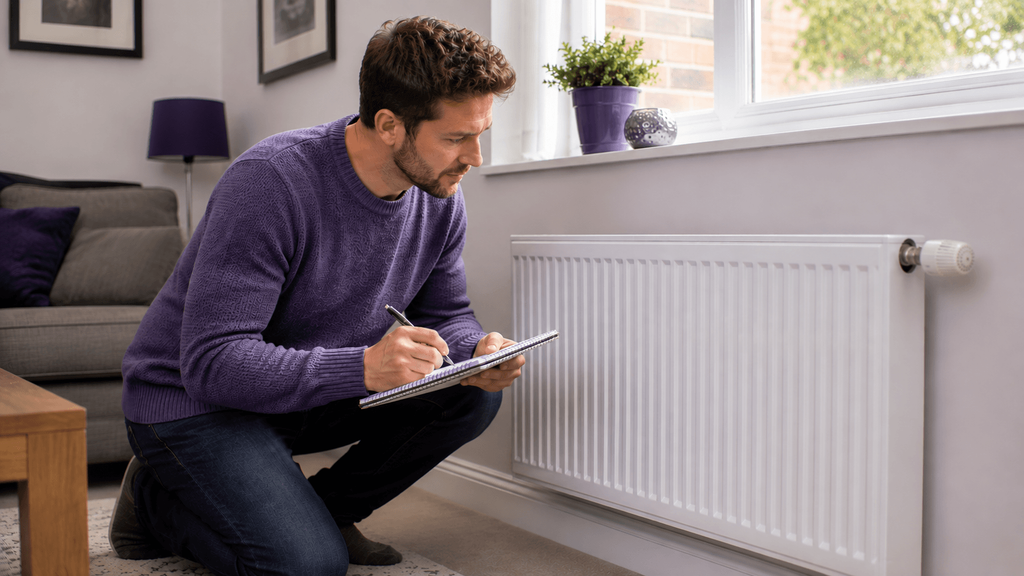
What does balancing radiators mean?
Hot water from your boiler is pumped around your central heating system and through your radiators. However, the water doesn’t necessarily flow equally through every radiator.
Radiators with an easier path through the pipework may receive more flow and heat up quickly, while others can take much longer. Balancing adjusts the lockshield valves to control this flow.
The aim isn’t necessarily to make every radiator the same temperature. Instead, each radiator should receive enough hot water to heat its room effectively without other radiators taking more flow than they need.
How do you know if radiators need balancing?
Your radiators may need balancing if:
- Some rooms heat much faster than others
- Some radiators get hot quickly while others take much longer
- Rooms farther from the boiler struggle to reach the desired temperature
- All the radiators eventually get hot, but heating is noticeably uneven
- The heating system has recently had radiators or valves replaced
Balancing is particularly worth considering after work has been carried out on the heating system. According to some boiler manufacturers, balancing is recommended when a system is installed and after maintenance that may have affected its settings.
However, uneven heating doesn’t always mean balancing is required.
Do you need to bleed or balance your radiators?
Bleeding and balancing are different jobs.
Bleeding a radiator removes trapped air. Balancing radiators adjusts how much hot water flows through them.
If a radiator is cold at the top or makes gurgling noises, trapped air is a more likely problem. Bleed it before attempting to balance the system.
If your radiators eventually become hot but some take considerably longer than others, balancing is more likely to help.
A radiator that’s hot at the top but persistently cold at the bottom can indicate sludge or another circulation problem. Balancing won’t remove sludge.
What tools do you need to balance radiators?
You don’t need specialist equipment for a basic balance. Depending on your radiator valves, you’ll need:
- An adjustable spanner or lockshield valve key
- A screwdriver if required for the valve caps
- A radiator bleed key
- Pen and paper or your phone to record the heating order
- A digital pipe or contact thermometer for more accurate balancing
A thermometer is optional. You can make useful adjustments based on how quickly the radiators heat, but measuring the flow and return temperatures gives you a more precise way to fine-tune them.
Which radiator valve do you use for balancing?
Most radiators have valves at both ends.
One may be a thermostatic radiator valve (TRV). This is the numbered valve you normally use to control the temperature of the room. TRVs automatically alter the flow of hot water according to the room temperature and selected setting.
The valve at the opposite end is usually the lockshield valve. It normally has a plastic cap rather than a numbered temperature control.
The lockshield is the valve you’ll adjust when balancing the system. Opening it allows more flow through that radiator; closing it restricts the flow.
How to balance radiators step by step
Allow plenty of time for this job. Much of the process involves waiting for the heating system to cool or allowing temperatures to stabilise after making adjustments.
1. Bleed any radiators that need it
Check the radiators for trapped air before you start.
If any are cold at the top or making gurgling noises, bleed them first. Balancing a system containing trapped air can give misleading results because the air itself is affecting radiator performance.
If you have a sealed heating system, check the boiler pressure afterwards and follow the manufacturer’s instructions if it needs repressurising.
2. Turn the heating off
Switch off the central heating and allow all the radiators to cool completely.
Starting from cold makes it much easier to identify the order in which they receive hot water once the heating is switched back on.
3. Open all the radiator valves
Fully open the valves on every radiator.
Turn the TRVs to their fully open position. Remove the caps from the lockshield valves and carefully open those as well.
Lockshield valves normally open anticlockwise and close clockwise.
Don’t force a valve that won’t move easily.
4. Turn the heating back on
Switch the heating on and move around the house checking the radiators.
Make a note of the order in which they heat up.
You don’t need to wait until every radiator is completely hot. You’re trying to establish which radiators receive hot water first.
Radiators closer to the boiler often heat sooner, although the actual pipework layout matters more than physical distance alone.
5. Turn the heating off again
Once you know the heating order, switch the system off and let the radiators cool.
Your list now gives you a starting point for adjusting the lockshield valves.
6. Adjust the first radiator
Start with the radiator that heated up first.
Close its lockshield valve completely by turning it clockwise. Then reopen it approximately a quarter of a turn.
This restricts the amount of water flowing through a radiator that was previously receiving hot water very easily.
7. Adjust the remaining radiators
Work through the radiators in the order you recorded.
Open each subsequent lockshield slightly more than the previous one. Radiators that were slowest to heat will generally need their lockshield valves opened further.
One manufacturer’s basic approach starts the first radiator at roughly a quarter turn and progressively allows more flow through later radiators.
These positions are starting points rather than universal settings. The correct adjustment depends on your particular heating system.
8. Test the heating again
Turn the heating back on and monitor how the radiators warm up.
They should now heat more evenly than before. If one radiator still becomes hot significantly faster than the others, slightly restrict its lockshield valve. If another remains slow, it may need a little more flow.
Make small adjustments rather than opening or closing valves dramatically.
Allow several minutes after each adjustment for the temperatures to stabilise before deciding whether another change is needed.
How to balance radiators using a thermometer
For a more accurate balance, measure the temperature of the water entering and leaving each radiator.
The pipe carrying hot water into the radiator is the flow. The cooler pipe carrying water away is the return.
Vaillant’s professional guidance uses a target of approximately a 12°C difference between flow and return temperatures. For example, if the flow is 65°C, a return temperature around 53°C would give a 12°C difference.
To use this method:
- Start with the radiator that heated first.
- Measure the temperature of the flow pipe close to the radiator.
- Measure the return pipe at the other side.
- Calculate the difference.
- Adjust the lockshield valve slightly.
- Wait several minutes for the temperature to stabilise.
- Measure again and continue adjusting as necessary.
- Repeat for the other radiators.
Opening the lockshield generally increases the flow through the radiator, while closing it restricts the flow.
Don’t become overly focused on achieving exactly 12°C on every radiator. Checkatrade also uses approximately 12°C as a target but notes that some variation can occur, particularly on older systems.
The overall aim is a heating system that distributes heat effectively throughout the property.
Can you balance radiators without a thermometer?
Yes.
The heating-order method can substantially improve an obviously unbalanced system without measuring individual pipe temperatures.
Start with the radiator that heated fastest and restrict its lockshield valve to roughly a quarter turn open. Progressively open the lockshields further as you work towards the slowest-heating radiators.
Then run the heating and see how the rooms respond.
If a radiator continues to heat too quickly, restrict it slightly. If another remains slow, open its lockshield a little further.
Should thermostatic radiator valves be fully open when balancing?
Yes, during the balancing process.
A TRV changes the flow through a radiator according to the room temperature. If some TRVs are partly or completely closed while you’re trying to determine the natural heating order, they can interfere with your observations.
Fully opening the TRVs allows you to balance the system using the lockshield valves.
Once you’ve finished, return the TRVs to the settings you normally use. It is recommended to set each TRV to the lowest setting that keeps its room comfortably warm rather than simply leaving every radiator at maximum.
How long does balancing radiators take?
There’s no fixed time, but expect the job to take at least a couple of hours in many homes.
The adjustments themselves are quick. Waiting for the entire heating system to cool before testing and allowing temperatures to stabilise after adjustments takes most of the time.
A larger property with many radiators can take considerably longer.
Don’t rush the process by making large valve adjustments. Small changes followed by observation generally produce more useful results.
How often should you balance radiators?
A properly balanced heating system shouldn’t require constant adjustment.
Consider checking the balance after:
- Installing or replacing radiators
- Replacing radiator valves
- Removing and reinstalling radiators
- Significant central-heating work
- Flushing the heating system
- Noticing that rooms have begun heating unevenly
If you remove a radiator for decorating, make a note of its lockshield position before closing it.
What if balancing the radiators doesn’t work?
Balancing only corrects uneven distribution of heating water. It won’t fix every reason a radiator fails to heat.
If a radiator remains cold after balancing, possible causes include trapped air, a faulty or stuck valve, sludge, a blockage or a wider circulation problem.
The pattern of cold areas can provide another clue. A cold top commonly points towards trapped air, while persistent cold areas at the bottom can indicate sludge or poor circulation.
If several radiators still aren’t heating correctly despite bleeding and balancing, have the central heating system assessed rather than continuing to adjust the valves.
When should you call a heating engineer?
Balancing radiators can be a reasonable DIY maintenance job if you’re comfortable identifying and making small adjustments to the valves.
Consider calling a heating engineer if the valves are stuck, radiators remain cold after bleeding and balancing, you suspect sludge or blockages, the heating system has wider circulation problems, or you’re simply not comfortable adjusting the system yourself.
Don’t remove the boiler casing or adjust internal boiler components when trying to solve uneven radiator heating.
Frequently asked questions
Which way do you turn a lockshield valve?
Turning a lockshield valve clockwise closes it and restricts flow, while turning it anticlockwise opens it and increases flow.
Do you balance radiators with the heating on or off?
Both. The heating needs to be off while the system cools and while you establish your initial valve settings. You’ll then switch it on to determine the heating order and measure temperatures.
What temperature difference should there be across a radiator?
Around 12°C between the flow and return pipes is commonly used as a balancing target. Treat it as a target rather than assuming every radiator must achieve exactly 12°C.
Do you balance radiators from nearest to furthest from the boiler?
Not necessarily. It’s better to record which radiator heats first and work in that order. The layout of the pipework means physical distance from the boiler doesn’t always tell you which radiator receives hot water first.
Can balancing radiators make your home warmer?
It can improve comfort if poor balancing means some rooms aren’t receiving enough heat. Balancing redistributes the available flow rather than making the boiler produce additional heat.
Should I bleed radiators before balancing them?
Yes, if they contain trapped air. Air can interfere with circulation and make it harder to judge whether the system is properly balanced. We recommend starting with bleeding-related symptoms separately before assessing the balance of the system.
Sources
Vaillant, How to balance radiators (https://www.vaillant.co.uk/advice/heating-tips/home-advice/how-to-balance-radiators/)
Checkatrade, How to balance a radiator: step-by-step guide (https://www.checkatrade.com/blog/how-to/balance-radiator/)
Accurate as of: 29 August 2026