

Yes, you can install a gas boiler outside in the UK, provided the boiler is specifically designed or approved for the proposed outdoor installation. Purpose-built external gas boilers have protective housings and frost-protection features that allow them to operate in outdoor conditions.
However, most standard indoor combi boilers cannot simply be mounted on an outside wall. Even installing a weatherproof cover doesn’t automatically make an indoor boiler suitable for external use.
The installation must follow the manufacturer’s instructions, comply with the relevant building regulations and be carried out by a suitably qualified Gas Safe registered engineer.
Can any gas boiler be installed outside?
Not every gas boiler is suitable for outdoor installation.
Most domestic gas boilers are designed to operate inside a building, where they’re protected from rain, frost and extreme temperature changes.
Purpose-built external boilers, on the other hand, are manufactured or supplied in approved configurations that provide the necessary protection.
The following table explains the main differences.
| Installation type | Is it possible? | Main requirement |
| Purpose-built outdoor gas boiler | Yes | Designed and approved for outdoor use |
| Standard indoor boiler exposed to weather | Generally no | Not approved for direct outdoor exposure |
| Indoor boiler inside a garage | Often | Must meet manufacturer requirements |
| Boiler inside a garden shed | Sometimes | Building and installation must be suitable |
| Boiler inside an outdoor cabinet | Sometimes | Manufacturer must approve the arrangement |
| Indoor boiler with an external flue | Yes | Flue must be installed correctly |
The important point is that outdoor suitability depends on the specific appliance and approved installation arrangement, not simply whether the boiler physically fits outside.
What’s different about an outdoor gas boiler?
An external gas boiler performs essentially the same heating function as an indoor model.
It heats water that circulates through the home’s radiators or other heating equipment. An external combi boiler can also produce hot water for taps and showers.
The main differences concern the boiler’s construction and installation.
Purpose-built external boilers may include weather-resistant casings, insulation, protected electrical components and automatic frost-protection controls.
These features help protect the equipment from rain, wind and freezing temperatures.
However, outdoor boilers still require appropriate servicing, drainage and protection for their connecting pipework.
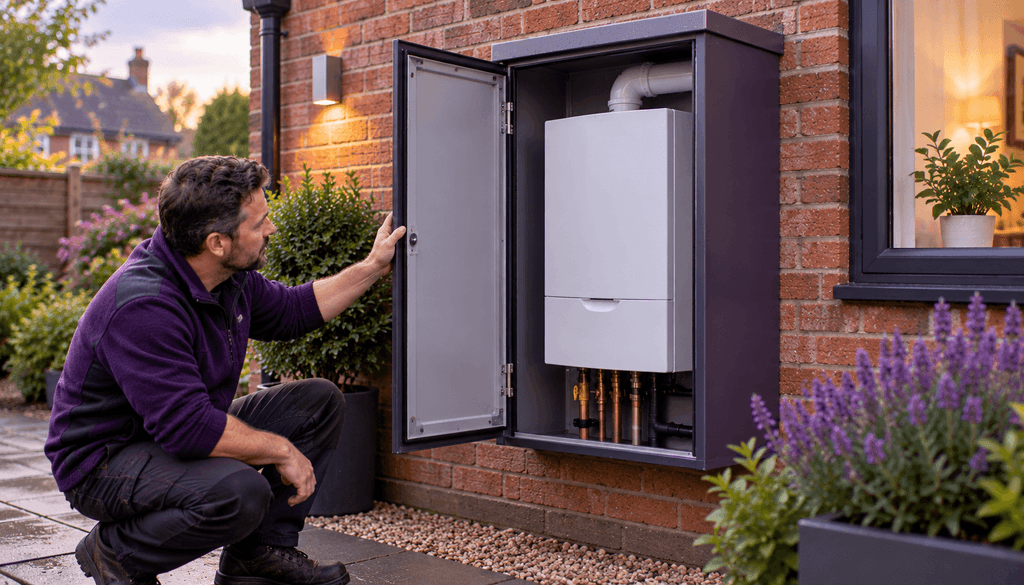
Can you put an indoor combi boiler in an outdoor cabinet?
Potentially, but only if the boiler manufacturer explicitly permits the proposed arrangement.
A common idea is to place an ordinary indoor combi boiler inside a weatherproof cabinet or insulated enclosure attached to an outside wall.
Although this might protect the appliance from direct rainfall, it doesn’t automatically create a suitable installation environment.
An engineer must consider several factors:
- Whether the boiler is approved for the proposed location.
- The enclosure’s ventilation requirements.
- Safe access for servicing and repairs.
- Protection against freezing.
- Flue positioning and clearances.
- Electrical protection and condensate drainage.
An enclosure must also allow any necessary space around the appliance for installation, inspection and maintenance.
In some cases, an approved protective housing may be available for a particular boiler or installation type.
However, homeowners shouldn’t assume that building a wooden box or buying a generic outdoor cabinet makes an indoor-only boiler suitable for external installation.
The manufacturer’s installation instructions should determine whether the arrangement is permitted.
Can you install a gas boiler in a garage or shed?
A garage or suitable outbuilding can sometimes accommodate a gas boiler, but this is different from installing one outdoors in an exposed location.
Installing a boiler in a garage
Many boilers can be installed in garages where the environment and installation meet the manufacturer’s requirements.
Important considerations include frost protection, ventilation where required, safe flue positioning and access for servicing.
A garage may become very cold during winter, particularly if it isn’t insulated or heated.
The boiler and any exposed pipework therefore need appropriate protection against freezing.
Installing a boiler in a garden shed
A garden shed is more complicated.
A lightweight or poorly insulated shed may not provide a suitable environment for an indoor boiler. Moisture, freezing temperatures, inadequate structural support and restricted servicing access can all create problems.
A properly constructed outbuilding or dedicated boiler room may be suitable for certain appliances, but the engineer must assess the proposed installation.
The distinction is between a building that provides a manufacturer-approved installation environment and one that merely offers some shelter from the weather.
We’ve covered the wider considerations in where you can install a boiler.
What protection does an outdoor gas boiler need?
Outdoor installations face environmental conditions that indoor boilers are generally protected from.
Frost protection
Freezing is one of the main concerns.
Water inside the boiler or connecting pipework can freeze during very cold weather, potentially damaging components or preventing the heating system from operating.
Purpose-built outdoor boilers commonly include automatic frost-protection functions.
However, these systems may depend on electricity and gas remaining available.
A power cut or interrupted fuel supply can therefore affect the protection provided.
External heating pipes also need appropriate insulation, and additional frost-protection measures may be necessary depending on the installation.
Condensate drainage
Modern condensing gas boilers produce condensate that must drain away safely.
Where a condensate pipe runs outside, freezing temperatures can cause water inside it to freeze and create a blockage.
Appropriate pipe sizing, routing and weather-resistant insulation help reduce this risk.
Weather resistance
Outdoor boilers need protection from rain, moisture and other environmental conditions.
Their approved housings and electrical components must be suitable for the intended installation.
Homeowners shouldn’t modify the casing or add covers that might interfere with ventilation, combustion or servicing access.
Maintenance access
An outdoor boiler must remain accessible for inspection, servicing and repairs.
Placing it behind fixed structures, dense vegetation or inaccessible fencing could make maintenance difficult or unsafe.
The boiler should be positioned so that an engineer can work on it without unnecessary hazards.
What are the UK regulations for installing a gas boiler outside?
Installing a gas boiler outdoors is subject to the same fundamental safety requirements as other gas-boiler installations, alongside any additional conditions associated with its location.
The appliance must be suitable for the proposed installation, have a compliant flue arrangement and be installed by a Gas Safe registered engineer competent for the work.
The relevant building-regulation guidance also varies across the UK.
In England, Approved Document J covers combustion appliances and the safe discharge of combustion products.
Wales publishes its own Approved Document J, while Scotland uses its Building Standards Technical Handbooks and Northern Ireland uses Technical Booklet L.
The engineer must follow the requirements applicable to the property’s location, as well as the boiler manufacturer’s instructions.
Flue positioning
The flue must safely discharge combustion gases away from windows, doors, ventilation openings and other relevant obstructions.
Outdoor installation doesn’t remove these requirements.
For some common modern gas flue arrangements, a 300 mm separation from an openable window is used in the guidance. However, this isn’t a universal distance for every appliance or terminal position.
Building control and planning
Gas-boiler installations may require building-regulation notification or approval, depending on the work and the nation in which the property is located.
An appropriately registered installer can often self-certify eligible work through a competent person scheme where applicable.
Planning permission is a separate issue and may depend on the property, location, proposed external works and any restrictions affecting the building.
Don’t assume that moving a boiler outside is automatically exempt from all approval requirements.
Where is the best place to install an outdoor gas boiler?
The most suitable location depends on the approved boiler design and how easily it can connect to the existing heating system.
An external wall near the current heating pipework may provide a relatively straightforward installation.
However, the engineer must also consider the flue route, drainage, available space and maintenance access.
A location that’s convenient for pipework may be unsuitable because of nearby windows, boundaries or other restrictions.
Similarly, positioning the boiler far from the house may require longer pipe runs, additional insulation and more installation work.
The best location is therefore one that meets all installation requirements while keeping the system practical to operate and maintain.
What are the advantages and disadvantages of installing a gas boiler outside?
The main advantage is freeing up space indoors.
Removing the boiler from a kitchen or utility room may create additional storage space or make renovations easier.
An external boiler may also be more accessible for certain maintenance tasks.
However, there are disadvantages to consider.
Weather exposure creates additional protection and maintenance requirements.
Longer pipe runs may increase installation complexity and heat loss if they’re not properly insulated.
Limited boiler choice can make it harder to find a model that suits the property.
Installation costs can also increase when relocation, electrical work or new pipework is required.
An outdoor boiler isn’t inherently more efficient than an indoor boiler simply because it’s located outside. Its efficiency depends on the appliance, installation and operating conditions.
How much does it cost to install a gas boiler outside?
The total external gas boiler installation cost depends on the boiler model, existing heating system and the amount of work required.
As a broad guide, a standard UK boiler installation can cost several thousand pounds, while external gas boiler installations may involve additional expenses.
These can include:
- A purpose-built external boiler or approved housing.
- Additional heating and gas pipework.
- Pipe insulation and frost protection.
- Electrical connections and controls.
- Condensate drainage.
- Alterations to the existing flue arrangement.
EnergyGuide’s existing outdoor-boiler guide provides an indicative installed cost of approximately £2,800–£5,000 across different outdoor boiler arrangements. This shouldn’t be treated as a guaranteed quotation for an external gas boiler.
Where an existing indoor boiler is being relocated, moving the boiler may introduce further costs depending on the distance and alterations involved.
Request an itemised quotation from a Gas Safe registered engineer before making a decision.
Is installing a boiler outside worth it?
An outdoor gas boiler can be worthwhile where indoor space is limited and there’s a suitable location for an approved external appliance.
However, relocating a working indoor boiler purely to gain a small amount of space may not always justify the expense.
A garage, utility room or other indoor position could sometimes offer a simpler alternative without requiring a purpose-built outdoor model.
Before proceeding, compare the available space, installation costs, ongoing maintenance requirements and the expected remaining life of the existing boiler.
The decision should be based on the property’s circumstances rather than assuming an external installation is automatically better.
Frequently asked questions
Can you put a normal combi boiler outside?
Generally, an indoor-only combi boiler cannot be installed in an exposed outdoor location. It must be approved for the proposed installation conditions, including any protective enclosure.
Are outdoor gas boilers legal in the UK?
Yes. Purpose-built external gas boilers can be installed where the appliance and installation comply with the applicable regulations and manufacturer’s instructions. Gas work must be completed by a suitably qualified Gas Safe registered engineer.
Can an outdoor gas boiler freeze?
Yes. Outdoor boilers and their connecting pipework can be vulnerable to freezing. Approved frost-protection systems and suitable pipe insulation reduce the risk, but some protection functions depend on an uninterrupted electricity or gas supply.
Can a boiler be installed in a garden shed?
Potentially, but the shed must provide a suitable installation environment, and the boiler manufacturer must permit the proposed arrangement. A typical lightweight garden shed shouldn’t automatically be considered suitable.
Is an outdoor boiler more expensive to run?
Not necessarily. A correctly installed outdoor boiler can operate efficiently, although poorly insulated external pipework may waste heat. Running costs depend primarily on the boiler’s efficiency, the building’s heating demand and the way the system is used.
Sources
UK Government, Approved Document J: Combustion Appliances and Fuel Storage Systems (https://www.gov.uk/government/publications/combustion-appliances-and-fuel-storage-systems-approved-document-j)
Welsh Government, Approved Document J (https://www.gov.wales/approved-document-j-combustion-appliances-and-fuel-storage-systems)
Scottish Government, Building Standards Technical Handbook: Domestic — April 2026 (https://www.gov.scot/publications/building-standards-technical-handbook-domestic-april-2026-pdf/documents/)
Building Control Northern Ireland, Technical Booklet L (https://www.buildingcontrol-ni.com/assets/pdf/TechnicalBookletL2012.pdf)
HSE, Gas Safety – Home Owners (https://www.hse.gov.uk/gas/domestic/faqownerocc.htm)
Accurate as of: 20 October 2026