

External gas boilers are designed to provide central heating and hot water while being installed outside the home. They can free up indoor space, but require suitable weather protection, frost protection and a safe installation location.
Installing an external gas boiler can cost several thousand pounds, depending on the appliance and work required. As a comparison, a standard gas-boiler installation costs around £3,000 on average in the UK, while an outdoor installation may involve additional pipework, insulation and electrical work.
The most important distinction is between replacing an existing outdoor boiler and moving an indoor heating system outside. The second option can involve considerably more work and higher costs.
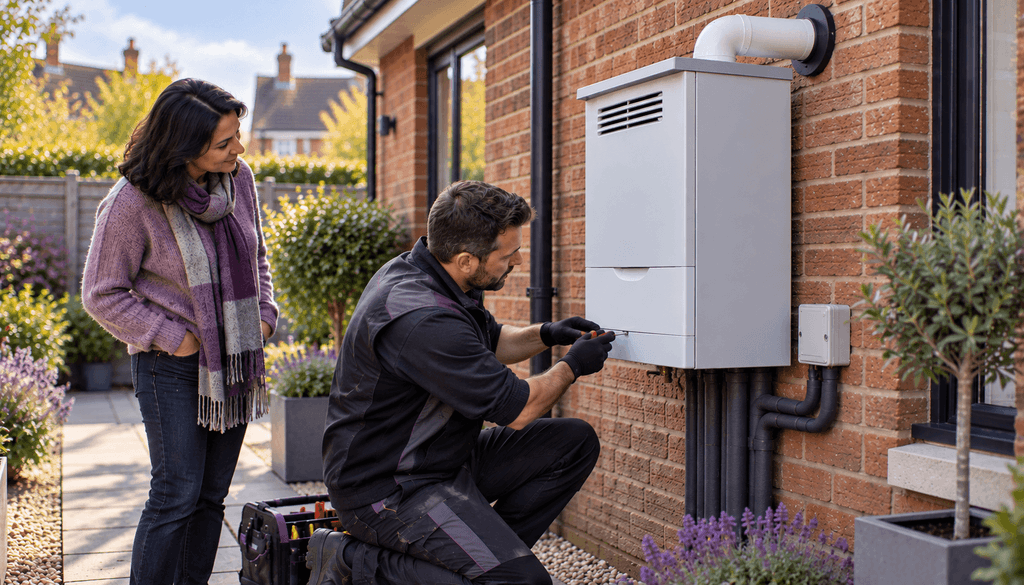
What is an external gas boiler?
An external gas boiler is a boiler specifically designed and approved for installation outside a building.
Like an indoor model, it burns natural gas or liquefied petroleum gas (LPG) to heat water for central heating and, depending on the boiler type, domestic hot water.
The difference is that an external boiler is supplied in an approved arrangement suitable for outdoor conditions. This typically includes weather-resistant housing, protection for electrical components and measures to reduce freezing risks.
Not every gas boiler can be installed outdoors. An ordinary indoor boiler cannot simply be placed in a weatherproof box unless the manufacturer specifically permits that installation.
The boiler and its housing must be suitable for the proposed location, with adequate access for installation and servicing.
How much does an external gas boiler cost?
The cost depends on the boiler model, existing heating system and complexity of the installation.
The average is approximately £3,000 for a standard UK gas-boiler installation, with straightforward like-for-like combi replacements commonly costing £2,500–£4,000.
However, these figures don’t specifically represent purpose-built external boilers.
| Installation scenario | Main cost considerations |
| Replacing an existing external gas boiler | New appliance, labour and any required pipework alterations |
| Moving an indoor boiler outside | External boiler, new connections, and relocation work |
| Installing an external system boiler | Boiler, cylinder compatibility and heating-system alterations |
| Installing an external LPG boiler | Boiler installation plus any required LPG supply infrastructure |
| Standard indoor gas-boiler replacement | Approximately £2,500–£4,000 for a straightforward combi replacement |
The standard boiler prices provide a UK market comparison, not a confirmed price range for external gas boilers.
A relatively straightforward outdoor replacement may cost less than a complete relocation involving substantial new pipework.
For an accurate estimate, an installer needs to assess the property and specify the actual boiler and installation requirements.
What affects external gas boiler installation costs?
The boiler itself is only one part of the total price. Several installation requirements can add to the work involved.
Boiler type and specification
External gas boilers are available in different capacities and configurations.
A combi boiler produces hot water on demand, while a system boiler works with a separate hot-water cylinder.
The correct model depends on the property’s heating requirements and how much hot water the household uses.
An external boiler may also cost more than an equivalent indoor model because of its protective housing and additional installation features.
Gas and heating pipework
Moving a boiler outside may require extending or rerouting the gas supply and central-heating pipes.
The engineer must check that the gas supply is suitable for the selected appliance and that the heating connections can be installed safely.
Longer pipe runs, difficult access or substantial alterations to existing pipework can increase labour and material costs.
Exposed heating pipes also need appropriate insulation to reduce heat loss and freezing risks.
Flue and condensate drainage
The flue must discharge combustion gases safely, with sufficient clearance from openings, boundaries and other relevant features.
Condensing boilers also need suitable condensate drainage.
Where condensate pipework runs outside, it must be appropriately designed and protected against freezing.
Both requirements can affect where the boiler can be positioned and how much installation work is necessary.
Electrical connections and controls
Gas boilers use electricity for components such as pumps, controls and ignition systems.
An outdoor installation therefore needs a suitable electrical supply and weather-protected connections.
The installer must also consider how the boiler communicates with indoor thermostats and other heating controls.
Removing or relocating the existing boiler
If an indoor boiler is being replaced by an outdoor model, the old appliance and its connections may need to be removed or altered.
This can involve closing the old flue opening, changing pipe routes and repairing walls or other affected surfaces.
These costs should be included when comparing boiler relocation costs with a straightforward replacement.
External combi vs system boilers: which is better?
Both types can be suitable for outdoor installation, provided the particular model is approved for that location.
| Feature | External combi boiler | External system boiler |
| Central heating | Yes | Yes |
| Hot water | Heated on demand | Stored in a separate cylinder |
| Hot-water cylinder | Usually not required | Required |
| Typical suitability | Homes with modest simultaneous hot-water demand | Homes with greater or simultaneous hot-water demand |
| Space requirements | No separate cylinder in most cases | Indoor cylinder space needed |
A combi can be a practical choice when the main objective is freeing up indoor space.
However, a system boiler may be preferable in a larger home where several bathrooms are used simultaneously.
The appropriate boiler size should be based on the property’s calculated heat loss and household hot-water requirements, rather than simply copying the output of the existing appliance.
How is an external gas boiler installed?
An installation normally begins with a site assessment by a Gas Safe registered engineer.
The engineer checks whether the proposed location is suitable, identifies an appropriate boiler and determines what alterations are needed.
The process typically involves:
- Site assessment: Checking the proposed position, flue route, drainage, accessibility and suitability of the appliance.
- System preparation: Arranging the necessary gas, heating and electrical connections.
- Boiler installation: Securing the approved external appliance in accordance with the manufacturer’s instructions.
- Flue and drainage installation: Providing compliant combustion-gas discharge and condensate drainage.
- System connections: Connecting the boiler to the home’s heating and hot-water arrangements.
- Commissioning: Testing operation, checking safety and completing the necessary installation records and notifications.
The work required varies considerably between a direct replacement and an entirely new outdoor installation.
A straightforward replacement may require limited alterations, while relocating the heating system could involve more substantial work.
Where can an external gas boiler be installed?
An external boiler needs a position that satisfies both the manufacturer’s instructions and the applicable regulations.
An outside wall near the existing heating pipework may be convenient, but proximity to the house isn’t the only consideration.
The location must provide a suitable flue route, secure support and safe access for maintenance.
Nearby windows, doors, ventilation openings and property boundaries can restrict where the appliance can be positioned.
There must also be a practical route for condensate drainage and any necessary electrical connections.
A position farther away from the property may require longer pipework, increasing installation complexity and potential heat loss.
The best location balances compliance, servicing access and the amount of additional work required.
What are the UK regulations for external gas boilers?
External gas boilers must comply with the relevant gas-safety and building-regulation requirements.
The appliance must be suitable for the proposed installation, and gas work must be carried out by a Gas Safe registered engineer competent for the work involved.
Although the general safety principles are similar, the UK nations publish separate building-regulation guidance.
| Nation | Main regulatory guidance |
| England | Approved Document J: Combustion Appliances and Fuel Storage Systems |
| Wales | Welsh Approved Document J |
| Scotland | Building Standards Technical Handbook: Domestic, Section 3.20 |
| Northern Ireland | Technical Booklet L: Combustion Appliances and Fuel Storage Systems |
In England, Approved Document J covers combustion-air supply and the safe removal of combustion products, including flue positioning.
Wales publishes its own Approved Document J, while Scotland’s domestic technical handbook and Northern Ireland’s Technical Booklet L provide their respective guidance.
The manufacturer’s installation instructions must also be followed.
Flue clearance requirements
An external boiler’s flue must safely discharge combustion gases away from relevant openings and obstructions.
For some common modern gas-flue arrangements, the guidance includes a minimum distance of 300 mm from an openable window. However, this isn’t a universal measurement.
The appropriate flue clearance requirements depend on the appliance, terminal design and installation conditions.
Building regulations and certification
Boiler installations may require building-regulation notification or approval, depending on the work and the nation involved.
In England and Wales, eligible work can often be self-certified by an installer registered with an authorised competent person scheme.
Scotland and Northern Ireland have different building-control procedures.
The installer should explain which certificates, commissioning records and notifications apply to the installation.
Is planning permission required?
Planning permission is separate from building-regulation compliance.
In England, installing or replacing a boiler wholly inside a property doesn’t normally require planning permission. External flue work may also fall within permitted-development rules when the relevant conditions are met.
However, installing an outdoor boiler can involve additional external equipment, structures or alterations that need separate consideration.
Rules also vary across the UK, and listed buildings or properties in designated areas may face additional restrictions.
Check the proposed work with the relevant local planning authority before installation where permission requirements are uncertain.
How do you protect an external boiler from freezing?
An external boiler and its pipework need suitable frost protection.
Purpose-built outdoor appliances commonly include automatic frost-protection functions, but these may depend on the electricity and gas supplies remaining available.
During a prolonged power cut, the boiler may not be able to operate its normal frost-protection system.
External heating pipes should be appropriately insulated, and the condensate drainage arrangement should minimise the risk of freezing.
Any insulation or additional protective equipment must be suitable for the installation.
Homeowners shouldn’t modify an approved boiler housing or obstruct openings to improve weather protection.
What should an installation quotation include?
A written quotation should clearly describe the proposed appliance and work involved.
Before agreeing to installation, check that it covers:
- The exact external boiler model and any required housing.
- Removal and disposal of the existing boiler.
- Gas, heating and hot-water pipework.
- Flue components and condensate drainage.
- Electrical connections and heating controls.
- Frost protection and external pipe insulation.
- Commissioning and required certification.
- Labour, VAT and any expected additional charges.
Also ask what happens if the installer discovers unsuitable pipework, system contamination or other problems during the job.
These issues can affect the final bill if they haven’t been included in the original quotation.
Comparing itemised quotations is more useful than choosing solely on the lowest advertised boiler price.
Is an external gas boiler worth the cost?
An external gas boiler may be worthwhile when indoor space is limited or when replacing an existing outdoor appliance.
It can remove the need to accommodate the boiler in a kitchen or utility room, although a system boiler may still require space for a hot-water cylinder.
However, purpose-built outdoor equipment, pipework alterations and frost protection can increase installation costs.
If the existing indoor boiler is reliable and occupies little space, relocating it purely for convenience may be difficult to justify financially.
A straightforward indoor replacement may also provide a wider choice of appliances.
The best option depends on the property, available installation locations and the total quoted cost.
Frequently asked questions
Are external gas boilers more expensive than indoor boilers?
They can be. Purpose-built external appliances may cost more, and installation can require additional pipework, weather protection and electrical work. However, a straightforward replacement of an existing outdoor boiler may be less complicated than relocating an indoor system.
Can you install any gas boiler outside?
No. The boiler must be specifically designed or approved for the proposed outdoor installation. A generic weatherproof cabinet doesn’t automatically make an indoor-only boiler suitable.
Can an external gas boiler run on LPG?
Yes, some external gas boilers are designed for LPG or offered in compatible versions. The installation must use the correct appliance configuration and comply with the relevant fuel-supply requirements.
How long does external gas boiler installation take?
The time depends on the work involved. Replacing an existing outdoor appliance may be relatively straightforward, while moving a boiler outside or changing the heating-system layout can require several days.
Do external gas boilers need annual servicing?
Yes. External gas boilers require regular maintenance just like indoor appliances. HSE strongly recommends servicing gas appliances at least annually by a suitably qualified Gas Safe registered engineer.
Sources
UK Government, Approved Document J: Combustion Appliances and Fuel Storage Systems (https://www.gov.uk/government/publications/combustion-appliances-and-fuel-storage-systems-approved-document-j)
Welsh Government, Approved Document J (https://www.gov.wales/sites/default/files/publications/2024-10/approved-document-j-combustion-appliances-and-fuel-storage-systems.pdf)
Scottish Government, Building Standards Technical Handbook: Domestic — April 2026 (https://www.gov.scot/publications/building-standards-technical-handbook-domestic-april-2026-pdf/)
Building Control Northern Ireland, Technical Booklet L (https://www.buildingcontrol-ni.com/assets/pdf/TechnicalBookletL2012.pdf)
Planning Portal, Boilers and Heating: Planning Permission (https://www.planningportal.co.uk/permission/common-projects/boilers-and-heating/planning-permission/)
HSE, Gas Safety – Home Owners (https://www.hse.gov.uk/gas/domestic/faqownerocc.htm)
UK Government, Competent Person Scheme: Current Schemes (https://www.gov.uk/guidance/competent-person-scheme-current-schemes-and-how-schemes-are-authorised)
Accurate as of: 24 October 2026