

Central heating sludge is a build-up of corrosion particles and other debris inside your radiators, pipes and boiler. Over time, these deposits can restrict water circulation, leave cold patches on radiators and contribute to noisy or inefficient heating.
Central heating sludge can be removed through targeted radiator cleaning, chemical flushing or powerflushing, depending on how widespread the contamination is.
However, not every cold radiator or circulation problem is caused by sludge, so it’s important to identify the problem before paying for treatment.
What is central heating sludge?
Most central-heating systems circulate the same water through radiators and pipework repeatedly. Over time, metal components can corrode, releasing tiny particles into the water.
These particles can accumulate and form dark deposits commonly known as central heating sludge.
One of the main components is magnetite, a black magnetic form of iron oxide produced by corrosion. Other deposits and debris can also collect inside the system.
Sludge often accumulates in areas where water moves more slowly, including the lower sections of radiators. It can also interfere with pumps, valves and the boiler’s heat exchanger.
A small amount of debris doesn’t necessarily mean the heating system has a serious problem. The concern is when contamination begins restricting circulation or affecting components.
What are the symptoms of central heating sludge?
Sludge can produce several symptoms, although many overlap with other heating-system faults.
| Symptom | Could sludge be responsible? | Other possible explanations |
| Radiator hot at top but cold at bottom | Yes | Restricted flow or normal temperature variation |
| Several radiators heating unevenly | Yes | Trapped air, balancing or valve problems |
| Heating takes longer than before | Possible | Controls, boiler settings or circulation faults |
| Boiler makes unusual rumbling noises | Possible | Scale or other boiler faults |
| Dark or dirty heating-system water | Stronger indication | Needs further investigation to establish severity |
| Repeated pump or valve problems | Possible | Wear, electrical faults or other restrictions |
Cold patches at the bottom of radiators
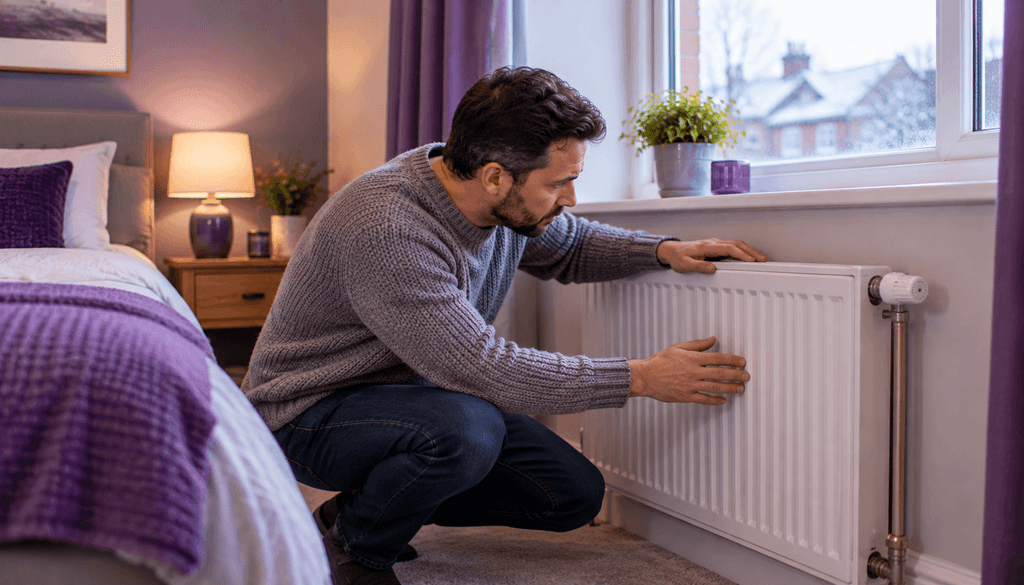
One of the most recognisable signs of sludge is a radiator that becomes warm near the top but stays noticeably cold towards the bottom.
This can happen when deposits collect in the lower sections and interfere with normal water circulation.
However, radiators naturally become cooler as they release heat into a room. A cooler bottom isn’t automatically evidence of contamination.
A persistent cold patch that affects a substantial part of the radiator is more concerning, particularly if the radiator used to heat evenly.
Radiators taking longer to heat up
Sludge can restrict water movement, causing radiators to warm slowly or unevenly.
If several radiators are affected, contamination elsewhere in the heating system may be responsible.
If one radiator isn’t heating up, however, a stuck valve, trapped air or local blockage may be a more likely explanation.
Boiler noises and circulation problems
Deposits can interfere with water circulation through the boiler and its heat exchanger.
Restricted circulation may contribute to unusual noises, overheating or repeated shutdowns.
Sludge can also affect circulation pumps and valves, although these components can fail for unrelated reasons.
Don’t assume that noises or a boiler fault code automatically mean the system needs flushing.
How can you tell the difference between sludge and trapped air?
Both problems can leave parts of a radiator cold, but they often produce different temperature patterns.
Trapped air commonly leaves the top of a radiator cold while the bottom remains warm. Air rises and can prevent heated water from filling the upper section.
Sludge more commonly causes persistent cold patches near the bottom, where deposits may accumulate.
These patterns provide useful clues, not definitive diagnoses.
If the top is cold, bleeding the radiator may help. If the bottom remains cold despite normal operation, restricted circulation or contamination may need investigating.
Repeatedly bleeding a radiator won’t remove accumulated sludge.
What causes sludge to build up?
The main cause is corrosion within the heating system.
Iron and steel components react with oxygen in the water, producing corrosion particles that can circulate and collect over time.
Several conditions can make the problem worse.
Inadequate corrosion protection. Without suitable inhibitor treatment, corrosion may develop more readily.
Repeatedly adding fresh water. Frequent topping up can introduce additional oxygen and minerals into the system.
Leaks and other system faults. Problems that cause repeated water loss and replenishment can contribute to continuing contamination.
Poor maintenance. Neglected filters and water treatment may allow debris to accumulate.
Sludge doesn’t develop simply because a heating system is old. A properly maintained older system may have fewer contamination problems than a newer system with poor water treatment.
Can central heating sludge damage your boiler?
Yes. Significant contamination can affect more than radiator performance.
Circulating debris may restrict narrow waterways inside the boiler’s heat exchanger or interfere with pump and valve operation.
Reduced water circulation can also cause the boiler to overheat or shut down.
Pumps, radiators and boiler heat exchangers are components that can be affected by corrosion deposits.
However, removing sludge won’t necessarily repair components that have already been damaged.
A faulty pump, for example, may still need replacing after the heating system has been cleaned.
How do heating engineers check for sludge?
An engineer will usually consider several observations rather than relying on one symptom.
They may inspect radiator temperature patterns, check circulation and examine water or debris removed from the system.
A magnetic filter can provide additional evidence. Large amounts of collected magnetic debris may indicate that corrosion products are circulating.
Engineers can also carry out water-quality checks, including tests associated with corrosion and treatment levels.
Dark water can suggest contamination, but its colour alone doesn’t establish how much sludge remains inside the radiators or whether a complete system flush is necessary.
The aim is to determine whether the problem affects one radiator, several radiators or the entire system.
How do you remove sludge from a central-heating system?
The most appropriate treatment depends on the extent of the contamination and the condition of the heating system.
| Treatment | When it may be suitable | Main limitation |
| Targeted radiator cleaning | One radiator has significant deposits | Doesn’t address contamination elsewhere |
| Chemical or gravity flushing | Suitable systems with lighter or moderate contamination | May not remove stubborn blockages |
| Powerflushing | Widespread contamination affecting circulation | More costly and not suitable for every system |
| Magnetic filtration | Collecting circulating magnetic debris | Won’t remove existing heavy deposits on its own |
| Corrosion inhibitor | Reducing future corrosion | Doesn’t remove accumulated sludge |
Cleaning an individual radiator
If contamination is limited to one radiator, targeted cleaning may be enough.
An engineer may isolate and remove the radiator before flushing accumulated deposits from it.
This can be more proportionate than cleaning the entire system when the other radiators are working normally.
However, if debris is continually circulating from elsewhere, the radiator may become contaminated again.
Chemical or gravity flushing
Chemical cleaning involves adding an appropriate cleaning product to help loosen deposits before the system is drained and rinsed.
Depending on the method, cleaning may use normal system circulation or other controlled flushing arrangements.
This can be suitable for some systems with moderate contamination, but it may not remove severe blockages or heavily compacted deposits.
The cleaning product and procedure must be appropriate for the particular system.
Powerflushing
Powerflushing uses specialist equipment to circulate water and cleaning chemicals through the heating system at a higher flow rate, helping dislodge accumulated sludge and debris.
The engineer can work through different radiator circuits before rinsing the system and adding suitable corrosion protection.
It’s often considered when contamination is widespread and circulation has significantly deteriorated.
However, powerflushing isn’t automatically necessary for every system containing sludge.
Older radiators or weakened pipework may also require particular care. Cleaning can reveal existing leaks or weaknesses, and even a thorough powerflush cannot guarantee that every deposit will be removed.
How much does central heating sludge removal cost?
The price depends on the cleaning method, number of radiators and condition of the system.
For powerflushing, Checkatrade’s 2026 guide gives a typical UK cost of approximately £350–£800.
| Property example | Indicative powerflush cost |
| Two-bedroom flat, four radiators | £350 |
| Two-bedroom house, six radiators | £450 |
| Three-bedroom house, ten radiators | £550 |
| Four-bedroom house, fifteen radiators | £800 |
These examples exclude VAT and are intended as estimates rather than guaranteed prices.
Targeted radiator cleaning or another treatment may be more appropriate than a complete powerflush.
For a more detailed breakdown of powerflushing costs and whether it’s worthwhile, the total also depends on the cleaning work required and any additional repairs.
Ask whether the quotation includes chemicals, inhibitor, filter cleaning, labour and VAT.
Can you remove central heating sludge yourself?
Homeowners can observe radiator temperatures, check boiler pressure and look for signs of poor circulation.
However, removing significant sludge generally requires appropriate equipment and knowledge of the heating system.
Attempting to flush the system incorrectly can cause leaks, introduce air or leave cleaning chemicals behind.
Professional cleaning is particularly important where boiler components, electrical equipment or fragile pipework are involved.
If contamination is suspected, arrange an inspection rather than repeatedly draining radiators or adding cleaning products without a diagnosis.
How do you prevent central heating sludge?
Preventing new deposits is just as important as removing existing contamination.
A good approach combines appropriate cleaning, corrosion protection and ongoing maintenance.
Use a suitable corrosion inhibitor
Corrosion inhibitors are chemical treatments added to heating-system water to help protect internal metal components.
They can reduce the rate at which corrosion develops, but they cannot remove a large existing sludge blockage.
Treatment should follow the product and heating-system manufacturer’s instructions.
Consider a magnetic boiler filter
A magnetic filter captures circulating magnetic corrosion particles before they can continue through the heating system.
It can be particularly useful after cleaning or when a new boiler is installed on an existing system.
However, a magnetic boiler filter won’t remove sludge already settled inside a radiator, and it needs periodic cleaning.
Maintain the heating system
Regular servicing and appropriate water-quality checks can help identify problems before circulation is significantly affected.
If the boiler repeatedly loses pressure, investigate the cause instead of continually adding fresh water.
When replacing a boiler, the existing radiators and pipework should also be assessed. Installing a new appliance doesn’t automatically remove contamination already present in the system.
Frequently asked questions
Can central heating sludge cause cold radiators?
Yes. Sludge can accumulate inside radiators and restrict water circulation, creating persistent cold patches. However, trapped air, closed valves and balancing problems can produce similar symptoms.
Does bleeding a radiator remove sludge?
No. Bleeding releases trapped air from a radiator. It doesn’t remove substantial deposits that have collected inside.
Do I need a powerflush to remove sludge?
Not necessarily. A single contaminated radiator may be cleaned individually, while lighter contamination may respond to another suitable cleaning method. Powerflushing is more likely to be considered when contamination is widespread.
Can central heating sludge increase energy bills?
Potentially. Significant restrictions can make heat distribution less effective and may cause the heating system to run longer to achieve comfortable room temperatures. However, cleaning doesn’t guarantee a particular reduction in energy consumption.
Will a magnetic filter remove existing sludge?
A magnetic filter can collect magnetic particles moving through the heating water. It won’t reliably remove deposits already trapped inside radiators or blocked pipework.
Accurate as of: 12 October 2026