

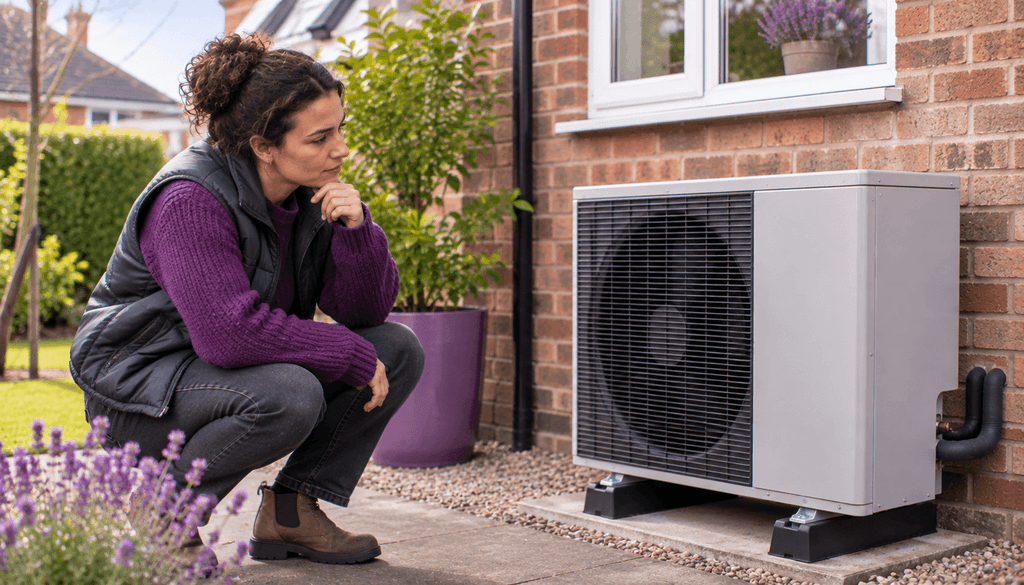
Air source heat pumps produce some noise during operation, but UK planning regulations are designed to limit their impact on neighbouring properties.
In England and Wales, domestic installations that qualify as permitted development must meet a calculated noise limit of 37 dB(A) at specified positions outside neighbouring habitable rooms. Scotland and Northern Ireland use an older assessment method with a 42 dB(A) criterion.
These figures don’t mean the heat pump itself must be quieter than 37 or 42 decibels. They apply to the calculated sound level at a neighbouring property, accounting for factors such as distance, positioning and barriers.
The rules also differ across the UK, so it’s important to understand which requirements apply before installing an air source heat pump.
What is the legal noise limit for heat pumps in the UK?
There isn’t one universal noise limit for every heat pump installation in the UK.
The relevant rules depend on where you live and whether the installation qualifies as permitted development, meaning it can proceed without a separate planning application if all the applicable conditions are met.
| UK nation | Noise criterion | Assessment standard |
| England | 37 dB(A) | MCS 020(a) |
| Wales | 37 dB(A) | MCS 020(a) |
| Scotland | 42 dB(A) | MCS 020 |
| Northern Ireland | 42 dB(A) | MCS 020 |
These are criteria within the relevant permitted-development noise calculations. The older 42 dB(A) method includes an assumed background noise level, so the figures aren’t directly interchangeable.
England introduced its updated heat pump planning rules on 29 May 2025. Wales followed with changes taking effect on 1 June 2026 (Planning Portal, Welsh Government).
Scotland and Northern Ireland continue to reference the earlier MCS 020 assessment for domestic permitted-development installations.
The noise requirement is only one part of the planning rules. Restrictions relating to building type, installation position, protected buildings and other factors may also apply.
Why did the heat pump noise limit change from 42 dB to 37 dB?
The change is mainly associated with an updated calculation method rather than a straightforward reduction in the permitted noise from every heat pump.
The older MCS 020 standard uses a calculation that includes an assumed background noise level.
The newer MCS 020(a) standard assesses the calculated contribution from the heat pump itself against a 37 dB(A) criterion, without adding that assumed background level.
Both methods consider the likely impact of the installation on neighbouring rooms, but they approach the calculation differently.
Consequently, it’s misleading to say that the UK simply reduced the noise limit by five decibels.
The newer method also forms part of wider planning changes intended to make suitable domestic heat pump installations easier.
For homeowners, the important point is that older advice quoting 42 dB(A) may no longer apply in England or Wales.
What does 37 dB(A) actually mean?
Decibels measure sound levels. The additional “(A)” means the measurement has been adjusted to reflect how the human ear responds to different sound frequencies.
The 37 dB(A) criterion is relatively quiet, but understanding it requires distinguishing between the sound produced by the equipment and the sound experienced farther away.
Sound power vs sound pressure
Heat pump manufacturers often publish sound-power figures, while planning assessments calculate sound pressure at a particular location.
| Measurement | What it describes |
| Sound power | The total sound energy emitted by the heat pump |
| Sound pressure | The sound level at a particular position, affected by distance and surroundings |
For example, an air source heat pump might have a published sound-power level of 58 dB(A).
That doesn’t automatically mean it fails the 37 dB(A) planning criterion.
The calculated noise at a neighbouring window may be considerably lower because sound becomes quieter as it travels away from the equipment.
The assessment also considers the arrangement of nearby surfaces and any suitable barriers.
You can’t determine planning compliance by comparing the manufacturer’s sound-power figure directly with 37 dB(A).
How loud is a typical air source heat pump?
Most modern air source heat pumps produce a combination of fan noise and a low mechanical hum.
The sound may resemble airflow from an outdoor air-conditioning unit, although the exact character depends on the equipment.
Typical published sound-power figures for domestic air source heat pumps can fall around 50–65 dB(A), depending on the model and test conditions.
However, this isn’t the sound level that a neighbour will necessarily hear.
Heat pump noise also changes during operation.
For example, the equipment may become more noticeable when heating demand increases or when the outdoor temperature falls.
Some models operate at lower fan or compressor speeds during periods of reduced demand.
Others have a quiet mode that limits noise under certain conditions, sometimes at the expense of available heating output.
Noise is one of several potential disadvantages of air source heat pumps, but suitable positioning and installation can substantially reduce its impact.
How is heat pump noise assessed?
For installations using MCS 020(a), the installer must carry out a sound assessment before proceeding under permitted-development rights.
The calculation estimates the noise contribution from the proposed heat pump at relevant neighbouring locations.
It considers several factors:
- The manufacturer’s declared sound-power level.
- The proposed position and orientation of the heat pump.
- The distance to neighbouring habitable rooms.
- The effect of nearby walls and reflective surfaces.
- Suitable barriers or other screening between the equipment and assessment position.
- The combined effect of multiple heat pumps, where applicable.
The installer then checks whether the calculated result meets the relevant criterion.
Where is the noise measured?
Under MCS 020(a), an assessment position is located one metre outside the centre of a door or window serving a habitable room in a neighbouring property.
A habitable room includes spaces used for living or sleeping, such as bedrooms and living rooms.
Bathrooms, corridors and utility rooms aren’t treated as habitable rooms for this purpose.
The calculation must consider the relevant neighbouring assessment positions rather than simply choosing the most convenient location.
The assessment point isn’t automatically the nearest garden boundary or the position immediately beside the outdoor unit.
MCS 020(a) also requires the installer to provide the customer with a copy of the completed assessment.
Can you measure the noise yourself?
You can use a sound-meter app to get a rough impression of noise, but it won’t establish whether a proposed installation meets MCS requirements.
The planning assessment uses defined equipment data and a specified calculation method.
If you’re concerned about noise before installation, ask the installer to explain the assessment results and how the proposed location affects neighbouring properties.
How close can a heat pump be to a neighbour?
There isn’t a single minimum distance that applies throughout the UK.
In England, the previous one-metre boundary restriction was removed in May 2025, although the installation must still comply with the relevant permitted-development requirements.
Wales also updated its planning rules in June 2026.
Northern Ireland retains a one-metre boundary restriction for air source heat pumps installed under its domestic permitted-development rules.
Other restrictions may apply in Scotland.
However, meeting a minimum boundary distance doesn’t automatically mean the installation meets the noise requirements.
A heat pump positioned close to a neighbouring bedroom may need careful assessment, even where the location is otherwise permitted.
Likewise, a unit installed farther away could still create problems if sound reflects between nearby walls.
The best location should be determined using the property’s actual layout rather than a fixed distance alone.
What happens if a heat pump exceeds the noise limit?
If a proposed installation doesn’t meet the applicable permitted-development noise assessment, it may require a planning application.
This doesn’t necessarily mean the heat pump cannot be installed.
The local planning authority can consider the specific proposal, including its likely noise impact and any measures intended to reduce disturbance.
An installer may also be able to change the proposed design.
For example, repositioning the outdoor unit, selecting quieter equipment or introducing appropriate acoustic screening may improve the assessment result.
The installation must still meet all other applicable planning conditions.
A heat pump that receives planning permission isn’t automatically exempt from noise nuisance legislation once it begins operating.
Can neighbours complain about heat pump noise?
Yes. A neighbour can raise concerns if a heat pump causes persistent or unreasonable noise disturbance.
The first step is usually to discuss the issue with the heat pump owner.
The noise may be caused by a fault, poor positioning or operating settings that can be adjusted.
For example, a loose component or worn fan could create noise that wasn’t present when the equipment was installed.
If the problem continues, the neighbour can contact the local council.
There are two separate issues to consider.
Planning compliance: Whether the heat pump was installed in accordance with the relevant planning permission or permitted-development conditions.
Statutory noise nuisance: Whether the noise causes unreasonable interference with the use or enjoyment of neighbouring property.
Under the Environmental Protection Act 1990, councils can investigate potential statutory noise nuisances.
A heat pump doesn’t automatically become a statutory nuisance simply because it can be heard.
Equally, a compliant planning assessment doesn’t guarantee that operating noise can never become a nuisance.
Environmental Protection UK recommends keeping a record of persistent noise problems, including when they occur and how long they last.
How can you reduce heat pump noise?
Noise prevention is generally easier when it’s considered before installation.
Several measures can help reduce the sound experienced by homeowners and neighbours.
Choose the installation location carefully
Avoid placing the outdoor unit close to neighbouring bedrooms or living-room windows.
The installer should also consider nearby walls and corners, where reflected sound may make the equipment more noticeable.
Use appropriate anti-vibration mounts
Heat pumps contain moving components that can transmit vibration to their supporting structure.
Suitable mounts can help reduce vibration-related noise when selected and installed correctly.
Keep the unit maintained
Unexpected rattling, grinding or unusually loud operation may indicate a mechanical problem.
Follow the manufacturer’s servicing recommendations and arrange professional inspection when necessary.
Consider acoustic screening
An appropriately designed acoustic barrier may reduce sound travelling towards neighbouring properties.
However, screening needs to account for airflow, access and the manufacturer’s installation requirements.
Don’t build a tightly enclosed box around a heat pump simply to make it quieter.
Restricting airflow can reduce performance, increase operating costs and potentially damage the equipment.
Ask about quiet operating modes
Some heat pumps have settings that reduce noise during particular periods.
These can be useful, but the installer should confirm that the settings are suitable for the home’s heating requirements.
Quiet mode shouldn’t be relied upon as the sole means of meeting planning requirements unless the applicable assessment and equipment controls properly support that arrangement.
What should you ask your heat pump installer?
Before agreeing to an installation, ask for the proposed equipment’s declared noise information and the completed MCS assessment.
It’s also worth checking whether the installer has considered the nearest neighbouring habitable rooms and any sound reflections from walls.
If the result is close to the permitted-development criterion, ask whether alternative equipment or a different location would provide a greater margin.
Discuss how the unit will operate during colder weather, when heating demand may be higher.
Finally, confirm whether the installation qualifies as permitted development or requires a planning application.
These checks can help avoid disagreements and expensive changes after installation.
Frequently asked questions
Is 42 dB still the heat pump noise limit in the UK?
Not everywhere. England and Wales now use the 37 dB(A) criterion under MCS 020(a) for applicable permitted-development installations. Scotland and Northern Ireland continue to use the older MCS 020 assessment, which has a 42 dB(A) criterion that includes assumed background noise.
Can a heat pump be louder than 37 dB?
Yes. The 37 dB(A) criterion isn’t a limit on the sound measured directly beside the heat pump. It applies to the calculated contribution at specified neighbouring assessment positions.
Are heat pumps noisy at night?
Heat pumps may operate at night when heating or hot water is required. Their sound output depends on the model, operating conditions and settings. Some have quiet modes, but these may affect available heating performance.
Do heat pumps make more noise in winter?
They can. Lower outdoor temperatures and higher heating demand may require the fan and compressor to work harder. Defrost cycles can also change the sound temporarily.
Can I install a heat pump next to my neighbour’s fence?
Possibly, depending on the UK nation and the applicable planning conditions. England no longer has its former one-metre boundary restriction, but the installation must still satisfy the noise assessment and other requirements. Northern Ireland retains a one-metre boundary restriction under its domestic permitted-development rules.
Do ground source heat pumps have the same noise limits?
Ground source heat pumps generally don’t have an outdoor fan unit like air source heat pumps. Their noise characteristics and planning requirements differ, so the MCS air source heat pump noise assessment shouldn’t automatically be applied to them.
Sources
MCS, MCS 020(a) Issue 1.1: Air Source Heat Pump Sound Calculation (https://mcscertified.com/wp-content/uploads/2025/07/MCS-020-a-Issue-1.1-Final.pdf)
MCS, MCS 020 Planning Standards (https://mcscertified.com/wp-content/uploads/2025/06/MCS-020-Planning-Standards-Issue-1.2.pdf)
Planning Portal, Planning Permission: Air Source Heat Pump (https://www.planningportal.co.uk/permission/common-projects/heat-pumps/planning-permission-air-source-heat-pump/)
Welsh Government, Planning Permission: Domestic Heat Pumps (https://www.gov.wales/planning-permission-heat-pumps)
Scottish Government, Review of Permitted Development Rights: Domestic Renewables (https://www.gov.scot/publications/scottish-government-review-permitted-development-rights-phase-3-consultation/pages/2/)
Northern Ireland, Planning (General Permitted Development) (Amendment) Order 2023 (https://www.legislation.gov.uk/nisr/2023/95/2023-07-04)
Accurate as of: 10 November 2026