

A boiler doesn’t necessarily have to go in the kitchen. Depending on your property and the type of boiler, possible locations include a kitchen, utility room, cupboard, bathroom, bedroom, loft or garage. You may also be able to move a replacement boiler somewhere different from the existing one.
However, the location needs to work with the boiler’s flue, condensate drainage, pipework and electrical supply while providing suitable access for servicing. The installation must also comply with the relevant building and gas-safety requirements, so a convenient empty wall isn’t automatically a suitable place for a boiler.
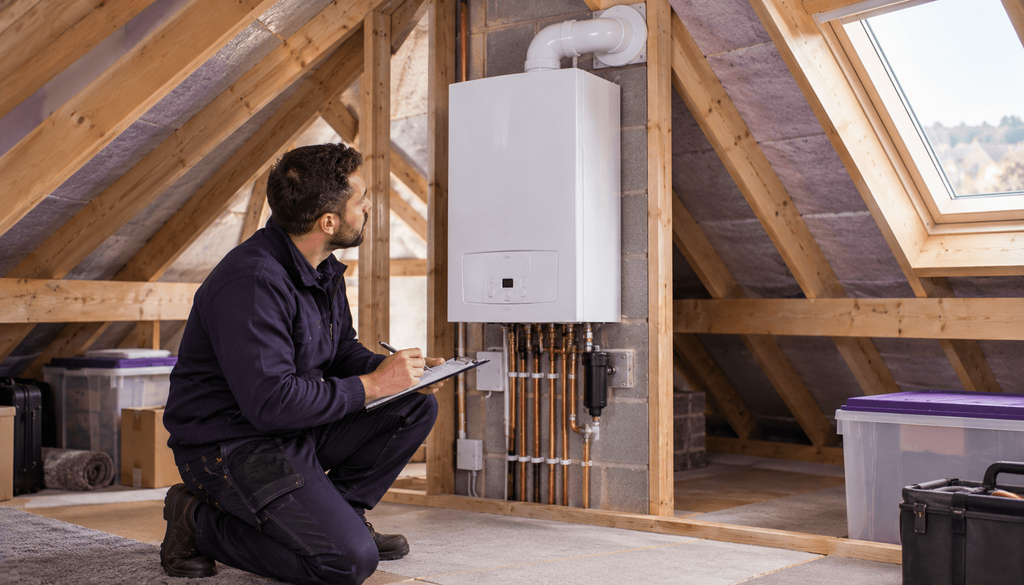
Where can you put a boiler?
Several areas of a home can potentially accommodate a boiler.
| Location | Can you install a boiler there? | Main consideration |
| Kitchen | Yes | Cupboard space, pipework and flue route |
| Utility room | Yes | Access, pipework and available wall space |
| Cupboard | Usually | Clearances and servicing access |
| Bathroom | Potentially | Electrical safety and boiler position |
| Bedroom | Potentially | Appliance suitability and noise |
| Loft | Potentially | Access, boarding, lighting and frost protection |
| Garage | Potentially | Frost protection and pipe runs |
| Under the stairs | Potentially | Space, access and manufacturer’s requirements |
Whether a particular position is suitable depends on the boiler and the property. The manufacturer’s installation instructions also need to be followed.
For a gas boiler, the installation itself must be completed by a suitably qualified Gas Safe registered engineer.
Can you install a boiler in a kitchen?
Yes. The kitchen is one of the most common places to install a boiler.
It can be a practical choice because kitchens already contain water and waste pipes, potentially making it easier to connect the boiler and dispose of condensate. An external wall may also provide a relatively straightforward route for the flue.
Many modern boilers are compact enough to fit inside a kitchen cupboard. This can keep the appliance out of sight without moving it somewhere that’s difficult to access.
The downside is that the boiler takes up valuable kitchen storage space. The position also still needs to provide the clearances and access specified by the boiler manufacturer.
Can you install a boiler in a utility room?
Yes. A utility room can be one of the most convenient boiler locations if you have one.
It keeps the boiler away from the main living areas while still making it relatively easy to reach for servicing and repairs. Utility rooms often already contain plumbing and may have an external wall that can accommodate a suitable flue route.
There’s also less pressure to conceal the boiler than there might be in a newly fitted kitchen.
However, the same installation requirements still apply. The engineer needs to consider the flue, condensate drainage, pipework, electrical supply and servicing access before deciding whether a particular position will work.
Can a boiler go inside a cupboard?
Yes, many boilers can be installed inside a cupboard.
The cupboard needs to provide enough room for the appliance and the clearances specified by its manufacturer. There must also be enough access for an engineer to inspect, service and repair the boiler.
Don’t assume there is one universal minimum gap that applies to every boiler. Required clearances vary between appliances.
Ventilation requirements can also depend on the boiler. Modern room-sealed boilers obtain combustion air from outside rather than from the room itself, but you should still follow the appliance manufacturer’s instructions rather than assuming that any cupboard is suitable.
If you’re building a new cupboard around an existing boiler, check the manufacturer’s clearance and ventilation requirements before starting.
Can you install a boiler in a bathroom?
A boiler can potentially be installed in a bathroom, but there are additional considerations because electricity and water are present in the same room.
Electrical installations in bathrooms are subject to specific requirements, including rules concerning electrical equipment in defined zones around baths and showers. The boiler, electrical connections and controls therefore need to be positioned appropriately.
The appliance also has to be suitable for the proposed location and installed according to the manufacturer’s instructions.
This doesn’t mean boilers are universally prohibited from bathrooms. It means a Gas Safe registered engineer needs to assess whether the proposed location is suitable and whether the installation can meet the applicable gas, electrical and building requirements.
Can you install a boiler in a bedroom?
A boiler can potentially be installed in a bedroom, although it may not be the most convenient choice.
Aside from the drawbacks mentioned before, noise is the main practical drawback of installing a boiler in a bedroom. Boilers make some noise when operating, particularly when firing up, and pumps or nearby pipework can also be audible. Sounds that aren’t particularly noticeable during the day may become more disruptive when you’re trying to sleep.
If you have other suitable locations available, this can make a kitchen, utility room or cupboard a more practical choice than a bedroom.
Can you install a boiler in a loft?
Yes, a boiler can potentially be installed in a loft. Moving it upstairs can free up useful cupboard or wall space elsewhere in the house, but a loft installation needs more planning.
An engineer will need suitable access to install, service and repair the appliance. Practical considerations can include:
- Safe access into the loft
- Suitable boarding to reach the boiler
- Adequate lighting
- Enough working space around the appliance
- A suitable structure to support the boiler
- Protection against freezing
- A practical flue route
Cold temperatures are particularly important. Water-containing components and pipework in an unheated loft can be vulnerable during freezing weather, so suitable frost protection may be necessary.
A loft can therefore be a good way to get the boiler out of the main living space, but it can also make installation and future servicing more complicated.
Can you install a boiler in a garage?
Yes, a garage can also be a suitable boiler location.
Like a loft, a garage keeps the boiler away from the main living areas and avoids sacrificing kitchen cupboard space. Access may also be easier than with a loft installation.
The main concern is usually temperature. Garages can become very cold during winter, so the boiler and associated pipework need appropriate protection against freezing.
Pipe runs matter too. Moving a boiler into a garage can require significant changes to the heating, hot-water, gas and condensate pipework. A detached garage is likely to make this considerably more complicated.
The extra installation work means a garage isn’t automatically a better choice simply because there’s plenty of available wall space.
Can you put a boiler under the stairs?
Potentially.
An under-stairs cupboard can provide a convenient way to conceal the boiler without using kitchen storage. Whether it works depends on factors including the available space, flue route, condensate drainage and access.
An engineer must be able to reach the boiler for servicing and repairs, and the cupboard must meet the boiler manufacturer’s clearance and any applicable ventilation requirements.
This is another situation where simply being able to fit the boiler into the space isn’t enough to establish that it’s a suitable location.
How does the boiler flue affect where it can go?
The flue is one of the most important factors when deciding where to install a gas boiler.
It carries combustion products safely outside, so its terminal can’t simply be placed wherever is most convenient. In England, Approved Document J covers the safe discharge of combustion products as part of the Building Regulations requirements for combustion appliances.
The installer needs to consider the boiler manufacturer’s instructions and the position of features such as doors, windows and other parts of the building.
For this reason, an apparently ideal internal wall may turn out to be unsuitable once the required flue route is considered.
Avoid relying on a single generic flue-clearance measurement found online. The required position and clearances depend on the appliance, flue configuration and surrounding building.
What about the condensate pipe?
Condensing boilers produce condensate that needs to drain away.
Where possible, the condensate pipe should drain into an indoor waste pipe rather than taking an unnecessarily long route outside. External condensate pipework is more vulnerable to freezing during very cold weather and should be installed to reduce that risk where an external run is unavoidable.
This can influence where the boiler is most practical to install.
For example, a position close to suitable internal drainage may make condensate disposal simpler than a location requiring a long external pipe run.
Does the boiler need to be on an external wall?
Not necessarily.
An external wall can make installation easier because it may provide a straightforward route for the flue, but boilers can sometimes be installed on internal walls.
The deciding factor is whether the installer can create a suitable flue arrangement and make the other required connections.
Different flue systems can allow more flexibility than simply terminating directly through the wall behind the boiler. However, more complicated flue and pipe routes can increase the amount of work required.
Does the boiler need to be accessible?
Yes. Accessibility is an important practical consideration even when a proposed location otherwise meets the installation requirements.
A boiler needs periodic servicing and may eventually need repairs. Engineers therefore require suitable access to the appliance and its components.
Putting the boiler somewhere extremely difficult to reach may make future maintenance more complicated and expensive.
This is particularly relevant when considering lofts, high cupboards and tightly enclosed spaces. Think about how an engineer will reach and work around the appliance, not just whether the boiler itself physically fits.
Can you move a boiler to a different location?
Yes. You don’t normally have to install a replacement boiler in exactly the same place as the old one.
However, moving it can make the installation considerably more complicated.
The engineer may need to reroute:
- Gas pipework
- Central-heating flow and return pipes
- Hot and cold water pipes
- Condensate drainage
- Electrical connections
- The flue
A straightforward boiler replacement in the same position can therefore involve substantially less work than moving the boiler across the room or to another floor.
The farther the new position is from the existing connections, the more disruption you’re likely to encounter.
Do you need planning permission to move a boiler?
Planning permission isn’t normally required simply to install or replace a boiler inside a house in England or Wales. An external flue can also normally be installed under permitted development rights, although restrictions apply to listed buildings, designated areas and some properties where permitted development rights have been removed.
Building Regulations are separate from planning permission. In England, qualifying boiler work can often be notified through a registered competent person rather than requiring the homeowner to make a separate Building Regulations application. In Wales, boiler replacement work also needs to meet Building Regulations, with registered installers generally able to deal with the necessary notification.
In Scotland, the system works differently. Building standards apply even where a building warrant isn’t required. Scottish guidance specifically allows certain work associated with replacing an existing gas or oil boiler with one of the same general type to be carried out without a warrant, subject to the conditions in the regulations. Small penetrations for balanced flues can also fall within work that doesn’t require a warrant. More substantial alterations may require one, so moving rather than simply replacing a boiler can change the position.
In Northern Ireland, Building Control guidance says installing a heating appliance generally requires an application, unless you’re replacing an existing appliance without structural alterations. Moving a boiler or installing a new flue can therefore trigger a Building Control application even where a straightforward like-for-like replacement would not.
For gas boilers throughout the UK, the gas work itself must still be carried out by an appropriately registered Gas Safe engineer. Northern Ireland’s official guidance confirms that Gas Safe Register is also the legal registration scheme there.
Where is the best place to install a boiler?
There’s no single best location for every home.
A good boiler location generally combines:
Straightforward flue and condensate routes + sensible pipework + protection from cold + convenient servicing access + minimal loss of useful living space.
For many homes, that makes a kitchen or utility room a practical choice. A cupboard can conceal the appliance, while a loft or garage can free up living space.
Each option involves trade-offs.
| Location | Main advantage | Main drawback |
| Kitchen | Convenient connections and access | Uses kitchen space |
| Utility room | Accessible but away from living areas | Not every home has one |
| Cupboard | Keeps boiler hidden | Needs sufficient space and access |
| Bathroom | Can free space elsewhere | Additional electrical considerations |
| Bedroom | May use otherwise available space | Operating noise |
| Loft | Frees up living space | Harder access and frost risk |
| Garage | Keeps boiler outside living areas | Cold temperatures and potentially longer pipe runs |
If you’re replacing a boiler, ask the installer to compare the cost and practicality of keeping it in its existing position with any alternative location you’re considering.
Frequently asked questions
Can a boiler be installed anywhere in a house?
No. Boilers can be installed in several different rooms, but the location has to accommodate the flue, condensate drainage, pipework and electrical connections while meeting the relevant installation requirements and providing access for servicing.
Can a boiler go in a kitchen cupboard?
Yes, many boilers can be installed in kitchen cupboards. The cupboard needs to provide the clearances and access required by the boiler manufacturer. Any applicable ventilation requirements also need to be followed.
Can you sleep in a room with a boiler?
A suitable modern boiler can potentially be installed in a bedroom if the installation meets the applicable requirements. However, operating noise can make a bedroom a less desirable location than a kitchen or utility room.
Can a combi boiler go in the loft?
Yes, a combi boiler can potentially be installed in a loft. The installation needs suitable access and working space, and protection against freezing may be required. The practicality of the water, gas, heating, condensate and flue connections also needs to be considered.
Is it expensive to move a boiler?
Moving a boiler generally adds work compared with replacing it in the same location because pipework, drainage, electrical connections and the flue may need to be rerouted. How much extra it costs depends heavily on the distance and complexity of the move.
Does a boiler have to be boxed in?
No. A boiler doesn’t generally have to be concealed inside a cupboard simply because it’s installed indoors. If you choose to box one in, however, the enclosure needs to meet the appliance manufacturer’s requirements for clearance, access and any required ventilation.
Sources
GOV.UK, Building work, replacements and repairs to your home (https://www.gov.uk/government/publications/building-work-replacements-and-repairs-to-your-home)
GOV.UK, Approved Document J: Combustion appliances and fuel storage systems (https://www.gov.uk/government/publications/combustion-appliances-and-fuel-storage-systems-approved-document-j)
GOV.UK, Building regulations approval: Use a competent person scheme (https://www.gov.uk/building-regulations-approval/use-a-competent-person-scheme)
Planning Portal, Boilers and heating (https://www.planningportal.co.uk/permission/common-projects/boilers-and-heating/planning-permission)
Scottish Government, Building standards technical handbook – Work not requiring a warrant (https://www.gov.scot/publications/building-standards-technical-handbook-2022-domestic/0-general/0-5-buildings-work-services-fittings-equipment-not-requiring-warrant/)
Building Control NI, Replacement Boilers (https://www.buildingcontrol-ni.com/assets/pdf/Replacement-Boilers.pdf)
Building Control NI, FAQs (https://www.buildingcontrol-ni.com/faqs)
Welsh Government, Planning permission: boilers and heating (https://www.gov.wales/planning-permission-boilers-and-heating)
Welsh Government, Building regulations: boilers and heating (https://www.gov.wales/building-regulations-boilers-and-heating)
Accurate as of: 3 September 2026