

Weather compensation and load compensation both help a boiler adjust how much heat it sends to your heating system, but they use different information to decide what your home needs.
Weather compensation responds to the temperature outside. Load compensation responds to the temperature inside your home. Instead of always sending very hot water to your radiators, both controls can reduce the boiler’s flow temperature when less heat is required.
The result can be steadier heating and more efficient operation, particularly with a modern condensing boiler.
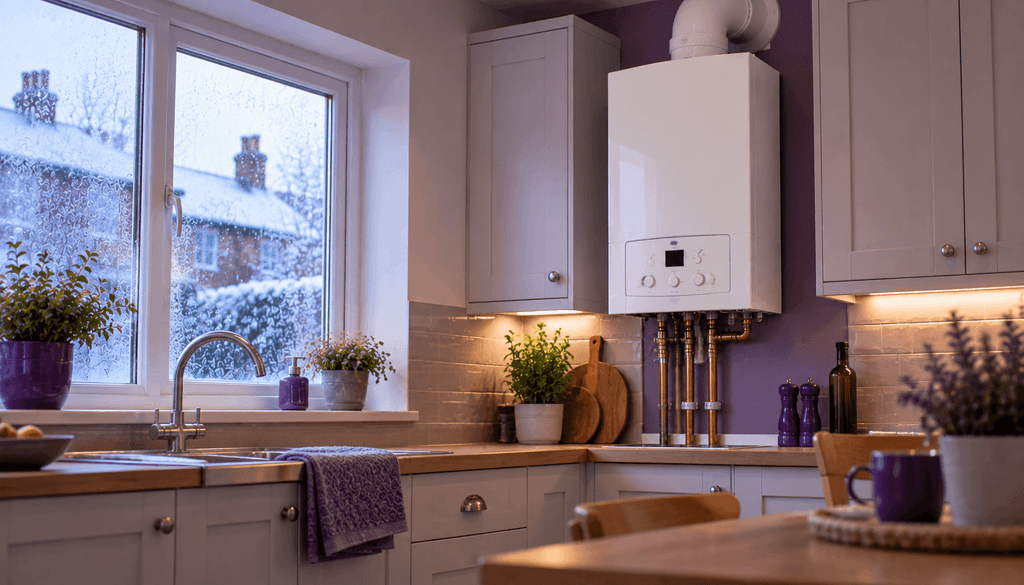
Weather compensation vs load compensation at a glance
| Weather compensation | Load compensation | |
| What does it monitor? | Outdoor temperature | Indoor room temperature |
| What is it responding to? | Changing heat loss from the building | Difference between actual and desired room temperature |
| How does it respond? | Adjusts heating temperature as outdoor conditions change | Adjusts heating temperature as the room approaches or moves away from its target |
| Does it need an outdoor sensor? | Sometimes; some controls use internet weather data | No |
| Does it use a room thermostat? | Depends on the system | Yes |
| Can both be used together? | Yes, with compatible controls | Yes, with compatible controls |
The exact way these features operate depends on the boiler and control system.
How does weather compensation work?
Your home loses heat to the outdoors. The colder it is outside, the greater the difference between the indoor and outdoor temperatures and, generally, the more heat the property loses.
Weather compensation uses outdoor temperature information to adjust the heating system accordingly.
Imagine you want your home to stay at 20°C.
If it’s 12°C outside, your home may only need relatively warm water circulating through the radiators. If the outdoor temperature falls to -2°C, the building loses heat more quickly, so hotter radiator water may be required.
The system makes these adjustments automatically rather than leaving the boiler at the same flow temperature throughout autumn, winter and spring.
Depending on the control, outdoor temperature can be measured by a physical sensor or obtained using internet weather data. Some manufacturers use both approaches on different control setups.
What is a weather-compensation heating curve?
Weather compensation needs a way to decide how hot the heating water should be at different outdoor temperatures. This relationship is commonly called a heating curve.
The easiest way to think about the heating curve is as a set of instructions telling the system:
“The colder it gets outside, the hotter I need the radiator water to be.”
A purely illustrative heating curve might look like this:
| Outdoor temperature | Heating flow temperature |
| 15°C | 35°C |
| 10°C | 42°C |
| 5°C | 50°C |
| 0°C | 58°C |
These aren’t recommended settings. The appropriate relationship depends on the property and heating system.
If the heating curve is set too high, the boiler may send hotter water around the radiators than necessary. Set it too low and the home may warm too slowly or struggle to reach the desired temperature in cold weather.
The aim is to provide enough heat to replace what the building is losing without unnecessarily overheating the heating water.
How does load compensation work?
Load compensation approaches the problem from inside the house.
A traditional room thermostat can operate relatively simply:
Room too cold → heating on.
Target temperature reached → heating off.
A compatible load-compensating control can give the boiler more useful information.
Imagine the thermostat is set to 20°C and the room is currently 16°C. There’s a large difference between the actual and desired temperature, so significant heating is required.
Later, the room reaches 19.5°C. The system now needs much less heat to reach and maintain 20°C. Instead of continuing to heat the radiators to the same high temperature until the thermostat switches the boiler off, load compensation can reduce the boiler’s heating temperature as the room approaches its target.
Why can compensation controls improve boiler efficiency?
A boiler doesn’t need the same heating-water temperature throughout the year.
A freezing winter morning places much greater demand on the heating system than a mild autumn afternoon. Sending very hot water through the radiators regardless of conditions can therefore be unnecessary.
Both types of compensation can reduce the flow temperature when the home needs less heat.
That’s particularly useful with a condensing boiler.
Lower flow temperatures generally lead to lower temperatures in the water returning to the boiler. Cooler return water allows a condensing boiler to recover more heat from its combustion gases rather than allowing that heat to escape through the flue. Lower flow temperatures produce lower return temperatures, helping the boiler operate more efficiently.
That doesn’t mean either control will reduce every home’s gas use by a fixed percentage. The result depends on the property, heating system, existing controls, settings and how the heating is used.
What’s the practical difference between weather and load compensation?
The biggest difference is when and where they detect changing heating demand.
Weather compensation reacts to conditions outside. If outdoor temperature falls, it can respond before that colder weather has fully affected the indoor temperature.
Load compensation gets direct feedback from inside the property. It knows how far the measured room temperature is from the temperature you’ve requested.
You can think of them like this:
Weather compensation asks: “How cold is it outside, and how much heat is the building likely to lose?”
Load compensation asks: “How warm is the room now, and how far are we from the temperature the homeowner wants?”
Neither approach is simply measuring the same thing in a different way.
Is weather compensation or load compensation better?
There isn’t one control that’s automatically the better option for every heating system.
Weather compensation can react to changes in outdoor conditions before the room temperature has changed significantly. Once configured appropriately for the property, it can continuously adjust heating temperatures as the weather changes.
Load compensation has the advantage of direct indoor feedback. If the controlled room is already close to its desired temperature, the control knows that relatively little additional heat is needed.
The suitability of either option also depends on the boiler and controls. A particular boiler may support one type through its manufacturer’s own communication system, while another may work with compatible third-party controls.
For that reason, compatibility and correct setup can matter as much as choosing between the two technologies.
Can you use weather and load compensation together?
Yes. Some heating-control systems combine information from indoors and outdoors.
For example, a system might use outdoor temperature to establish how much heat the property is likely to need while also monitoring the actual room temperature and adjusting its operation accordingly.
Vaillant’s sensoROOM system, for example, combines enhanced load compensation with internet weather data, while other Vaillant controls can use a dedicated outdoor sensor.
This doesn’t mean you can simply install any weather-compensating control alongside any load-compensating thermostat. The controls and boiler need to be designed to communicate and operate together.
Where does OpenTherm fit in?
OpenTherm can be confusing because it’s often mentioned alongside load compensation, but it isn’t another type of compensation.
OpenTherm is a communication protocol. In simple terms, it’s a way for compatible heating controls and boilers to exchange more detailed information.
A basic on/off thermostat essentially tells the boiler whether there’s a demand for heating. A compatible modulating control can communicate more precisely with the boiler so that the heating-water temperature or output can be adjusted according to demand.
Load compensation can use this type of communication, but OpenTherm isn’t the only way to achieve it. Some boiler manufacturers use their own communication protocols.
The important point for homeowners is therefore compatibility, rather than assuming that any smart thermostat will provide compensation simply because it can control the boiler.
Why might your radiators feel cooler with compensation controls?
Radiators don’t have to feel extremely hot to heat a home.
If it’s mild outside or your room is already close to its desired temperature, a compensation control may deliberately reduce the temperature of the water circulating through the radiators.
They might consequently feel warm rather than very hot.
That can actually be a sign that the system is doing what it’s supposed to do: supplying enough heat to maintain comfort without heating the water more than necessary.
The heating may also operate more steadily instead of repeatedly heating the radiators to a high temperature and then switching off.
If the property consistently fails to reach its desired room temperature, however, the control settings or heating system may need checking.
Will weather or load compensation work with any boiler?
No. You need to check compatibility for the specific boiler and control.
A thermostat being described as “smart” doesn’t automatically mean it provides load or weather compensation. Smart thermostats can offer features such as app control, scheduling and geofencing without necessarily controlling boiler flow temperature in the same way.
Before choosing a compensation control, check:
- the exact boiler model;
- the exact thermostat or controller;
- which type of compensation the combination supports;
- whether an outdoor sensor or internet connection is required;
- which communication protocol the boiler uses; and
- whether the heating system has multiple zones or a hot-water cylinder.
Manufacturer instructions should explain compatible controls and the available functions.
Professional installation and setup can also be important. A sophisticated weather-compensation system with an unsuitable heating curve won’t necessarily perform better than a simpler control that’s correctly configured for the property.
Frequently asked questions
What is the main difference between weather and load compensation?
Weather compensation adjusts heating according to outdoor temperature. Load compensation responds to indoor temperature and how far it is from the thermostat setting. Both can adjust boiler heating temperature rather than relying on one fixed temperature.
Does weather compensation need an outdoor sensor?
Not always. Some systems use a physical outdoor temperature sensor, while others can obtain local weather information through an internet-connected control.
Does load compensation work with any thermostat?
No. The thermostat or control needs to be able to communicate appropriately with the boiler. A basic on/off thermostat doesn’t automatically provide load compensation.
Can weather and load compensation work together?
Yes. Compatible heating controls can use both indoor and outdoor information when determining how much heat the system requires. Some current manufacturer control systems combine both functions.
Will compensation controls make my radiators cooler?
They can. When less heat is required, the control may reduce the heating-water temperature. The radiators can therefore feel cooler while still providing enough heat to maintain the desired room temperature.
Do compensation controls guarantee lower heating bills?
No. They can help the heating system avoid unnecessarily high temperatures and improve boiler operation, but actual savings depend on the property, boiler, existing controls, system setup and heating habits.
Sources
UK Government, Heating controls: compensation and time proportional and integral (TPI) controls (https://www.gov.uk/government/publications/heating-controls-compensation-and-time-proportional-and-integral-tpi-controls
Accurate as of: 3 October 2026