

Improving boiler efficiency can help reduce the amount of gas you use, but the biggest savings don’t always come from changing the boiler itself. Better heating controls, lower heat loss and a properly maintained system can all make a difference.
Start with low-cost changes: check whether your central-heating flow temperature is unnecessarily high, use your thermostat effectively and address obvious draughts or insulation problems. Expensive upgrades should generally be considered when there’s a clear reason to do so.
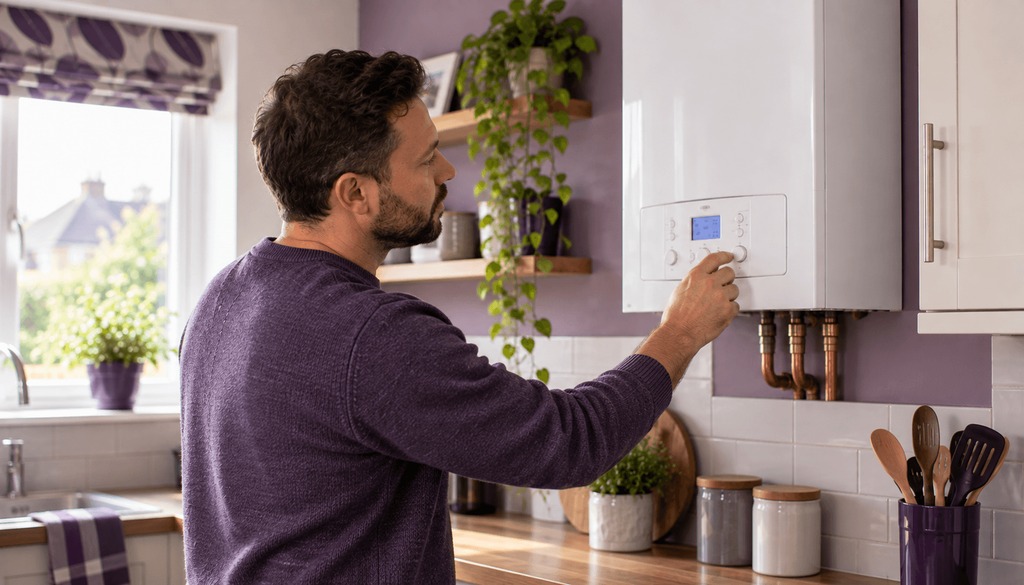
What does boiler efficiency mean?
Boiler efficiency describes how much of the energy in the fuel is converted into useful heat. A more efficient boiler needs less gas to provide the same amount of heat.
Modern condensing boilers recover heat from combustion gases that would otherwise be lost through the flue. They work particularly efficiently when the water returning from the radiators is cool enough to allow more heat to be recovered.
However, boiler efficiency and heating costs aren’t the same thing. Even an efficient boiler can use a lot of gas if the home loses heat quickly or is heated unnecessarily. Reducing heat demand is therefore just as important as improving the boiler’s operation.
1. Check your central-heating flow temperature
The central-heating flow temperature is the temperature of the water leaving the boiler and travelling to your radiators.
Reducing an unnecessarily high flow temperature can improve the efficiency of a suitable condensing boiler. Cooler water returning to the boiler allows it to recover more heat from its combustion gases.
There isn’t one ideal setting for every home. A well-insulated property with adequately sized radiators may heat comfortably at a lower temperature, while an older home with greater heat loss may need hotter water during cold weather.
For a suitable combi boiler, you can gradually reduce the central-heating setting and check whether the home still warms up adequately. Make a note of the original setting so you can restore it if necessary. If rooms become too cold or take an unreasonable amount of time to heat, the setting may be too low.
Don’t confuse central-heating flow temperature with domestic hot-water temperature. These are usually separate controls on a combi boiler.
If you have a system or conventional boiler with a hot-water cylinder, lowering a shared boiler temperature too far can affect the cylinder’s ability to reach a safe temperature. It is recommended that a conventional boiler’s flow temperature should not be set below 65°C where it needs to heat a cylinder to 60°C.
If you’re unsure which setting controls what, consult the manual or ask your heating engineer.
2. Use your thermostat and heating schedules effectively
Heating controls help ensure your boiler produces heat when and where it’s needed.
A room thermostat controls heating demand according to the temperature you set, while a programmer or smart thermostat allows you to schedule heating around your routine.
To reduce unnecessary heating, set schedules around when you normally need the home warm, avoid unnecessarily high room temperatures and review your settings when your routine changes. TRVs can also help prevent individual rooms from becoming warmer than needed.
A smart thermostat can make these adjustments more convenient, particularly if your schedule changes frequently. However, it won’t automatically deliver large savings if you already use your existing controls effectively.
Some compatible systems also support weather or load compensation. These controls adjust the boiler’s water temperature according to outdoor conditions or heating demand, helping suitable boilers operate at lower temperatures when full output isn’t needed.
3. Reduce heat loss through insulation and draught-proofing
Insulation doesn’t directly change the boiler’s efficiency, but it reduces the amount of heat the boiler needs to produce.
Heat escapes through poorly insulated roofs, walls, floors, windows and gaps around the building. Reducing these losses can help your home stay warm for longer.
Depending on your property, useful improvements may include loft insulation, appropriate wall or floor insulation, draught-proofing around doors and windows, and insulating accessible hot-water pipework.
The most worthwhile measures depend on what’s already installed. A home with little loft insulation may have a much greater opportunity for improvement than one that’s already well insulated.
Don’t block purpose-provided ventilation or air vents when draught-proofing. Ventilation requirements must be maintained, particularly around fuel-burning appliances.
4. Make sure your radiators are heating properly
Your boiler can be operating correctly while the heating system distributes heat poorly.
If radiators are cold, heat unevenly or take much longer to warm up than others, the cause may be trapped air, poor balancing, a valve problem, sludge or another circulation issue.
| Radiator symptom | Possible issue | Appropriate next step |
| Cold at the top | Trapped air | Bleed if appropriate |
| Some heat much faster than others | System imbalance | Consider balancing |
| One remains cold | Valve, air or local circulation issue | Check accessible controls |
| Cold areas at the bottom | Possible sludge or poor circulation | Have the cause assessed |
| All struggle to heat | Controls, boiler or circulation issue | Check basic settings and seek advice |
Bleeding and balancing can improve heat distribution where those problems are present, but they aren’t universal energy-saving measures. A radiator that already heats properly won’t necessarily become more efficient simply because it’s bled again.
Similarly, a powerflush should be considered when there’s evidence of contamination or circulation problems, not as a routine upgrade that guarantees lower bills.
5. Keep your boiler serviced and address faults
Regular servicing helps ensure your boiler is operating safely and correctly.
A service may include checking the appliance’s operation, controls, combustion performance and relevant components, as well as identifying developing faults. It is recommended to get your boiler serviced annually, and gas appliances, flues and pipework should be regularly maintained and serviced at least annually by a Gas Safe registered engineer.
Servicing shouldn’t be presented as a guaranteed way to reduce your gas bill by a fixed percentage. However, identifying and correcting a fault that affects performance can help restore proper operation and prevent a more expensive problem developing.
If your boiler is making unusual noises, losing pressure, repeatedly shutting down or failing to heat the home properly, have the underlying issue investigated rather than compensating by increasing the thermostat or flow temperature.
Gas work must be carried out by a Gas Safe registered engineer who is competent for the work involved. Don’t remove the boiler casing or attempt to adjust gas valves or internal combustion settings yourself.
6. Check whether your heating system is appropriately sized
An appropriately designed heating system should meet the home’s heat demand without relying on unnecessarily high temperatures or excessive boiler output.
A substantially oversized boiler may cycle more frequently if it cannot reduce its output sufficiently. However, a larger headline kW rating doesn’t automatically mean higher running costs. Combi boilers, for example, often have a high maximum output for domestic hot water, while their central-heating output can be lower.
If you’re replacing a boiler, ask the installer to assess the property’s heat demand rather than simply fitting a new appliance with the same maximum output as the old one.
Radiator sizing also matters. Larger or more effective radiators may allow a system to heat the home adequately at lower flow temperatures, but replacing functioning radiators solely for a small efficiency improvement may not be financially worthwhile.
7. Consider system cleaning or a magnetic filter when needed
Sludge and corrosion products can affect circulation and contribute to heating-system problems.
If there’s evidence of contamination, an engineer may recommend appropriate cleaning, inhibitor treatment or magnetic filtration. These measures can help protect the system and restore proper circulation where contamination is causing problems.
However, a magnetic filter doesn’t remove every type of contamination, and a powerflush isn’t necessary for every heating system. Neither should be treated as a guaranteed way to reduce heating costs.
The best approach is to identify the actual problem first, then choose the appropriate treatment.
8. When is replacing an old boiler worthwhile?
Replacing an older, inefficient non-condensing boiler with a modern condensing model can reduce the amount of gas needed to provide the same useful heat.
However, replacing a relatively modern, functioning condensing boiler solely to gain a small efficiency improvement may not provide a worthwhile financial return.
Consider the existing boiler’s age, condition, repair history, efficiency and expected remaining life, as well as the cost of replacement.
If the boiler is unreliable, expensive to repair or no longer suitable for the property, replacement may make more sense. If it’s working well, improving controls, reducing heat loss and maintaining the system may be more cost-effective.
How can you tell whether the changes are saving money?
Compare gas consumption in kWh, rather than relying only on the amount shown on your bill.
Energy prices can change, so a lower bill doesn’t necessarily mean you’ve used less gas, and a higher bill doesn’t necessarily mean your heating has become less efficient.
Use your supplier account, smart-meter data or gas bills to compare consumption over similar periods. Try to account for differences in weather, occupancy and hot-water use.
For example, if you reduce your flow temperature, compare gas consumption over several days with similar outdoor temperatures while keeping your thermostat and heating schedule broadly consistent.
You can estimate the financial saving using your own tariff:
Gas saved (kWh) × your unit rate (£/kWh) = estimated saving
Frequently asked questions
What is the most efficient temperature to run a gas boiler?
There isn’t one ideal setting for every property. A suitable condensing boiler generally operates more efficiently with lower return temperatures, but the flow temperature must still be high enough to heat the home adequately. Systems with hot-water cylinders require additional care.
Does turning down the boiler temperature save money?
It can, particularly if a condensing boiler’s central-heating flow temperature is higher than necessary. The saving depends on the original setting, the heating system and whether the home remains comfortably warm.
Does bleeding radiators improve boiler efficiency?
Bleeding can restore proper heating if trapped air is preventing a radiator from warming up. It doesn’t necessarily improve efficiency if the radiator is already working correctly.
Will a new boiler reduce my heating bills?
A modern condensing boiler can use less gas than an older inefficient model, but savings depend on what you’re replacing and how the system is used. Replacing a functioning modern condensing boiler may offer a much smaller improvement.
Sources
GOV.UK, Improving boiler standards and efficiency consultation (https://www.gov.uk/government/consultations/improving-boiler-standards-and-efficiency/)
GOV.UK, Heat and Buildings Strategy (https://www.gov.uk/government/publications/heat-and-buildings-strategy/heat-and-building-strategy-accessible-webpage)
HSE, Gas safety – Home owners (https://www.hse.gov.uk/gas/domestic/faqownerocc.htm)
Accurate as of: 8 September 2026