
Yes, you can replace a roof that already has solar panels. In most cases, the existing panels can be temporarily removed, the roof replaced, and the solar panels reinstalled afterwards. Provided the equipment is still in good condition and compatible with the new roof, you won’t necessarily need to purchase a new solar system.
However, replacing a roof with solar panels requires more planning than a standard roof replacement. You’ll need to coordinate a roofing contractor and solar installer, arrange safe removal and storage, and make sure the system is properly tested before being switched back on. This guide explains how the process works, what it costs, and what to check when comparing quotations.
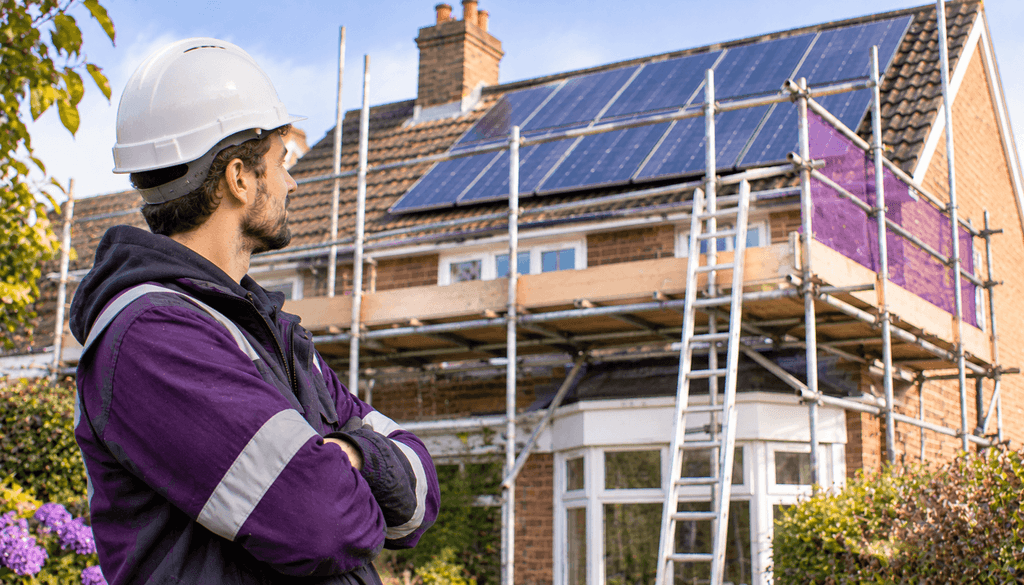
How does roof replacement work when you have solar panels?
Replacing a roof with solar panels generally involves six stages. The roofing work itself is largely unchanged, but the solar installation needs to be safely removed and reinstated.
- Inspect the roof and solar system: The roofer assesses the roof’s condition, while the solar installer examines the panels, mounting equipment and electrical connections.
- Arrange scaffolding and agree responsibilities: Both contractors establish when they’ll need access and who is responsible for each stage of the work.
- Disconnect and remove the solar panels: The solar installer safely isolates the system and removes the panels and any mounting components that would interfere with the roofing work.
- Replace the roof: The roofer removes the old covering, completes any necessary repairs and installs the new roofing materials.
- Reinstall the solar panels: The solar installer refits the panels using suitable mounting equipment and reconnects the system.
- Test and recommission the system: The installer carries out the necessary inspections and electrical tests before restoring normal operation.
For integrated solar panels, which form part of the roof covering rather than sitting above it, the process may be more complicated. These installations require particularly close coordination because removing the panels also affects the roof’s weatherproofing.
Who should remove and reinstall the solar panels?
Solar panel removal and reinstallation should be handled by an appropriately qualified and experienced solar PV installer.
Your original installer is a sensible first contact, particularly if the system is still under warranty. They may already have records of the electrical layout, mounting system and equipment specifications.
However, another competent solar installer can also undertake the work. It is recommended to use installers certified under the Microgeneration Certification Scheme (MCS) for domestic solar installations.
The responsibilities of the two contractors should be clearly separated:
- Roofing contractor: Removes and replaces the roof covering, completes structural repairs and ensures the finished roof is weatherproof.
- Solar installer: Safely disconnects, removes, reinstalls and recommissions the solar PV system.
Responsibility for roof hooks, flashing, brackets and penetrations should be agreed between both contractors before work begins.
It’s important not to treat solar panel removal as an ordinary roofing task. Solar panels can generate DC electricity whenever they’re exposed to light, even when the inverter is switched off. Electrical disconnection and handling require appropriate precautions.
How to coordinate the roofer and solar installer
One of the biggest challenges is ensuring that both contractors are available at the right time.
The solar panels must be removed before the roofer can begin work on the affected areas. Once the roof is finished, the solar installer must return to reinstall them.
If these visits aren’t coordinated, the project could be delayed while one contractor waits for the other.
Before accepting either quotation, establish:
- Who will act as the main project coordinator.
- When the panels will be removed.
- When roofing work is expected to begin and finish.
- Who will confirm that the new roof is ready for solar installation.
- When the panels will be reinstalled and tested.
- Who will arrange additional visits if delays occur.
You should also agree how unexpected problems will be handled. For example, the roofer might discover damaged timber beneath the old tiles, extending the project beyond its original schedule.
Ideally, both contractors should agree on a realistic timetable before scaffolding is erected.
How much does it cost to remove and refit solar panels?
Removing and reinstalling solar panels on a typical UK home can cost approximately £1,200–£2,500 for a system with 10–12 panels, based on indicative 2026 UK contractor and quotation guides.
This is not a verified national average. Actual prices vary depending on the number of panels, roof accessibility, mounting equipment and the services included.
Some contractors quote much less for removal and refitting labour alone, but charge separately for scaffolding, storage or electrical testing.
The roof replacement itself is an additional expense.
What should your quotations include?
When comparing quotations, it’s important to understand exactly what each contractor has included.
| Cost item | What should be included |
| Solar panel removal | Electrical isolation, dismantling and safe handling |
| Scaffolding | Erection, suitable access, hire period and dismantling |
| Temporary storage | Secure storage, transportation and insurance where applicable |
| Roof replacement | Roofing materials, labour, repairs and waste disposal |
| Mounting equipment | Replacement rails, brackets, hooks and flashing where needed |
| Solar panel refitting | Reinstallation, mounting checks and electrical reconnection |
| Recommissioning | Electrical inspections, testing and operational checks |
| Additional work | Agreed rates for unforeseen repairs or extended scaffolding hire |
A quotation covering removal only shouldn’t be compared directly with one covering the entire removal-and-refit process.
Ask each contractor for an itemised quotation and check whether VAT is included. Confirm which costs are fixed and which could change following an inspection.
Can both contractors share the same scaffolding?
In many cases, the roofer and solar installer can use the same scaffolding. This can reduce the cost and disruption of arranging separate access for each contractor.
However, the scaffolding must be suitable for both types of work.
The HSE requires scaffolding to be appropriately designed, erected and inspected by competent people. Its configuration must provide safe access for the tasks being undertaken.
Before arranging scaffolding, ask both contractors to agree on the requirements.
Consider the following:
- Can the same scaffolding provide safe access for removing and reinstalling the panels?
- Who will arrange and pay for it?
- How long will it remain in place?
- Are additional hire charges payable if the project is delayed?
- Will any alterations be required between the roofing and solar work?
- Is permission required if scaffolding extends onto a public pavement?
Sharing scaffolding isn’t automatically cheaper if it results in a considerably longer hire period.
Compare the total cost of the proposed arrangements rather than assuming that one installation will always offer the best value.
Where should solar panels be stored during roof replacement?
Once removed, the solar panels will need somewhere safe to remain until the new roof is ready.
Depending on the available space and expected duration of the work, they may be stored at your property or transported elsewhere.
On-site storage can avoid transportation costs, but requires enough secure space to protect the panels from accidental damage, theft and interference from other building work.
Off-site storage may be more practical for longer projects or properties with limited space. However, transportation and storage fees can increase the overall cost.
Before the panels are removed, confirm who is responsible for:
- Providing a suitable storage location.
- Transporting and handling the panels.
- Protecting equipment against accidental damage.
- Insuring the panels while they’re off the roof.
- Returning all components when installation resumes.
It’s sensible to photograph the panels before removal and record their serial numbers.
The installer should follow the manufacturer’s handling and storage instructions. Panels, connectors and other electrical components must be protected appropriately throughout the project.
Can you reuse the existing mounting rails and brackets?
You may be able to reuse the existing mounting equipment, but it shouldn’t be assumed that every component will be suitable for the new roof.
The solar installer needs to inspect the rails, brackets, hooks and fixings before deciding what can be reused.
For example, replacing concrete tiles with natural slate may require different roof hooks or flashing arrangements.
Existing components may also have deteriorated through corrosion, weather exposure or previous installation problems.
The installer should confirm that the mounting system is compatible with the new roof covering and that the roof can safely support the installation.
Any replacement components should be included in the quotation.
It’s also important to clarify who is responsible for the weatherproofing around the mounting points. The roofer’s guarantee and the solar installer’s workmanship warranty may cover different elements of the completed work.
What checks are needed before switching the solar panels back on?
Once the panels have been reinstalled, the solar system must be inspected and recommissioned.
Recommissioning involves checking that the equipment has been installed correctly, is electrically safe and operates as expected.
Depending on the system, the installer may need to:
- Inspect the panels, mounting components and electrical connections.
- Complete the appropriate electrical safety tests.
- Check the inverter and any associated equipment.
- Confirm that monitoring equipment is working.
- Verify that the system is generating electricity normally.
- Provide relevant test results and documentation.
If the system’s equipment, electrical configuration or generating capacity changes, further documentation, approvals or notifications may be required.
However, a straightforward like-for-like refit doesn’t automatically mean that a new MCS certificate or distribution network operator (DNO) application is necessary.
Will replacing your roof affect solar panel warranties?
Removing and reinstalling solar panels doesn’t automatically invalidate every warranty.
However, manufacturers and installation companies may have specific conditions concerning dismantling, alterations or work performed by third parties.
Before arranging removal, check the terms of your:
- Solar panel product and performance warranties.
- Inverter warranty.
- Mounting-system warranty.
- Original installation workmanship guarantee.
Contact the original installer or relevant manufacturer if you’re unsure whether the proposed work could affect your cover.
You should also check with your home insurer that the equipment remains appropriately covered while it’s being removed, transported or stored.
Will roof replacement affect Feed-in Tariff payments?
If your solar panels receive Feed-in Tariff (FIT) payments, it’s particularly important to check the rules before work begins.
Ofgem’s guidance states that replacing or temporarily removing generating equipment, including during roof repairs, does not in itself affect an installation’s compliance with the FIT scheme. However, the system must continue to meet the applicable requirements.
The treatment of your installation depends on the circumstances, including whether the equipment is returned to the same location and whether its generating capacity changes.
Contact your FIT licensee before removing the panels and ask whether any notifications or supporting documents are required.
Keep records of the removal, equipment details, dates and recommissioning.
You won’t generate solar electricity while the system is disconnected, so you’ll lose the associated electricity savings and generation income during that period.
If you receive Smart Export Guarantee (SEG) payments, you also won’t earn export payments for electricity that isn’t being generated and exported. Check your supplier’s terms if the installation changes.
Should you replace your old solar panels while replacing the roof?
Roof replacement provides an opportunity to assess whether your existing solar equipment is worth keeping.
If the panels are relatively new, working properly and suitable for reinstallation, reusing them will usually be the more economical option.
However, if they’re approaching the end of their expected lifespan, it may be worth comparing the cost of refitting them with purchasing a new system.
You can use current solar panel installation costs to assess whether the potential benefits of newer equipment justify the additional expense.
New solar panels may generate more electricity from the same roof area, but the extra output doesn’t necessarily make replacement financially worthwhile.
The condition of your inverter also matters. If it’s ageing or already showing signs of problems, you should consider potential solar inverter replacement costs when comparing your options.
Replacing equipment on a FIT-accredited installation requires particular care, because changes to generating capacity or other system details can affect the scheme requirements.
Checklist before replacing a roof with solar panels
Before accepting quotations and scheduling the work, use this checklist to make sure the main arrangements have been covered.
- Have the roof and existing solar system inspected.
- Obtain itemised quotations from the roofer and solar installer.
- Agree who is responsible for coordinating the project.
- Confirm the removal, roofing and reinstallation dates.
- Establish whether both contractors can share scaffolding.
- Check what happens if scaffolding hire needs to be extended.
- Agree on suitable panel storage and insurance arrangements.
- Confirm whether existing mounting components can be reused.
- Check warranties and any relevant FIT or export tariff requirements.
- Ensure the solar quotation includes recommissioning and documentation.
Getting these details agreed in writing can help prevent unexpected charges and disagreements about responsibility once work begins.
Frequently asked questions
Can you replace roof tiles without removing solar panels?
It may be possible to replace individual accessible tiles without removing the entire solar array. However, tiles directly beneath the panels can be difficult to reach. More extensive repairs or a complete roof replacement will usually require the affected panels to be removed.
How long does it take to remove and reinstall solar panels?
For a straightforward domestic system, removal and reinstallation may each take approximately a day, although larger or more complicated installations can take longer. The panels will remain disconnected while the roofing work takes place, so the total period depends on the roofing schedule and contractor availability.
Can you use a different solar installer to refit your panels?
Yes. You don’t necessarily have to use the original installer, provided the replacement contractor is competent and experienced with your equipment. However, check the original workmanship warranty and any manufacturer conditions before arranging the work.
Do solar panels need replacing when you replace the roof?
No. If your existing panels are serviceable, compatible with the new roof and safe to reinstall, they can generally be reused. The installer should inspect them and the mounting equipment before confirming whether replacement components are necessary.
Sources
Health and Safety Executive, Roof Work (https://www.hse.gov.uk/construction/safetytopics/roofwork.htm)
Health and Safety Executive, Scaffolds (https://www.hse.gov.uk/construction/safetytopics/scaffoldinginfo.htm)
Ofgem, Feed-in Tariffs: Guidance for FIT Generators (https://www.ofgem.gov.uk/guidance/feed-tariffs-guidance-fit-generators)
Accurate as of: 20 November 2026