
You can install solar panels on some conservatory roofs, but most traditional glass and polycarbonate conservatory roofs aren’t suitable for conventional solar panels without structural modifications. These roofs are often designed to be lightweight and may not safely support the additional weight and wind forces associated with solar equipment.
A conservatory with a properly constructed solid or tiled roof may be suitable, provided its supporting structure can carry the additional loads. Specialist solar glazing and lightweight panels are other possibilities, although their suitability depends on the roof design.
Before arranging an installation, the most important step is to have the conservatory’s structural capacity assessed by a suitably qualified professional.
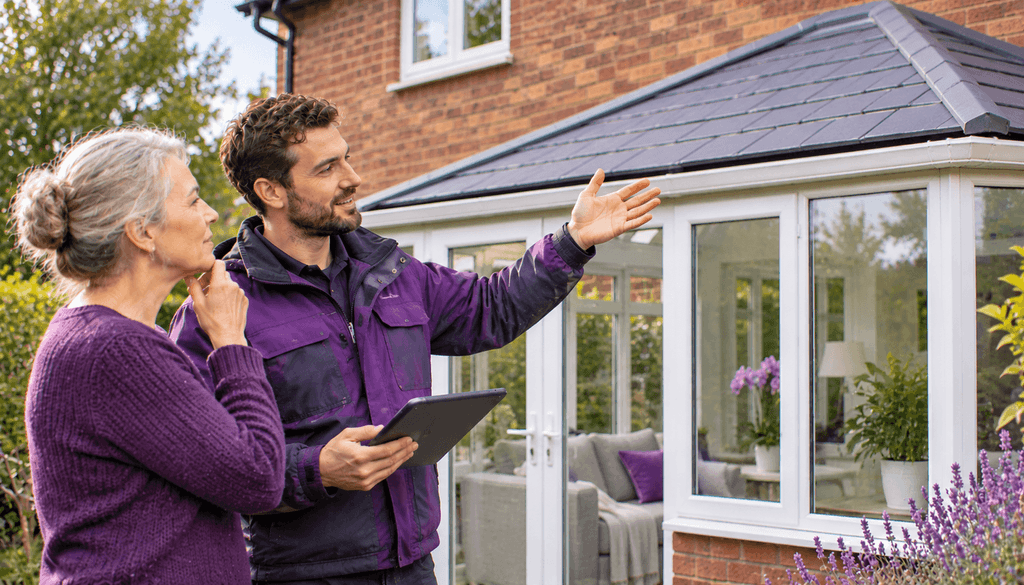
Which conservatory roofs can support solar panels?
The type of roof makes a significant difference to whether solar panels can be installed safely.
| Conservatory roof type | Suitability for solar panels | Main consideration |
| Glass roof | Usually unsuitable for standard panels | Fragility and limited mounting options |
| Polycarbonate roof | Usually unsuitable for standard panels | Lightweight supporting structure |
| Solid or tiled roof | Potentially suitable | Structural capacity and secure mounting |
| Flat solid roof | Potentially suitable | Roof loading, drainage and wind resistance |
| Specialist solar glazing | Possible with purpose-designed products | Structural compatibility and cost |
| Lightweight flexible panels | Depends on the installation | Attachment method and roof strength |
A roof’s appearance doesn’t confirm whether it’s strong enough for solar panels. Even solid roofs need to be checked before installation.
The roof’s ability to carry the additional load must be established and you may need to strengthen the roof.
Can you install solar panels on a glass conservatory roof?
Traditional glass conservatory roofs are generally unsuitable for mounting standard framed solar panels.
The problem isn’t simply the weight of the panels themselves.
A solar installation also includes mounting rails, brackets, cables and other equipment. These components introduce additional loads that the original conservatory may not have been designed to withstand.
Glass roofing also presents difficulties when securing the panels.
Unlike a conventional tiled house roof, a glazed conservatory may not have suitable structural members or fixing points for standard solar mounting systems.
There are also risks of damaging the glazing, compromising weatherproofing or creating problems during future maintenance.
Glass roofs must be treated carefully during any installation work. The Health and Safety Executive identifies fragile roofing materials as a significant risk for people working at height.
Don’t assume that strengthened or toughened glass makes an existing conservatory roof suitable for conventional solar panels.
The entire roof structure, including its supports and connections to the main building, needs to be considered.
Can you install solar panels on a polycarbonate conservatory roof?
Polycarbonate conservatory roofs are also generally unsuitable for conventional solar installations.
These roofs are popular because they’re lightweight and relatively inexpensive.
However, their supporting structures are often designed around the low weight of polycarbonate sheets.
Adding solar panels and mounting equipment may introduce loads beyond the original design.
The roof may also lack suitable fixing points, and attaching equipment incorrectly can cause leaks or damage.
Wind forces are another important consideration.
Solar panels can experience uplift forces during strong winds, placing additional stress on their mounting points and the underlying structure.
Even if the polycarbonate covering can tolerate some additional weight, the supporting framework may not be adequate.
For these reasons, a traditional polycarbonate conservatory roof is rarely the most practical location for standard solar panels.
Can you put solar panels on a solid conservatory roof?
A solid or tiled conservatory roof is generally a more realistic option.
These roofs often have more substantial supporting structures and may provide suitable surfaces for conventional solar mounting systems.
However, they aren’t automatically strong enough.
Some conservatory roof conversions use lightweight tiles specifically to avoid placing excessive loads on the original structure.
Although the roof looks similar to a conventional house roof, it may still have relatively lightweight framing underneath.
A structural assessment should consider:
- The weight of the solar panels and mounting equipment.
- The strength of the roof supports.
- The conservatory’s walls and supporting framework.
- Wind and snow loading.
- The condition of existing materials and fixings.
- Whether the structure can accommodate installation and maintenance safely.
The installer may need input from a structural engineer before confirming that the installation is possible.
What about a flat conservatory roof?
Solar panels can potentially be installed on a flat solid conservatory roof.
However, the mounting system must be suitable for the roof’s construction.
Some flat-roof systems use additional ballast to hold panels in position. This can introduce substantial extra weight.
The design must also account for wind forces, drainage, waterproofing and access for maintenance.
A flat roof shouldn’t be assumed suitable simply because there’s enough physical space for the panels.
Can you use lightweight solar panels instead?
Lightweight solar panels may be worth considering when conventional framed panels are too heavy.
Some products use flexible or lightweight materials that reduce the load placed on the roof.
However, lightweight doesn’t automatically mean safe.
Even a lighter panel must be secured correctly and withstand wind and weather conditions.
The attachment method must also be compatible with the conservatory roof.
For example, adhesive mounting may not be suitable for every roof covering, and unsuitable fixings can compromise weatherproofing.
Flexible panels can also differ from conventional framed panels in durability, efficiency and warranty conditions.
Before choosing a lightweight product, confirm that both the panel manufacturer and the roof manufacturer support the proposed installation method.
A suitable structural assessment may still be required.
What about solar glass for conservatories?
Specialist solar glazing offers a different approach to generating electricity from a conservatory roof.
Instead of mounting conventional solar panels above existing glass, photovoltaic technology is incorporated into purpose-designed glazing.
These products are sometimes called building-integrated photovoltaics (BIPV).
Depending on the design, solar glazing can allow some daylight through while generating electricity.
This may make it attractive for conservatories where maintaining natural light is important.
However, solar glazing isn’t a simple replacement for every existing glass panel.
Its suitability depends on the glazing specification, framing, electrical installation and structural design.
The amount of light transmitted also varies between products.
Some solar glazing provides partial transparency, while other designs substantially reduce the light entering the conservatory.
Specialist installation costs may be considerably higher than those of conventional solar panels.
For most homeowners, solar glazing is more realistic to consider during a new conservatory build or substantial roof renovation than as a straightforward retrofit.
How much does it cost to install solar panels on a conservatory roof?
The cost depends heavily on the existing roof and the type of solar installation.
A conservatory that already has a suitable solid roof may only require the solar equipment and associated installation work.
A traditional glazed conservatory could require extensive structural changes or a complete roof replacement.
The Federation of Master Builders provides the following indicative UK roof replacement costs.
| Conservatory roof work | Indicative cost |
| Polycarbonate roof replacement | £2,000–£4,000 |
| Glass roof replacement | £3,000–£5,000 |
| Solid or tiled roof replacement | £4,000–£6,000 |
| Structural strengthening | Depends on the property |
| Solar panel installation | Additional cost depending on system size |
These are approximate conservatory roof replacement costs, not quotations for solar installation. Structural alterations, electrical work and other expenses may increase the total.
A new solar installation involves additional costs for panels, mounting equipment, an inverter, cabling and labour.
Specialist solar glazing may require a bespoke quotation.
Is replacing the roof just for solar panels worth it?
Not always.
If your existing conservatory roof is in good condition, replacing it solely to support solar panels could make the project difficult to justify financially.
This is particularly true if the roof has limited space or experiences substantial shading.
However, if you already intend to replace an ageing conservatory roof with a solid construction, incorporating solar panels into the project may be more practical.
It’s worth comparing the cost and expected electricity generation with alternative locations before committing to the work.
Do you need planning permission for conservatory solar panels?
Solar panels on domestic buildings are often covered by permitted-development rights, meaning separate planning permission may not be required.
However, the rules differ across the UK and depend on the property and installation.
| UK nation | Main planning consideration |
| England | Permitted-development rights apply subject to conditions, including updated rules introduced in August 2026 |
| Wales | Domestic solar installations are often permitted development, subject to limits and restrictions |
| Scotland | Separate permitted-development rules apply to dwellings and buildings within their grounds |
| Northern Ireland | Domestic solar equipment may qualify as permitted development under the applicable planning order |
In England, updated solar permitted-development rules came into effect on 27 August 2026.
A transitional period runs until 27 August 2027, during which installations may follow either the previous or the updated rules, provided all the conditions of the chosen route are satisfied.
Wales, Scotland and Northern Ireland have their own requirements covering matters such as equipment position, roof projections and protected buildings.
Listed buildings, conservation areas and properties with restricted permitted-development rights may require additional permissions.
The precise classification of the conservatory also matters. An attached conservatory and a separate outbuilding may not fall under identical provisions.
Check the applicable rules with your local planning authority before installation.
Do Building Regulations apply?
Planning permission and Building Regulations are separate matters.
Even where solar panels qualify as permitted development, the installation must still meet the applicable structural and electrical requirements.
The roof must be capable of supporting the additional equipment, and the work must not compromise the building’s safety or weather resistance.
Planning Portal and Welsh Government guidance both emphasise the importance of checking roof strength before installing solar panels.
A conservatory that was originally exempt from certain Building Regulations requirements doesn’t automatically make a later roof alteration or electrical installation exempt.
Your installer should explain which approvals, notifications and certificates are needed.
How much electricity can conservatory solar panels generate?
Electricity generation depends on the size of the installation and how much sunlight reaches the panels.
A conservatory roof may have less usable space than the main house roof.
Its shape can also limit the number of panels that can be fitted.
One important issue is shading from the main property.
Because conservatories are often attached to the rear of a house, the building itself may block sunlight from part of the conservatory roof during the day.
Nearby trees, fences and neighbouring buildings can also reduce generation.
The main factors affecting performance include:
- Available roof space.
- Roof orientation and angle.
- Shading throughout the day and year.
- Solar panel capacity and efficiency.
- The location of the property.
A qualified installer should provide an estimate based on the actual proposed system rather than relying on a generic output figure.
Will solar panels make a conservatory darker?
Potentially.
Conventional solar panels are opaque and block sunlight passing through the section of roof they cover.
Installing them over a glazed roof would therefore reduce the amount of natural light entering the conservatory.
The extent depends on the number, size and positioning of the panels.
This could be beneficial for a conservatory that regularly overheats in summer, but it may also make the room darker during winter.
Specialist solar glazing may allow some light through, although transparency varies between products.
For solid or tiled roofs, the issue is generally less important because the roof covering already blocks most direct sunlight.
What are the alternatives to installing solar panels on a conservatory?
If the conservatory roof isn’t suitable, there may be better locations elsewhere on the property.
| Alternative | Main advantage | Main consideration |
| Main house roof | Often provides more space | Structural suitability and shading |
| Garage or outbuilding roof | Keeps panels off the conservatory | Roof strength and mounting |
| Ground-mounted panels | More flexibility over positioning | Garden space and planning restrictions |
| Solar carport | Can be designed to support panels | Additional construction costs |
| Purpose-built solar canopy | Combines shelter with generation | Requires suitable foundations and design |
The main house roof is often the most straightforward alternative, especially if it has a large, relatively unshaded area.
Garage and outbuilding roofs can also be suitable, provided they’re structurally adequate.
Ground-mounted systems offer more flexibility but need sufficient outdoor space.
Is installing solar panels on a conservatory worth it?
For most traditional glass or polycarbonate conservatories, conventional solar panels aren’t the most practical option.
The roof may require structural strengthening or replacement, making installation more expensive than using a suitable roof elsewhere.
However, a conservatory with a properly engineered solid roof could be a reasonable location, particularly if it receives plenty of sunlight.
Specialist solar glazing is another possibility for homeowners planning a new conservatory or major renovation.
Before proceeding, obtain a structural assessment and compare quotations with the likely electricity generation.
If the main house or another building has a suitable roof, that will often be the simpler and more economical place to install solar panels.
Frequently asked questions
Can solar panels be installed on a glass conservatory roof?
Conventional framed solar panels are generally unsuitable for traditional glass conservatory roofs without structural modifications. Specialist solar glazing may be possible with a purpose-designed system.
Can you put solar panels on a polycarbonate roof?
Most polycarbonate conservatory roofs aren’t designed to support conventional solar panels. A professional assessment is needed before considering any alternative mounting arrangement.
Can a tiled conservatory roof support solar panels?
Potentially, but the roof covering alone doesn’t determine suitability. The underlying roof structure, walls and supports must be capable of carrying the additional loads.
Are lightweight solar panels suitable for conservatories?
They may be suitable for certain purpose-designed installations. However, reduced weight doesn’t eliminate the need to assess structural capacity, wind forces and attachment methods.
Can solar panels power a conservatory?
Yes. Solar panels installed on a suitable part of the property can contribute electricity used by appliances and other equipment in the conservatory. They don’t have to be mounted directly above the room.
Do conservatory solar panels need planning permission?
Not necessarily. Some installations qualify as permitted development, but the rules depend on the UK nation, property type and proposed equipment. Building Regulations and structural requirements may still apply.
Sources
Planning Portal, Solar Panels: Building Regulations (https://www.planningportal.co.uk/permission/common-projects/solar-panels/building-regulations/)
Planning Portal, Planning Permission for Solar Equipment Mounted on Buildings (https://www.planningportal.co.uk/permission/common-projects/solar-panels/planning-permission-solar-equipment-mounted-on-a-house-or-a-block-of-flats-or-on-a-building/)
Planning Portal, Solar Photovoltaics and Solar Glazing (https://www.planningportal.co.uk/planning/sustainability-and-planning/home-energy-generation/solar-electricity-photovoltaics/)
Health and Safety Executive, Fragile Surfaces (https://www.hse.gov.uk/construction/safetytopics/fragile.htm)
Federation of Master Builders, Conservatory Costs: Roof Replacement and Upgrades (https://www.fmb.org.uk/resource/conservatory-costs-roof-replacement-costs-upgrades-and-extensions.html)
Welsh Government, Planning Permission: Solar Panels (https://www.gov.wales/planning-permission-solar-panels)
Scottish Government, Householder Permitted Development Rights: Installing Microgeneration Equipment (https://www.gov.scot/publications/circular-1-2024-householder-permitted-development-rights/pages/6/)
Northern Ireland, Planning (General Permitted Development) Order 2015 (https://www.legislation.gov.uk/nisr/2015/70/made)
Accurate as of: 13 November 2026