

If your boiler keeps losing pressure but you can’t see a leak, water may still be escaping somewhere you can’t easily see. Small leaks around radiator valves can evaporate before leaving an obvious puddle, while pipework beneath floors or inside walls can leak without immediately producing visible damp.
The problem can also be inside or around the boiler. A faulty expansion vessel or pressure relief valve (PRV), for example, can cause repeated pressure loss without water appearing underneath the appliance.
Losing a small amount of pressure occasionally isn’t necessarily a problem. Worcester Bosch says a heating system may need topping up once or twice a year. If you’re repressurising it much more frequently, however, the cause should be investigated rather than continually topping it up.
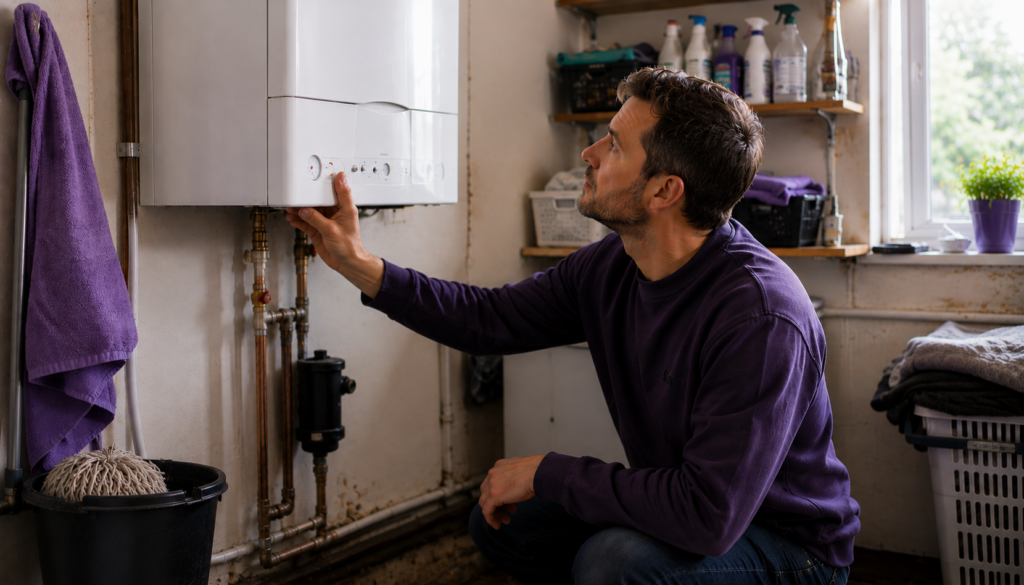
Why does a boiler lose pressure?
Most modern combi and system boilers operate as part of a sealed heating system containing pressurised water.
When the system is cool, Worcester Bosch recommends a pressure of around 1 to 1.5 bar for its boilers. Pressure naturally increases as the water heats and expands, before falling again as the system cools.
If the gauge keeps falling below its normal cold pressure, something is changing within that sealed system.
The most likely explanations when there is no obvious puddle are:
| Possible cause | What you might notice |
| Very small leak | Slight staining or corrosion around radiator valves or joints |
| Hidden pipe leak | Pressure falls but visible pipework remains dry |
| Expansion vessel problem | Pressure rises substantially when heating is on, then falls when cool |
| Pressure relief valve | Water or staining at the external discharge pipe |
| Recently bled radiators | One-off pressure drop afterwards |
| Internal boiler fault | Persistent pressure loss with no obvious external cause |
| System corrosion/gassing | Radiators repeatedly need bleeding |
1. A leak may be too small to see
“No visible leak” does not necessarily mean “no leak”.
One manufacturer explains that low pressure is normally associated with water loss or micro-leaks. These can be so small that the escaping water evaporates from warm components before it forms a noticeable puddle.
Radiator valves and air vents are common places for these tiny leaks. Instead of obvious water, you might see:
- Slight discolouration
- Rust or corrosion
- White or greenish deposits around a joint
- A valve that feels slightly damp
- Marks beneath a radiator
- Repeated air collecting in one radiator
Inspect accessible radiator valves, exposed pipe joints and the area beneath each radiator when the system is cool. Running a dry piece of kitchen roll around an accessible valve can sometimes reveal moisture that isn’t immediately visible.
Don’t dismantle valves or fittings simply to look for a leak.
2. The leak could be under the floor or inside a wall
Heating pipes don’t all run where you can see them.
Pipework can pass beneath floorboards, through walls or within floors. A small leak in one of these locations can reduce system pressure before enough water has escaped to create an obvious damp patch.
Possible clues include:
- Pressure that falls consistently over days
- Unexplained damp or staining
- Damage appearing on a ceiling below heating pipes
- An unusual warm or damp area of flooring
- A musty smell
- Pressure loss despite all visible radiator valves and joints remaining dry
The absence of these signs still doesn’t rule out a concealed leak.
If an engineer establishes that pressure is being lost from the heating circuit but can’t locate the source visually, specialist leak detection may be able to narrow down its location without immediately opening large sections of floors or walls.
3. The expansion vessel may be the problem
The expansion vessel helps a sealed heating system cope with the change in water volume as it heats and cools.
Some manufacturers say that the expansion vessel contains a diaphragm with pressurised air on one side. As heating water expands, the vessel accommodates that additional volume and helps control the rise in system pressure.
If the vessel loses its air charge or develops a fault, pressure can rise too much while the heating is running. The pressure relief valve may then release water. Once the system cools again, the pressure can end up too low.
A useful clue is therefore how the gauge behaves when the heating warms up.
One manufacturer says that if pressure rises by more than 1 bar as the heating reaches temperature, the expansion vessel may need repressurising by a service engineer.
This isn’t a homeowner repair. Diagnosing or repressurising an internal expansion vessel should be left to an appropriately qualified engineer.
4. Check the pressure relief valve discharge pipe
The pressure relief valve is a safety device designed to release water if boiler pressure becomes excessive.
The water it releases doesn’t necessarily appear underneath the boiler. It can be discharged through a pipe leading outside, which means you could repeatedly lose pressure indoors without seeing any water.
If you can safely identify the external discharge pipe, look for dripping water or staining around its outlet. Don’t block, cap or otherwise interfere with the pipe.
A PRV can also start passing water after being activated by another problem, such as excessive pressure caused by the expansion vessel. Finding water at the discharge pipe therefore doesn’t necessarily identify the original cause.
5. Have you recently bled your radiators?
If the pressure dropped once after you bled one or more radiators, there may be nothing wrong.
Bleeding releases trapped air from the heating system and can reduce system pressure. You may then need to repressurise the system according to the boiler manufacturer’s instructions.
The important distinction is what happens afterwards.
If you restore the correct cold pressure and it remains stable, bleeding the radiators may explain the drop. If the gauge continues falling over the following days or weeks, another issue is likely responsible.
Repeatedly needing to bleed radiators can itself be useful diagnostic information. Recurring radiator venting is a potential sign of system corrosion and gassing.
How can you find out where the pressure is going?
You don’t need to dismantle the boiler to collect useful information.
Start by recording the pressure when the heating system is completely cool. Then note what happens over the next few heating cycles.
Pay particular attention to three patterns:
Pressure falls slowly whether the heating is on or off
This can be consistent with water escaping somewhere in the heating system, including a small or concealed leak.
Check accessible radiator valves, exposed joints and pipework for moisture or staining.
Pressure rises sharply when the heating comes on, then drops when it cools
This pattern can point towards an expansion-vessel problem, particularly if the rise exceeds what the manufacturer considers normal.
An engineer should investigate it.
Pressure falls after the system has reached high pressure
Check the external pressure-relief discharge pipe for evidence that water has been released.
Again, the PRV itself may not be the underlying cause. Excessive system pressure can cause it to operate.
Keeping a simple record of the cold pressure, hot pressure and how quickly the pressure falls can give an engineer much more useful information than simply saying the boiler “keeps losing pressure”.
Can you repressurise the boiler yourself?
In many cases, yes, provided the manufacturer identifies repressurising as a homeowner procedure and you follow the instructions for your particular boiler.
Different boilers use different filling mechanisms. Worcester Bosch, for example, has models with external filling hoses, internal filling keys and keyless filling links.
Don’t assume the procedure is identical for every boiler. Check your user manual first.
More importantly, repressurising isn’t a repair for repeated pressure loss. It replaces the water that has been lost without addressing why it disappeared.
If you need to do it much more frequently than once or twice a year, we recommend contacting your installer.
Is it bad to keep topping up boiler pressure?
Repeated topping up shouldn’t become part of your normal heating routine.
If the pressure falls every few days or weeks, continually refilling the system can mask the underlying fault and delay a proper diagnosis.
Fresh water also introduces additional oxygen into the heating system and can dilute the chemical inhibitor used to protect components against corrosion.
The better approach is to record how quickly the pressure falls and have the cause investigated.
Could the boiler itself be leaking internally?
Yes. A leak or fault inside the boiler won’t necessarily produce an obvious puddle beneath it.
This is where homeowner troubleshooting should stop.
Do not remove the boiler casing to look for a leak. Internal boiler inspection and repairs should be carried out by someone appropriately qualified.
Is low boiler pressure dangerous?
Low water pressure itself is generally more likely to stop the boiler operating correctly than to create an immediate household emergency. Modern boilers can display a fault or stop operating when pressure becomes too low.
The more important question is why the pressure has fallen.
A concealed water leak can damage the property if left unresolved, while an internal boiler fault requires professional attention.
A falling water-pressure gauge is also different from a gas leak. If you smell gas, don’t continue troubleshooting the water pressure. Follow Gas Safe Register’s gas-emergency advice.
When should you call an engineer?
Get professional help if:
- You need to repressurise much more frequently than once or twice a year
- Pressure falls again shortly after topping up
- Pressure rises by more than about 1 bar when the system heats
- The external PRV discharge pipe is dripping
- You suspect an internal boiler leak
- You find signs of a concealed leak
- Radiators repeatedly fill with air
- The boiler shows recurring pressure-related fault codes
- Finding the cause would require removing the boiler casing
An engineer can distinguish between a boiler fault and pressure loss elsewhere in the heating system. If the boiler is ruled out but the system is still losing water, specialist leak detection may be the next step.
A simple troubleshooting order
If there is no visible leak, work through the problem in this order:
- Check the pressure when the system is cold. Compare it with the range in your boiler manual.
- Think about recent maintenance. If you’ve just bled radiators, a one-off pressure drop may be expected.
- Inspect accessible radiator valves and joints. Look for dampness, corrosion and staining rather than only puddles.
- Watch the pressure as the heating warms up. A large rise can point towards the expansion vessel.
- Check the external discharge pipe. Water here can indicate that the pressure relief valve has operated or is passing.
- Record how quickly pressure falls. Daily or weekly loss is more significant than occasional topping up.
- Call an engineer if it continues. Don’t keep repressurising indefinitely.
This sequence won’t diagnose every fault, but it can help distinguish a harmless one-off pressure drop from a recurring problem that needs investigation.
Frequently asked questions
Can a boiler lose pressure without a leak?
It can lose pressure without a visible leak. Water may be escaping through a micro-leak, concealed pipework or the pressure relief valve. An expansion-vessel or internal boiler fault can also be involved.
How often should I need to repressurise my boiler?
Worcester Bosch says its heating systems will usually require topping up once or twice a year. If you need to repressurise much more frequently, contact an installer to investigate the cause.
Why does my boiler lose pressure overnight?
A slow leak can continue regardless of whether the heating is running. Record the pressure when the system is cold and check it again later. If it repeatedly falls, inspect accessible fittings and arrange professional investigation if you can’t identify the cause.
Why does my boiler lose pressure when the heating is on?
Watch whether pressure first rises substantially as the system heats. An increase of more than 1 bar can indicate that the expansion vessel requires attention. Excessive pressure can also cause the pressure relief valve to discharge water.
Can bleeding radiators cause boiler pressure to drop?
Yes. Releasing air from radiators can reduce system pressure, so you may need to repressurise afterwards according to the manufacturer’s instructions.
Should I use leak sealer if I can’t find a leak?
Don’t add leak-sealing chemicals simply because the pressure is falling. Pressure loss can be caused by the expansion vessel, PRV or an internal boiler fault as well as a concealed heating-system leak. Establish the cause first and follow the boiler/system manufacturer’s guidance.
Sources
Worcester Bosch, Boiler Pressure — How often should I need to top up the pressure in the heating system? (https://www.worcester-bosch.co.uk/professional/support/troubleshooting/faqs/home-heating-faqs/how-often-should-i-need-to-top-up-the-pressure-in-the-heating-system)
Which?, What should your boiler pressure be? (https://www.which.co.uk/reviews/boilers/article/boiler-maintenance/what-should-your-boiler-pressure-be-aRAh43F9Jwjn)
Accurate as of: 17 August 2026