

A faulty boiler diverter valve can cause no hot water, no central heating, lukewarm water or radiators that heat up when you’re only running a hot tap. The valve is found inside a combi boiler and controls whether the boiler sends its heat towards your central heating or towards producing hot water.
Replacing a diverter valve on a UK combi boiler typically costs around £150–£350 including parts and labour, although the exact price depends on the boiler and the part that has failed. A valve that is simply sticking may sometimes be cleaned or repaired for less rather than completely replaced.
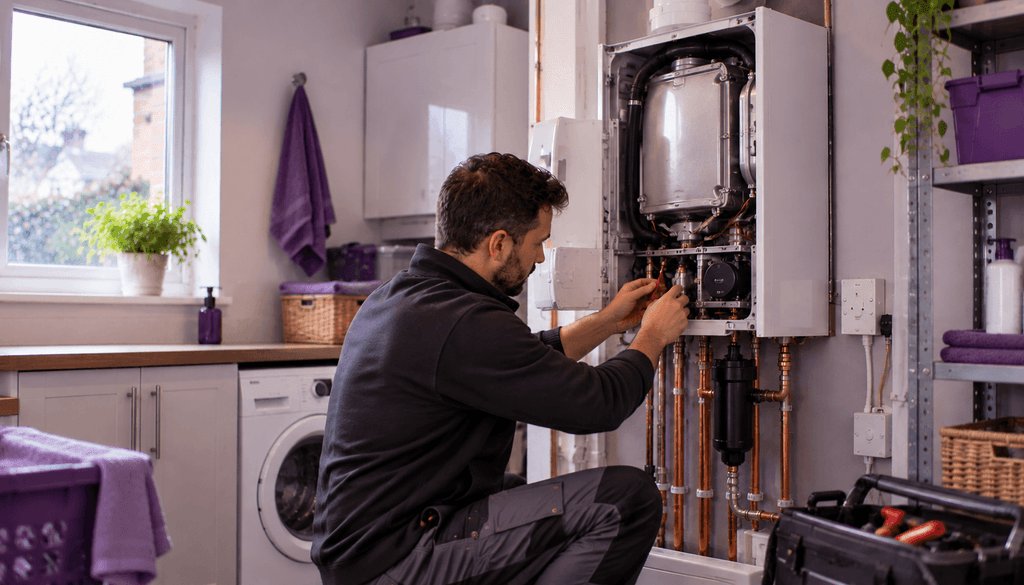
What does a boiler diverter valve do?
A combi boiler has two main jobs: heating your home and producing hot water for your taps, shower and bath.
The diverter valve helps the boiler switch between those jobs.
Think of it like a junction inside the boiler. When the central heating needs heat, the valve directs the boiler’s heated water towards the radiator circuit. When you open a hot tap, it switches position so that heat can instead be used to warm the mains water supplying the tap.
On a typical combi, the boiler’s own heating water doesn’t actually come out of your taps. Instead, it transfers its heat to the mains water through a separate heat exchanger.
Combi boilers generally prioritise hot water. If the heating is running and you turn on a shower, the boiler switches to producing hot water until the demand from the shower ends.
If the diverter valve sticks or fails to move properly, the boiler can struggle to send heat where it’s needed.
What are the signs of a faulty diverter valve?
The symptoms depend partly on the position in which the valve has become stuck.
| Symptom | Could the diverter valve cause it? | What may be happening |
| Heating works but there’s no hot water | Yes | Valve may not switch towards hot-water production |
| Hot water works but heating doesn’t | Yes | Valve may remain on the hot-water side |
| Radiators warm when you run a hot tap | Strong clue | Some heat may be passing into the heating circuit |
| Hot water only works when heating is on | Possible | Valve may not be switching correctly |
| Hot water is only lukewarm | Possible | Valve may be partially stuck |
| Hot water goes hot and cold | Possible, but less specific | Several other boiler faults can cause this |
These symptoms don’t prove that the diverter valve has failed. Sensors, controls, circulation problems and other boiler components can sometimes produce similar symptoms, so proper diagnosis matters.
Heating works but there’s no hot water
If your radiators heat normally but your taps remain cold or lukewarm, the diverter valve is one possible cause.
The valve may be stuck in a position that continues directing heat towards the central-heating circuit instead of switching over when you open a hot tap.
However, there are several other reasons you could have heating but no hot water (Heating Works but No Hot Water), including problems with hot-water demand detection or the plate heat exchanger.
This symptom alone therefore isn’t enough to diagnose a diverter-valve fault.
Hot water works but the heating doesn’t
The opposite can also happen.
If the valve becomes stuck towards the hot-water side, the boiler may still provide showers and hot taps while failing to send heat around the radiator circuit.
A diverter valve is consequently one possible explanation when hot water works but the central heating doesn’t (Hot Water Works but Central Heating Doesn’t: Causes and Fixes).
Before assuming the valve is responsible, check basic heating controls such as the thermostat and programmer. Boiler pressure and local radiator problems can also affect central heating.
Why do the radiators heat up when you run a hot tap?
This is one of the more useful clues that something may be wrong with the diverter valve.
Imagine the central heating is switched off and you take a shower. The boiler should direct its heat towards producing hot water.
If the diverter valve isn’t closing or moving completely, some heated water may also enter the radiator circuit. You could then notice one or more radiators becoming warm even though you haven’t requested central heating.
Checkatrade identifies heating and hot water operating together when they shouldn’t as a common indication of a stuck diverter valve.
It still isn’t definitive proof, but it’s useful information to give the heating engineer investigating the fault.
Why is my hot water only lukewarm?
A partially stuck diverter valve can sometimes cause lukewarm water rather than a complete loss of hot water.
Instead of directing the boiler’s heat fully towards producing hot water, the valve may allow some heat to pass into the central-heating circuit. Less heat is then available for the water coming from your taps.
Again, don’t assume the valve is responsible based on this symptom alone. A restricted plate heat exchanger, changing water flow and other faults can also cause poor or unstable hot-water temperatures.
What causes a boiler diverter valve to fail?
A diverter valve contains moving components and operates repeatedly throughout the life of a combi boiler. Eventually, parts can wear or stop moving freely.
Possible problems include:
- a sticking valve mechanism;
- wear to internal components;
- a failed actuator or motor that moves the valve;
- damaged seals or other valve components; and
- debris or deposits interfering with movement.
The exact design varies between boilers. A problem described generally as a “diverter-valve fault” also doesn’t necessarily mean that the complete valve assembly has failed.
An engineer needs to determine which part is causing the problem before deciding on the appropriate repair.
Can a diverter valve be repaired?
Sometimes.
If the valve itself is still serviceable but has become stuck, an engineer may be able to remove and clean it before refitting it.
Other faults may involve an individual component, such as the actuator or an internal cartridge, depending on the boiler’s design.
If the valve is badly worn or damaged, replacing the complete assembly may be the more appropriate option.
This distinction helps explain why diverter-valve repair quotes can vary significantly. Two homeowners experiencing similar symptoms don’t necessarily need exactly the same parts.
How much does a boiler diverter valve cost to replace?
A useful budget for a typical UK diverter-valve replacement is approximately £150–£350 including parts and labour. A straightforward job commonly takes around one to two hours.
According to Vaillant, the replacement valve itself is approximately £55–£200, demonstrating how much the component price can vary between boilers.
Typical costs can therefore look approximately like this:
| Work | Indicative cost |
| Boiler diagnosis/call-out | £60–£120 |
| Cleaning/freeing a sticking valve or simpler repair | Around £80–£150+ |
| Full diverter-valve replacement | Around £150–£350 |
| Common budget for a full replacement | Around £250–£350 |
These figures are guides rather than fixed prices, and the ranges overlap. Don’t add each line together to estimate the final bill. For example, an engineer may include the initial diagnostic charge within the final repair price.
Prices can also be higher for emergency visits or in areas with higher labour rates.
What affects the replacement cost?
One of the biggest factors is the boiler itself.
Different makes and models use different valve assemblies, and parts prices vary accordingly. Some boilers also provide easier access to the component than others.
The type of repair matters as well. Freeing a sticking mechanism or replacing an individual component may be cheaper than installing a complete new valve assembly.
Other factors include:
Labour. A straightforward replacement may take around one to two hours, but boiler design and accessibility can increase the time required.
Parts availability. Components for an older or less common boiler may be harder to source.
Location. Labour and call-out charges vary around the UK.
Timing. Emergency, evening or weekend repairs can cost more.
Warranty. If the boiler is still covered, the manufacturer may pay for an eligible component failure. Check the warranty terms before arranging a separate repair.
Getting a diagnosis before ordering parts is particularly important because diverter-valve symptoms can overlap with other boiler faults.
Should you repair the diverter valve or replace the boiler?
A failed diverter valve doesn’t automatically mean you need a new boiler.
If the boiler is otherwise reliable and a £200–£300 repair restores normal operation, replacing the entire appliance could be difficult to justify purely because one component has failed.
Age is worth considering, but it shouldn’t be the only factor.
Consider the boiler’s:
- overall condition;
- age;
- recent repair history;
- availability of replacement parts;
- warranty status; and
- cost of the proposed repair.
For an older boiler that has already required several expensive repairs, another significant fault may strengthen the case for replacement. If the diverter valve is the only meaningful problem and parts remain readily available, repairing it may still make more financial sense.
Can you fix a diverter valve yourself?
A homeowner can safely observe how the heating system behaves, but the internal diverter valve isn’t a suitable DIY repair.
Useful observations include checking whether:
- the heating works normally;
- every hot tap is affected;
- radiators warm when only hot water is being used;
- hot water only works while the heating is running; and
- the boiler displays a fault code.
Don’t remove the boiler casing to inspect, clean or replace the valve yourself.
Anyone employed to work on domestic gas appliances must be Gas Safe registered and competent in the relevant area of gas work.
When should you call a Gas Safe engineer?
Arrange an inspection if you consistently lose either heating or hot water, get only lukewarm water, or notice radiators heating when you’re only requesting hot water.
Tell the engineer exactly what happens and under which conditions. For example:
“The radiators stay cold normally, but start warming whenever we run the shower.”
That’s more useful diagnostically than simply saying that you think the diverter valve is broken.
The engineer can confirm whether the problem is actually the valve and determine whether cleaning, replacing an individual component or installing a complete replacement is appropriate.
If you suspect the boiler itself is unsafe rather than simply faulty, switch it off and don’t use it until it has been checked. A gas appliance suspected of being unsafe should not be used until a Gas Safe registered engineer has inspected it.
Frequently asked questions
How do I know if my boiler diverter valve is faulty?
Common clues include having heating but no hot water, hot water but no heating, lukewarm tap water or radiators warming when you run a hot tap. None of these symptoms confirms the diagnosis by itself.
How much does it cost to replace a boiler diverter valve?
A typical UK combi-boiler diverter-valve replacement costs approximately £150–£350 including parts and labour. The boiler model, parts required and labour involved can move the final price outside this range.
Can a diverter valve be repaired instead of replaced?
Sometimes. If the mechanism is sticking rather than damaged, an engineer may be able to clean and free it. Worn or damaged components may need replacing.
How long does a diverter valve replacement take?
A straightforward replacement commonly takes around one to two hours, although accessibility and boiler design can increase the time required.
Do all boilers have diverter valves?
The type of internal diverter valve discussed here is associated with combi boilers. System and conventional heating arrangements use different methods to control heating and stored hot water.
Sources
HSE, Gas safety – Home owners (https://www.hse.gov.uk/gas/domestic/faqownerocc.htm)
HSE, Gas safety check – who can do it? (https://www.hse.gov.uk/gas/landlords/safetycheckswhocan.htm)
Accurate as of: 5 October 2026