

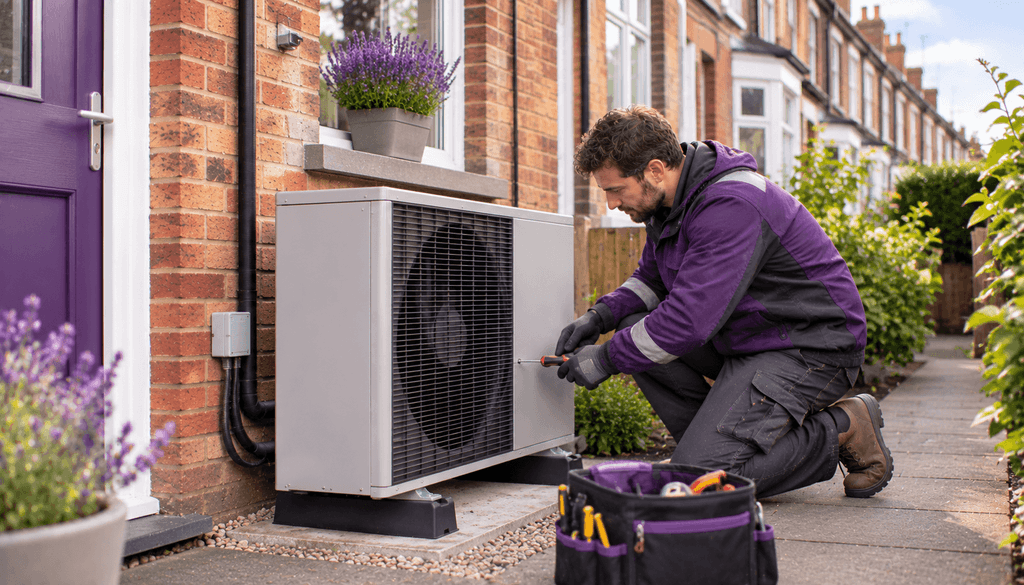
You can install an air source heat pump in a terraced house, including mid-terraced, end-terraced and older Victorian properties. However, limited outdoor space, proximity to neighbours and finding room for indoor heating equipment can make installation more challenging.
Terraced houses also have some advantages. Shared walls can reduce heat loss, meaning a smaller heat pump may be sufficient compared with a similarly sized detached property.
Before installing a heat pump, you’ll need to consider the property’s heating requirements, available space, insulation and applicable planning regulations.
Mid-terraced vs end-terraced houses
Both mid-terraced and end-terraced houses can accommodate heat pumps, although their installation requirements may differ.
| Consideration | Mid-terraced house | End-terraced house |
| External walls | Generally fewer | Generally more |
| Heat loss | Often lower | Often higher |
| Outdoor unit placement | More limited | Potentially more flexible |
| Neighbouring houses | Usually on both sides | Usually on one adjoining side |
| Installation access | May be restricted | May have side access |
| Heat pump capacity | Depends on heat loss | Depends on heat loss |
An end-terraced house may offer more flexibility when positioning the outdoor unit, particularly if there’s a side garden or passageway.
However, a mid-terraced house may require less energy to maintain a comfortable indoor temperature because fewer walls are exposed to the outside.
The UK government’s Electrification of Heat Demonstration Project included heat pump installations in terraced properties, demonstrating that this type of housing isn’t inherently unsuitable.
Where can you install a heat pump in a terraced house?
Finding a suitable location for the outdoor unit is often one of the biggest challenges.
Several locations may be suitable, depending on the property’s layout.
Rear garden or courtyard
The rear garden is often the most practical location for an air source heat pump.
The unit can be installed on a suitable base near an external wall, provided there’s sufficient space for airflow, maintenance and drainage.
However, smaller gardens may bring the heat pump close to neighbouring windows, making noise assessments particularly important.
Side passage
End-terraced houses sometimes have a side passage or garden that can accommodate a heat pump.
This can help preserve usable space in the rear garden.
However, narrow passages may restrict airflow, and sound reflecting between walls can make the equipment more noticeable.
Shared access routes must also remain unobstructed.
Front garden
A front garden may provide an alternative where rear space or access is limited.
However, installing a heat pump towards the front of a property can be subject to additional planning restrictions, particularly in conservation areas or where the equipment faces a road.
External wall
Some air source heat pumps can be mounted on suitable external walls using brackets.
The wall must be capable of supporting the equipment, and the installation must account for vibration, noise transmission and servicing access.
Ground-level installations may be preferable where wall mounting could transmit vibration into the building.
How much outdoor space does a heat pump need?
There isn’t a universal minimum garden size for installing an air source heat pump.
The outdoor unit itself may be relatively compact, but additional space is required around it.
The installer should consider:
- Manufacturer-specified airflow clearances.
- Access for servicing and repairs.
- Distance from neighbouring windows.
- Drainage for water produced during defrost cycles.
- Pipework routes into the property.
- Access for bringing the equipment into position.
The last point is particularly relevant for mid-terraced houses without direct access to the rear garden.
In some cases, equipment may need to be carried through the property, making installation more complicated.
Do you need planning permission for a heat pump in a terraced house?
Many domestic air source heat pump installations qualify as permitted development, meaning they don’t require a separate planning application if all applicable conditions are satisfied.
However, the rules differ across the UK.
Heat pump noise regulations
Because terraced houses are built close together, noise is an important consideration.
The applicable permitted-development noise assessment criteria are:
| UK nation | Noise criterion | Assessment standard |
| England | 37 dB(A) | MCS 020(a) |
| Wales | 37 dB(A) | MCS 020(a) |
| Scotland | 42 dB(A) | MCS 020 |
| Northern Ireland | 42 dB(A) | MCS 020 |
The older 42 dB(A) assessment includes an assumed background noise level, so the figures aren’t directly comparable.
The heat pump noise regulations assess the calculated sound level at specified neighbouring locations rather than directly beside the outdoor unit.
England removed its previous one-metre boundary restriction in May 2025, while Wales updated its permitted-development rules in June 2026. Northern Ireland retains a one-metre boundary restriction under its domestic permitted-development provisions.
If the proposed installation doesn’t meet the applicable conditions, a planning application may be necessary.
Additional restrictions may also apply to listed buildings and properties in conservation areas.
Can you install a heat pump in a Victorian terraced house?
Yes. Older Victorian terraced houses can be heated using heat pumps, although they may require more preparation than modern properties.
Common characteristics of Victorian houses include:
- Uninsulated solid brick walls.
- Suspended timber floors.
- Draughty windows and doors.
- Older radiators and pipework.
- Limited indoor storage space.
These characteristics can affect heating requirements and installation costs, but they don’t automatically prevent a heat pump from working effectively.
A qualified installer should carry out a room-by-room heat loss calculation to determine how much heating the property requires and whether the existing heating system is suitable.
Do you need to insulate a terraced house before installing a heat pump?
You don’t necessarily need to complete a full insulation retrofit before installing a heat pump.
However, better insulation reduces the amount of heat escaping from the property, regardless of the heating system used.
This can allow a heat pump to operate at lower heating water temperatures and potentially reduce running costs.
Useful improvements may include loft insulation, draught-proofing, floor insulation and suitable window upgrades.
Solid wall insulation can also reduce heat loss, although it may be relatively expensive and require careful consideration in older properties.
Not every improvement is necessary or financially worthwhile. Traditional buildings may also have ventilation and moisture-management requirements that need to be considered before adding insulation.
The installer should assess the property’s existing condition rather than assume that every older terraced house needs extensive renovation.
Will you need new radiators or a hot water cylinder?
Replacing a gas boiler with a heat pump may require changes to the equipment inside your home.
For smaller terraced houses, finding enough indoor space can be just as important as finding a location for the outdoor unit.
Radiators and pipework
Heat pumps generally operate more efficiently at lower heating water temperatures than conventional gas boilers.
Some existing radiators may therefore need replacing with larger models to provide sufficient heat.
However, you won’t necessarily need to replace every radiator.
The installer should assess the heating requirements of each room and determine whether the existing radiators and pipework can provide adequate heating.
Hot water cylinder
Unlike a combi boiler, a typical air-to-water heat pump installation providing domestic hot water requires a separate hot water cylinder.
If your terraced house currently has a combi boiler, you’ll need to find somewhere to accommodate the cylinder.
Possible locations include an airing cupboard, utility room, understairs cupboard or another suitable storage area.
The installer should also consider structural support, pipework connections and maintenance access.
Are air-to-air heat pumps suitable for terraced houses?
Air-to-air heat pumps may be an alternative where indoor space is particularly limited.
Instead of heating water that circulates through radiators, these systems heat indoor air directly using wall-mounted or other indoor units.
They can also provide cooling during summer.
An air-to-air heat pump doesn’t normally require a hot water cylinder for space heating, but you’ll still need a separate way to provide domestic hot water.
You may also need multiple indoor units to heat individual rooms effectively.
For terraced houses with several small, separate rooms, this can make the system more complicated than it would be in an open-plan property.
How much does it cost to install a heat pump in a terraced house?
A typical air source heat pump installation costs approximately £12,000 before grants, although individual quotations can be considerably higher or lower.
Historical analysis of MCS-certified installations also found a median cost of approximately £12,000 for terraced and semi-detached properties between January 2021 and mid-2023.
Several factors can affect heat pump installation costs in terraced houses.
| Installation factor | Potential impact on cost |
| Heat pump capacity | Lower heating requirements may reduce equipment costs |
| Radiator upgrades | Additional equipment and labour |
| Hot water cylinder | Additional equipment and installation work |
| Pipework alterations | May increase labour costs and disruption |
| Restricted property access | Can make installation more complicated |
| Electrical upgrades | Additional expense where required |
| Noise mitigation | May require specialist mounts or screening |
| Insulation improvements | Separate home improvement expenses |
Although terraced houses may have lower heating requirements than detached properties, limited access and additional installation work can offset potential savings.
Are heat pump grants available for terraced houses?
Yes. Terraced houses aren’t excluded from heat pump grants because of their property type.
Funding depends on where you live, the existing heating system and whether you meet the relevant eligibility requirements.
| Location | Available funding |
| England and Wales | £7,500 for eligible air-to-water heat pumps |
| England and Wales | £2,500 for eligible air-to-air heat pumps |
| Scotland | Up to £7,500 for eligible heat pump installations, with an additional £1,500 rural or island uplift where applicable |
| Northern Ireland | Check local energy efficiency schemes for available support |
In England and Wales, the Boiler Upgrade Scheme also provides an increased £9,000 grant for qualifying off-gas-grid properties replacing oil or LPG heating until 31 March 2027 (GOV.UK, Ofgem).
For example, a qualifying air-to-water heat pump installation costing £12,000 would leave the homeowner paying £4,500 after the standard £7,500 grant.
Are heat pumps cheaper to run in terraced houses?
Heat pumps can be economical to run in terraced houses, particularly where shared walls help reduce heating demand.
However, lower energy bills aren’t guaranteed.
Running costs depend on the property’s heat loss, heat pump efficiency, electricity tariffs and the type of heating system being replaced.
A well-designed heat pump operating at relatively low heating water temperatures is generally more efficient than one that regularly needs to operate at higher temperatures.
Dedicated heat pump electricity tariffs may also help reduce running costs.
Before proceeding, ask your installer for estimated annual consumption and running costs based on your property’s heating requirements.
Advantages and disadvantages of heat pumps in terraced houses
| Advantages | Disadvantages |
| Shared walls may reduce heat loss | Limited outdoor installation space |
| Potentially smaller heat pump required | Proximity to neighbouring windows |
| Reduced reliance on fossil fuels | Space needed for a hot water cylinder |
| Grants may reduce upfront costs | Restricted installation access |
| Potential energy bill savings | Possible radiator and pipework upgrades |
| Compatible with renewable electricity | Planning restrictions in some locations |
Is a heat pump worth installing in a terraced house?
A heat pump can be a worthwhile investment if the property has a suitable outdoor location and the heating system can be designed to operate efficiently.
Mid-terraced houses may benefit from relatively low heat loss, while end-terraced houses may offer greater flexibility for positioning the equipment.
However, if extensive heating system alterations are necessary or suitable outdoor space is difficult to find, installation may become more expensive and complicated.
A professional installation survey should help you determine whether a heat pump is a practical and financially worthwhile option for your home.
Frequently asked questions
Can you install a heat pump in a mid-terraced house?
Yes. Mid-terraced houses can accommodate heat pumps, provided there’s a suitable installation location and the system meets applicable noise, planning and heating requirements.
What size heat pump does a terraced house need?
The required capacity depends on the property’s heat loss, insulation, size and heating requirements. It shouldn’t be determined solely by the number of bedrooms or radiators.
Can you install a heat pump in a terraced house without a garden?
Potentially. A courtyard, suitable external wall or front area may accommodate the outdoor unit, subject to planning, structural and manufacturer requirements.
Do you need underfloor heating for a heat pump?
No. Heat pumps can work with suitable radiators. However, larger radiators may be necessary to provide sufficient heating at lower water temperatures.
Can neighbours object to a heat pump installation?
Yes. Neighbours can raise planning concerns or complain about unreasonable operating noise. A suitable location and completed noise assessment can help reduce the risk of problems.
Sources
Planning Portal, Planning Permission: Air Source Heat Pumps (https://www.planningportal.co.uk/permission/common-projects/heat-pumps/planning-permission-air-source-heat-pump/)
Welsh Government, Planning Permission: Domestic Heat Pumps (https://www.gov.wales/planning-permission-heat-pumps)
Scottish Government, Householder Permitted Development Rights (https://www.gov.scot/publications/circular-1-2024-householder-permitted-development-rights/pages/6/)
Northern Ireland, Planning (General Permitted Development) (Amendment) Order 2023 (https://www.legislation.gov.uk/nisr/2023/95/2023-07-04)
GOV.UK, Boiler Upgrade Scheme: What You Can Get (https://www.gov.uk/apply-boiler-upgrade-scheme/what-you-can-get)
Ofgem, Boiler Upgrade Scheme: Property Owners (https://www.ofgem.gov.uk/environmental-and-social-schemes/boiler-upgrade-scheme-bus/property-owners)
Home Energy Scotland, Grant and Loan (https://www.homeenergyscotland.org/home-energy-scotland-grant-loan)
Accurate as of: 17 November 2026