
Solar panel optimisers and microinverters both help individual solar panels operate more independently, reducing the impact of shading and differences between panels. However, they work in different ways.
Power optimisers manage the direct-current (DC) electricity produced by each panel but still require a central inverter. Microinverters convert DC electricity into alternating current (AC) directly at the panel, removing the need for a central string inverter.
Both technologies can be useful for complicated roofs, but neither is automatically better. The right choice depends on shading, roof layout, installation costs and whether you plan to add battery storage.
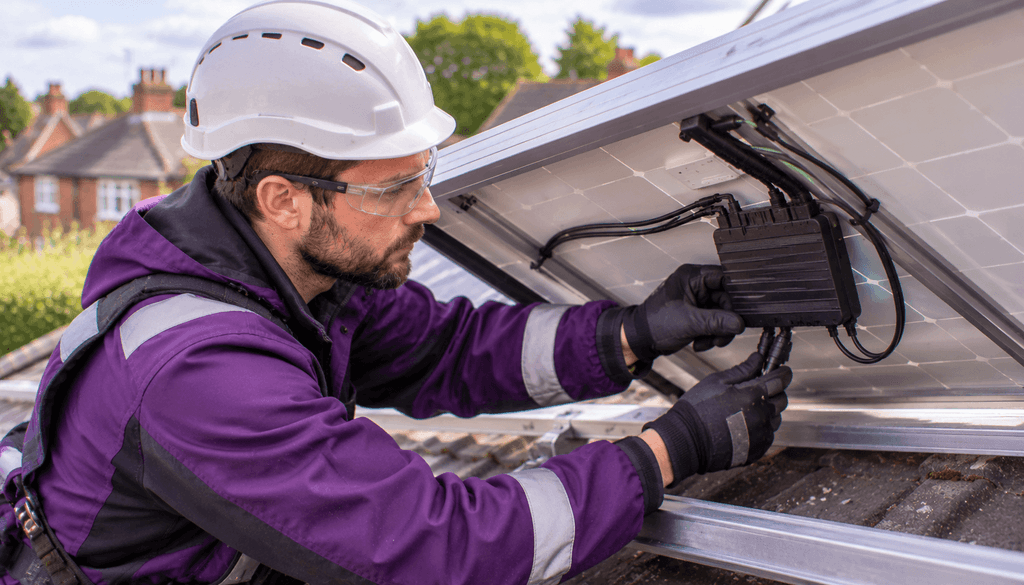
Solar optimisers vs microinverters: comparison
| Feature | Power optimisers | Microinverters |
| Main function | Manage each panel’s DC output | Convert DC to AC at panel level |
| Central inverter required | Yes | No |
| Handles partial shading | Yes | Yes |
| Individual panel monitoring | Available with compatible systems | Available with compatible systems |
| Upfront cost | Generally lower per unit | Generally higher per unit |
| Installation location | Usually behind solar panels | Usually behind solar panels |
| Central inverter failure | Can stop system generation | No central inverter to fail |
| Individual unit failure | Effect depends on system design | Usually affects the associated panel |
| Adding more panels | Depends on inverter capacity and compatibility | Often more flexible |
| Battery compatibility | Depends on the central inverter | Usually uses compatible AC-coupled storage |
The main difference is where the conversion from DC to AC electricity takes place.
Both technologies can reduce performance losses caused by uneven conditions across an array, but neither can replace sunlight that’s blocked by shading.
What is a solar panel optimiser?
A solar panel optimiser is a small electronic device fitted to an individual solar panel.
It manages the electrical output of that panel, allowing it to operate more independently of other panels connected to the same system.
This is particularly useful when some panels receive less sunlight than others.
For example, a chimney might shade one panel during the morning while the remaining panels are in direct sunlight.
An optimiser can reduce the additional losses that the shaded panel might otherwise cause elsewhere in the array.
However, it doesn’t convert the electricity into the AC used by household appliances.
The electricity remains DC until it reaches a compatible central inverter.
This means an optimiser system combines panel-level electronics with a conventional inverter.
Some systems also provide individual panel monitoring, allowing homeowners to identify which panels are generating less electricity.
Do optimisers work with any inverter?
No. Compatibility depends on the equipment.
Some optimisers are designed to work only with particular inverter systems, while others support a wider range of compatible models.
The installer must check the manufacturer’s requirements when designing the system.
This also matters when replacing equipment in the future.
What is a microinverter?
A microinverter performs the electricity conversion directly at the solar panel.
Instead of sending DC electricity from several panels to one central inverter, each microinverter converts the electricity into AC before it enters the household’s electrical system.
Many systems use one microinverter per panel, although certain models can serve more than one panel.
Because each panel has its own conversion equipment, it can operate largely independently of the others.
If one microinverter fails, the remaining units can generally continue generating electricity.
This removes the central string inverter as a single point of failure.
Microinverters can also provide individual panel monitoring through compatible equipment and software.
However, they usually cost more per unit than power optimisers, and repairing one may require rooftop access.
Which performs better with shading?
Both technologies can improve performance when solar panels experience different levels of sunlight.
In a conventional string system, several panels are electrically connected. Depending on the system design and shading conditions, a poorly performing panel can affect the output of others in the same string.
Power optimisers and microinverters help reduce these additional mismatch losses by managing panels individually.
However, neither technology can recover electricity that a shaded panel cannot generate.
For example, if a nearby tree blocks sunlight from one panel for several hours, that panel will still produce less electricity.
The benefit is that the better-lit panels may continue operating closer to their own potential.
Does every shaded roof need optimisers or microinverters?
Not necessarily.
Modern string inverters can already manage some differences between panels.
Many have multiple maximum power point tracking (MPPT) inputs, which allow separate groups of panels to operate independently.
Some also have features designed to reduce shading-related losses.
The benefit of additional panel-level electronics therefore depends on the severity and pattern of shading.
| Roof condition | Potential benefit |
| Open, unshaded roof | Often limited |
| Occasional chimney shading | May improve generation |
| Panels facing different directions | Can provide greater design flexibility |
| Regular partial shading | May offer meaningful benefits |
| Most panels heavily shaded | Cannot compensate for insufficient sunlight |
Microinverters and optimisers are useful options where uneven shading affects solar panels, but note that they generally cost more than conventional string systems.
The installer should assess the roof rather than assume that adding more equipment will always improve performance.
How much do solar optimisers and microinverters cost in the UK?
Power optimisers are generally less expensive per unit than microinverters.
However, an optimiser system still requires a central inverter, so comparing the individual components doesn’t provide the full installation cost.
Typical UK equipment prices are:
| Equipment | Indicative price |
| Power optimiser | £40–£150 per panel |
| Microinverter | £100–£200 per panel |
| Central string inverter | Additional cost for optimiser systems |
These are broad equipment price ranges, not complete installation quotations. Actual prices depend on the manufacturer, system size and installer.
For example, a 12-panel solar installation could require 12 optimisers or 12 single-panel microinverters, depending on the design.
However, the comparison also needs to include the central inverter, cables, monitoring equipment and installation labour.
Microinverters may cost more individually, but they eliminate the need to buy a conventional string inverter.
What else affects the installation cost?
Several factors can influence the total quotation:
- Number and capacity of solar panels.
- Roof layout and accessibility.
- Inverter and optimiser compatibility.
- Monitoring equipment and software.
- Electrical wiring and installation requirements.
- Battery storage or future expansion plans.
For a fair comparison, ask installers to quote for the same number and type of solar panels using different inverter arrangements.
The quotation should also include an estimate of annual electricity generation.
A more expensive system is only financially worthwhile if its additional benefits justify the cost.
Which is more reliable: optimisers or microinverters?
Both systems contain electronic components that can develop faults.
However, the consequences of a failure are different.
Optimiser system failures
An optimiser system depends on a central inverter.
If that inverter fails completely, the whole connected system will generally stop supplying usable AC electricity until the fault is repaired.
A problem with an individual optimiser may affect one panel, several panels or the operation of the string, depending on the equipment.
The central inverter is usually installed somewhere accessible, such as a garage or utility room.
This can make inspection and replacement easier than accessing electronic equipment behind roof-mounted panels.
Microinverter system failures
Microinverters remove the need for one central string inverter.
If a microinverter fails, the other panels will generally continue operating.
This can limit the loss of electricity generation while a fault is being resolved.
However, the faulty unit is usually located behind a solar panel.
Replacing it may require removing the panel and arranging suitable roof access.
For both technologies, scaffolding and labour can sometimes cost more than the replacement component itself.
How long do optimisers and microinverters last?
Some manufacturers provide long warranties for panel-level equipment.
For example, SolarEdge’s published warranty terms provide 25 years of cover for qualifying power optimisers, compared with a standard 12-year warranty for many of its central inverters.
Certain Enphase IQ8 microinverters also have limited warranties of up to 25 years.
However, warranty length isn’t the same as guaranteed equipment lifespan.
A power optimiser with a 25-year warranty doesn’t mean the central inverter will also last 25 years.
Similarly, a long microinverter warranty doesn’t necessarily cover every associated labour or access expense.
Before choosing either system, check what the warranty covers, how replacements are handled and whether there are any conditions relating to installation or monitoring.
For additional context, conventional central inverters typically have shorter working lives than solar panels. The likely replacement timing and associated expenses are covered in solar inverter replacement costs.
Are microinverters safer than power optimisers?
Both technologies can be installed safely when the system is designed and fitted correctly.
The main difference concerns how electricity travels from the solar panels.
Microinverters convert DC electricity to AC at panel level, avoiding the conventional high-voltage DC string arrangement between the roof and a central inverter.
Optimiser systems still use DC wiring between the panels and the central inverter.
However, some optimiser systems include safety functions that reduce DC voltage under specified shutdown conditions.
This doesn’t mean every optimiser provides the same protection.
Nor does it mean microinverter installations are free from electrical hazards.
Both systems must comply with the applicable UK electrical requirements and manufacturer’s installation instructions.
Homeowners shouldn’t attempt to install or repair rooftop electrical equipment themselves.
Which is better for battery storage?
Both systems can work with solar batteries, but their electrical arrangements differ.
An optimiser system can be paired with a compatible hybrid inverter and battery.
Depending on the equipment, this may allow solar electricity to be stored using a DC-coupled arrangement.
Microinverter systems produce AC electricity at panel level, so battery storage generally uses an AC-coupled arrangement.
This means additional equipment may be required to charge and discharge the battery.
However, neither approach is automatically cheaper or more efficient in every installation.
The choice depends on the battery, inverter, intended operating features and overall system design.
Importantly, neither optimisers nor microinverters automatically provide electricity during a power cut.
Backup power requires compatible equipment and appropriate installation arrangements.
Which is easier to expand?
Microinverter systems can be relatively flexible when adding more solar panels.
Because conversion takes place at panel level, additional panels can often be fitted with their own compatible microinverters.
However, electrical capacity, manufacturer compatibility and grid-connection requirements still apply.
With an optimiser system, expansion also depends on the central inverter’s capacity and supported string configuration.
Adding more panels may require changes to the inverter or other components.
If you expect to expand your solar installation later, discuss the proposed maximum system size with the installer before choosing equipment.
Do you actually need optimisers or microinverters?
Not every home needs either technology.
For a straightforward roof with little shading, a conventional string inverter may provide reliable performance at a lower installation cost.
Additional electronics can provide useful benefits, but they also introduce more components that may eventually need maintenance or replacement.
The choice should depend on your roof and the expected difference in electricity generation.
| Your situation | Option worth considering |
| Simple, unshaded roof | Conventional string inverter |
| Partial shading from trees or chimneys | Optimisers or microinverters |
| Panels on several roof orientations | Multi-MPPT string inverter, optimisers or microinverters |
| Lower upfront budget | Conventional string inverter |
| Want individual panel monitoring | Optimisers or microinverters |
| Prefer no central inverter | Microinverters |
| Planning battery storage | Compare compatible complete systems |
| Expect to add more panels later | Microinverters or an appropriately sized optimiser system |
These are starting points rather than universal recommendations.
A qualified installer should evaluate the roof, expected generation and overall system costs before recommending a particular design.
Solar optimisers vs microinverters: which should you choose?
Power optimisers may be a good choice if you want individual panel management while retaining a compatible central inverter.
They can help with shading and panel mismatches, although the central inverter remains an important part of the system.
Microinverters may be better suited to homeowners who prefer panel-level electricity conversion and want to avoid relying on one central inverter.
They can also be attractive for complicated roof layouts or systems that may expand later.
However, microinverters aren’t automatically more efficient or economical than optimisers.
For simple, unshaded roofs, a conventional string inverter may provide the best balance of cost and performance.
The most useful approach is to compare complete installation quotations, including estimated annual generation, warranties and potential future replacement costs.
Frequently asked questions
Are microinverters better than solar optimisers?
Not necessarily. Microinverters convert electricity to AC at panel level and remove the need for a central inverter. Optimisers manage each panel’s DC output but use a compatible central inverter. Both can help with shading and uneven panel performance.
Do solar optimisers work without an inverter?
No. Power optimisers don’t convert DC electricity into household AC electricity. A compatible inverter is still required.
Do microinverters produce more electricity than optimisers?
Not automatically. Actual generation depends on shading, panel orientation, inverter sizing and system design. Either technology may perform well when correctly matched to the installation.
Can you add optimisers to existing solar panels?
Sometimes. Compatibility depends on the existing panels, inverter and optimiser model. The system should be assessed by a qualified solar installer before making changes.
Can you mix optimisers and microinverters?
Not normally within the same electrical string. However, some properties may have separately designed solar arrays using different inverter technologies. Compatibility and grid-connection requirements must be checked.
Are microinverters more expensive to repair?
They can be, particularly when a failed unit requires rooftop access. However, repair costs depend on the product warranty, installation conditions and whether scaffolding is needed.
Sources
National Energy Action, Increasing Self-Consumption of Solar PV: Long-Term PV Analysis (https://www.nea.org.uk/wp-content/uploads/2023/06/CP1495-Increasing-Self-Consumption-of-Solar-PV-Long-term-PV-analysis.pdf)
SolarEdge UK, Residential Power Optimisers (https://www.solaredge.com/uk/products/residential/power-optimizers)
Accurate as of: 11 November 2026