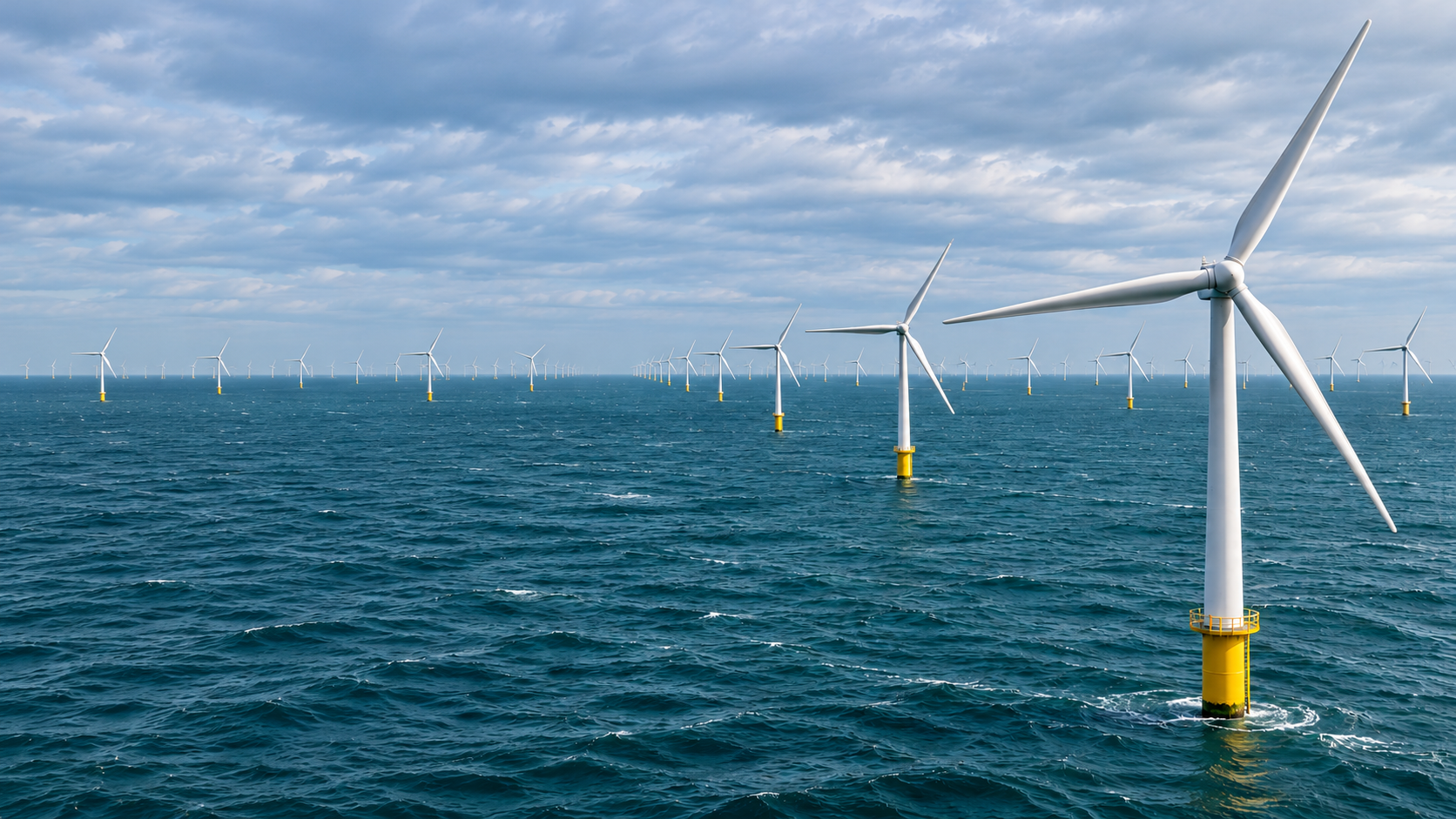

The UK’s offshore wind farms are owned by a mixture of British and international energy companies, investment funds and other institutional investors. Major companies involved include Ørsted, SSE Renewables, RWE, ScottishPower and Ocean Winds. However, most large offshore wind farms have several owners rather than belonging to one company.
For example, Hornsea 2 is operated by Danish energy company Ørsted but also has investment partners. Scotland’s Seagreen wind farm is jointly owned by SSE Renewables, TotalEnergies and Thailand’s PTTEP. Meanwhile, the Dogger Bank development is owned by three companies from the UK and Norway.
The Crown Estate also plays an important role, although it generally leases the seabed rather than owning the turbines themselves.
Who owns the UK’s 10 largest offshore wind farms?
The table below shows the ownership of the UK’s ten largest fully operational offshore wind farms, based on their installed generating capacity.
| Offshore wind farm | Owners and ownership stakes | Operator |
| Hornsea 2 | Ørsted 37.55%, AXA IM Alts 25%, Crédit Agricole Assurances 25%, Brookfield 12.45% | Ørsted |
| Hornsea 1 | Ørsted 50%; remaining 50% held by investment partners including Greencoat, Equitix, TRIG, GLIL and Octopus | Ørsted |
| Seagreen | SSE Renewables 49%, TotalEnergies 25.5%, PTTEP 25.5% | SSE Renewables |
| Moray East | Ocean Winds 40%, Diamond Green 33.4%, Equitix 26.6% | Ocean Winds |
| Moray West | Ocean Winds 95%, Ignitis Renewables 5% | Ocean Winds |
| Triton Knoll | RWE 59%, J-Power 25%, Kansai Electric Power 16% | RWE |
| East Anglia One | Iberdrola/ScottishPower 60%; remaining 40% held by investment partners | ScottishPower Renewables |
| Walney Extension | Ørsted 50%; remaining 50% held by AIP Management and PFA interests | Ørsted |
| London Array | RWE 30%, Greencoat 25%, La Caisse (formerly CDPQ) 25%, Masdar 20% | RWE |
| Beatrice | SSE Renewables 40%, Red Rock Power 25%, Equitix 17.5%, TRIG 17.5% | SSE Renewables |
Ownership information is based on The Crown Estate’s December 2024 register, updated where more recent information from operators and project companies is available. Shareholdings can change, and some older public records have not been updated.
These are the same major projects covered in our guide to the UK’s largest offshore wind farms, but their ownership arrangements are often more complicated than their operating companies suggest.
For example, Ørsted operates Hornsea 2 even though it holds less than half the equity in the wind farm.
Similarly, SSE Renewables operates Seagreen with a 49% ownership stake.
This is because operating a wind farm and owning it aren’t necessarily the same thing.
Which companies own the most UK offshore wind farms?
Several major energy companies have extensive offshore wind portfolios in British waters.
Some are based in the UK, while others are international businesses with substantial investment in British electricity generation.
Ørsted — Denmark
Ørsted is one of the UK’s most prominent offshore wind developers and operators.
The Danish company operates major projects including Hornsea 1, Hornsea 2, Walney Extension and Race Bank.
Although Ørsted originally developed many of these wind farms, it has subsequently sold ownership stakes to investment partners.
For example, Hornsea 2 is owned by Ørsted alongside AXA IM Alts, Crédit Agricole Assurances and Brookfield.
Ørsted continues to manage the turbines and day-to-day operations on behalf of the owners.
The company is itself listed on the Copenhagen stock exchange, with the Danish state holding a majority shareholding.
This means that one of the UK’s most important offshore wind operators is controlled by a foreign government through its ownership of the parent company.
SSE Renewables — United Kingdom
SSE Renewables is the renewable energy division of SSE, a UK-listed energy company headquartered in Perth, Scotland.
It has ownership interests in several major offshore wind farms, including Seagreen, Beatrice and Dogger Bank.
At Seagreen, SSE Renewables holds 49% of the project, while TotalEnergies and PTTEP each own 25.5%.
SSE operates the wind farm despite not owning a majority of its shares.
The company is also leading construction of Dogger Bank, where it holds a 40% stake.
SSE is therefore an important British participant in offshore wind development, although many of its projects involve international partners.
RWE — Germany
RWE is a German energy company with a substantial renewable electricity portfolio in the UK.
It owns and operates several offshore wind farms, including Triton Knoll, and holds a 30% stake in London Array.
Triton Knoll demonstrates how companies from several countries can invest in one project.
RWE owns 59%, while Japan’s J-Power holds 25% and Kansai Electric Power owns the remaining 16%.
RWE is also developing Sofia, a major offshore wind farm on Dogger Bank.
Unlike many existing projects, Sofia is currently wholly owned by RWE.
However, ownership can change as projects are developed and completed.
ScottishPower and Iberdrola — Spain
ScottishPower is a familiar name in the British electricity market, but its parent company is Spain’s Iberdrola.
Through ScottishPower Renewables, Iberdrola develops and operates offshore wind farms in UK waters.
One of its largest operating projects is East Anglia One, located off the Suffolk coast.
Iberdrola holds a 60% ownership stake, with the remaining shares held by investment partners.
ScottishPower is also developing further offshore wind capacity in the East Anglia region.
This illustrates why a UK-based company or familiar British brand doesn’t necessarily mean that the ultimate owner is British.
Ocean Winds — France and Portugal
Ocean Winds is responsible for some of Scotland’s largest offshore wind developments.
It operates Moray East and Moray West in the Moray Firth.
Unlike a traditional energy company with one corporate parent, Ocean Winds is a 50:50 joint venture between ENGIE and EDP Renewables.
ENGIE is based in France, while EDP Renewables belongs to the Portuguese EDP group.
Ocean Winds holds 40% of Moray East alongside Diamond Green and Equitix.
It also owns 95% of Moray West, with the remaining 5% held by Ignitis Renewables.
Other major offshore wind investors
Several other businesses also own stakes in UK offshore wind farms.
These include Equinor, the Norwegian energy company involved in Dogger Bank and other North Sea projects, and EDF Renewables, which is part of France’s EDF group.
Infrastructure investors are also increasingly important.
Companies and investment managers such as Equitix, Greencoat, Brookfield, Octopus and TRIG hold shares in offshore wind developments.
These investors typically provide capital in exchange for a financial interest in the project’s future revenues.
Are UK offshore wind farms British-owned or foreign-owned?
UK offshore wind farms have a mixture of British and foreign ownership.
Some projects are partly owned by UK-listed companies such as SSE, while others have major shareholders based in Denmark, Germany, Spain, France, Norway, Japan or elsewhere.
Many projects combine investors from several countries.
For example, Seagreen has shareholders from the UK, France and Thailand.
Triton Knoll combines German and Japanese ownership, while London Array includes investors from Germany, the UK, Canada and the United Arab Emirates.
This international investment isn’t unusual for infrastructure projects that require billions of pounds in financing.
However, it makes the question of whether a wind farm is British-owned difficult to answer with a simple yes or no.
A project may have a UK-registered operating company but foreign shareholders.
Likewise, a British investment fund may manage money on behalf of pension schemes or institutions with investors around the world.
There’s no straightforward, consistently updated figure showing what percentage of all UK offshore wind farms is ultimately British-owned.
Calculating that would require examining the ownership of every project and, in many cases, the investors behind individual funds and parent companies.
Does the Crown Estate own offshore wind farms?
The Crown Estate plays an important role in offshore wind development, but it doesn’t generally own the wind turbines or generating businesses.
Instead, it manages seabed rights and leases suitable areas to offshore wind developers.
In England, Wales and Northern Ireland, The Crown Estate manages the relevant seabed leasing arrangements.
In Scotland, Crown Estate Scotland performs a similar role on behalf of Scottish Ministers.
When a company wants to develop an offshore wind farm, it needs appropriate rights to use the seabed.
These rights don’t automatically provide permission to build.
Developers must also obtain the necessary planning, environmental and other regulatory consents.
Once the relevant requirements have been met, the developer can proceed with construction under the applicable agreements.
Who receives the money from seabed leases?
Companies developing offshore wind farms make payments for the rights to use the seabed.
In England, Wales and Northern Ireland, these revenues form part of The Crown Estate’s income.
The Crown Estate is a statutory organisation, and its profits are paid to HM Treasury rather than belonging to the monarch personally.
In Scotland, Crown Estate Scotland manages the relevant assets, with net revenues contributing to Scottish public finances.
This means public bodies receive income from offshore wind development even where the actual wind farms are privately owned.
Does the UK government own offshore wind farms?
The UK government doesn’t directly own most operational offshore wind farms.
Instead, the sector is largely financed and operated by commercial companies and investment partnerships.
However, some owners are themselves partly or wholly controlled by national governments.
For example, Denmark’s government holds a majority stake in Ørsted, while Norway’s government is a major shareholder in Equinor.
Similarly, some investment partners are state-backed or owned by public-sector institutions.
This creates an important distinction between government ownership of an individual UK wind farm and government ownership of a company that invests in UK wind farms.
The UK government also supports offshore wind development through policies, leasing frameworks and financial mechanisms, including Contracts for Difference.
However, providing policy support or agreeing a contract for electricity generation doesn’t automatically give the government an ownership stake in the wind farm.
Why do offshore wind farms have several owners?
Large offshore wind farms are expensive to construct.
They require investment in turbines, foundations, subsea cables, substations, construction vessels and other infrastructure.
Developers often sell part of their ownership after securing financing or reaching important construction milestones.
This allows them to recover some capital, share financial risks and invest in additional projects.
For investors, an operational offshore wind farm can offer a long-term infrastructure investment with revenues from electricity generation.
There are three main roles to understand.
| Role | Responsibility |
| Developer | Plans the project, arranges financing and oversees construction |
| Owner or shareholder | Holds an equity stake and receives a share of financial returns |
| Operator | Manages the turbines, maintenance and day-to-day operation |
One company may perform all three roles, but that isn’t always the case.
There can also be a separate owner for the electricity transmission infrastructure.
Under Great Britain’s Offshore Transmission Owner (OFTO) arrangements, offshore substations, export cables and associated transmission assets can be transferred to another company.
For example, the Seagreen project announced the sale of its transmission assets to a consortium involving Equitix and Kyuden Group in March 2025.
The ownership of those assets is separate from the ownership of the wind turbines and generating business.
Who owns Dogger Bank, Hornsea 3 and Sofia?
Several major offshore wind farms are under construction or commissioning and will substantially increase UK generating capacity.
Their ownership arrangements are also worth examining.
| Offshore wind farm | Ownership | Development status |
| Dogger Bank A, B and C | SSE Renewables 40%, Equinor 40%, Vårgrønn 20% | Under construction and commissioning |
| Hornsea 3 | Ørsted 50%, Apollo-managed funds 50% | Under construction |
| Sofia | RWE 100% | Under construction and commissioning |
Dogger Bank
Dogger Bank is being developed through a partnership between SSE Renewables, Equinor and Vårgrønn.
SSE and Equinor each own 40%, while Vårgrønn holds 20%.
SSE leads construction, but Equinor is expected to operate the completed development.
This is an example of a project where the construction lead, future operator and shareholders have different responsibilities.
Hornsea 3
Hornsea 3 is being developed by Ørsted, which sold a 50% ownership stake to funds managed by Apollo.
The transaction was announced in November 2025 and completed in December 2025.
Ørsted remains responsible for construction and will provide long-term operating and maintenance services.
The investment demonstrates how major financial institutions can acquire significant stakes in offshore wind farms before construction is complete.
Sofia
Sofia is a large offshore wind development in the North Sea.
RWE currently owns 100% of the project and is responsible for its development.
However, the company has indicated that it may seek investment partners as the project matures.
This means Sofia’s ownership structure could change after construction or once it becomes fully operational.
Can offshore wind farm ownership change?
Yes. Offshore wind farms can change ownership during development, construction or operation.
Some companies sell minority stakes to raise capital, while others buy out their partners to gain greater control of an established project.
A recent example is Gunfleet Sands 1 and 2, off the Essex coast.
In October 2026, Ørsted announced that it would acquire the remaining 49.9% of the project from its investment partners.
The acquisition would increase Ørsted’s ownership from 50.1% to 100%.
At the time of the announcement, completion was expected in November 2026, subject to the usual closing conditions.
Changes like this are one reason older ownership registers may differ from the information published by individual wind farm operators.
When checking who owns a particular project, it’s worth looking at the latest company announcements rather than relying exclusively on historical ownership tables.
Frequently asked questions
Who owns the largest offshore wind farm in the UK?
Hornsea 2 is owned by Ørsted (37.55%), AXA IM Alts (25%), Crédit Agricole Assurances (25%) and Brookfield (12.45%), according to The Crown Estate’s published ownership register. Ørsted operates the wind farm.
Does the King own UK offshore wind farms?
No. The Crown Estate manages seabed rights used by offshore wind developers, but the wind farms themselves are generally owned by commercial companies and investors. The Crown Estate isn’t the monarch’s private property.
Are all UK offshore wind farms foreign-owned?
No. Ownership is mixed. British companies and investment funds hold stakes in several projects, alongside international energy companies and institutional investors.
Who owns Dogger Bank wind farm?
Dogger Bank is owned by SSE Renewables (40%), Equinor (40%) and Vårgrønn (20%). SSE is leading construction, while Equinor is expected to operate the completed wind farm.
Does Ørsted own all the wind farms it operates?
No. Ørsted has sold ownership stakes in several offshore wind farms while continuing to operate them. Its ownership share varies between projects.
Who receives profits from offshore wind farms?
Profits ultimately belong to the project’s shareholders, after operating costs, financing obligations, taxes and other expenses. Developers also pay for seabed rights, creating a separate revenue stream for the relevant Crown Estate organisation.
Sources
The Crown Estate, Offshore Wind Farm Ownership (https://www.thecrownestate.co.uk/our-business/marine/wind-farm-ownership)
The Crown Estate, Offshore Transmission Owner Ownership (https://www.thecrownestate.co.uk/our-business/marine/ofto-ownership)
Crown Estate Scotland, Our Role in Offshore Wind (https://www.crownestatescotland.com/scotlands-property/offshore-wind/our-role-in-offshore-wind)
Ørsted, Hornsea 1 Offshore Wind Farm (https://orsted.co.uk/energy-solutions/offshore-wind/our-wind-farms/hornsea1)
Ørsted, Walney Extension (https://orsted.co.uk/energy-solutions/offshore-wind/our-wind-farms/walney-extension)
SSE Renewables, Seagreen (https://www.sserenewables.com/offshore-wind/operational-wind-farms/seagreen/)
SSE Renewables, Beatrice (https://www.sserenewables.com/offshore-wind/operational-wind-farms/beatrice/)
Moray East, Project Sponsors (https://www.morayeast.com/project/sponsors)
Moray West, Project Sponsors (https://www.moraywest.com/project/sponsors)
Triton Knoll, Project Overview (https://www.tritonknoll.co.uk/)
Iberdrola, East Anglia One Offshore Wind Farm (https://www.iberdrola.com/about-us/power/offshore-wind-energy/east-anglia-hub-offshore-wind-complex/east-anglia-one-offshore-wind-farm)
London Array, Our Shareholders (https://londonarray.com/our-shareholders/)
Dogger Bank, Joint Venture Partnership (https://doggerbank.com/a-joint-venture/)
Sofia Offshore Wind Farm, About the Project (https://sofiawindfarm.com/about/)
Ørsted, Hornsea 3 Stake Sale Completion, December 2025 (https://via.ritzau.dk/announcement/14738011?lang=en&publisherId=13560592)
Ørsted, Gunfleet Sands Acquisition Announcement, October 2026 (https://orsted.com/en/media/news/2026/10/orsted-to-take-full-ownership-of-gunfleet-sands-1–1519524911)
Accurate as of: 4 November 2026