

If your boiler keeps turning on and off every few minutes, it may be short cycling. This means the boiler fires but switches off again before completing a normal heating cycle, then starts again shortly afterwards.
Possible causes include boiler pressure, thermostat problems, trapped air, sludge or restricted circulation, incorrect settings and internal faults. However, some on-and-off operations are completely normal. A boiler should stop firing when your home reaches the required temperature and start again when more heat is needed.
The first step is therefore working out whether your boiler is genuinely short cycling or simply responding normally to your heating controls.
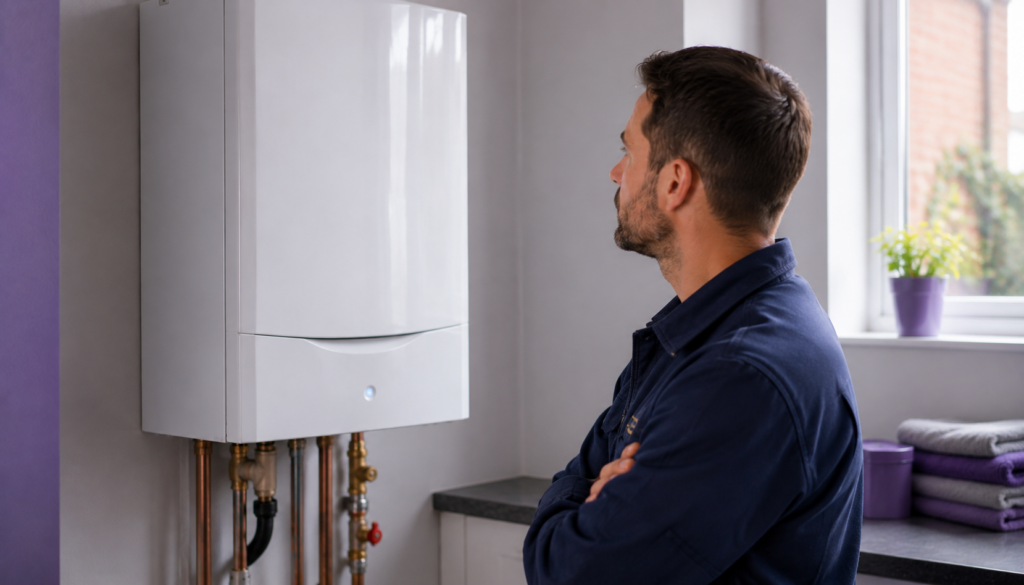
Is it normal for a boiler to turn on and off?
Yes. A boiler isn’t supposed to run continuously whenever your heating is switched on.
Your room thermostat calls for heat when the room falls below the temperature you’ve selected. Once it reaches that temperature, the heating switches off until the temperature drops again.
The pattern becomes worth investigating when the boiler repeatedly fires for a very short period, shuts down and starts again soon afterwards, particularly if:
- Rooms aren’t reaching the thermostat temperature
- Radiators aren’t heating properly
- Boiler pressure is unusually low or high
- A fault code appears
- The boiler repeatedly goes into lockout
- You hear unusual noises
- Heating or hot-water performance is inconsistent
There isn’t one universal number of minutes that separates normal cycling from short cycling. Boiler design, outside temperature, heating demand and controls all affect how long an individual cycle lasts.
Why does my boiler keep turning on and off?
Several faults and heating-system problems can produce similar symptoms.
| Possible cause | Other signs to look for | What to do |
| Normal thermostat operation | Home reaches the selected temperature | No action normally needed |
| Low or high boiler pressure | Gauge outside the manufacturer’s recommended range | Check pressure and manual |
| Thermostat/control problem | Heating doesn’t correspond with temperature or programmed times | Check settings and batteries |
| Trapped air | Radiators cold towards the top | Bleed radiators if appropriate |
| Sludge/poor circulation | Radiators cold at the bottom or heating unevenly | Have circulation assessed |
| Flow temperature issue | Boiler reaches its target quickly | Check user-adjustable settings |
| Frozen condensate pipe | Freezing weather, possible fault code | Safely thaw accessible pipework |
| Internal component fault | Persistent cycling, fault codes or lockouts | Contact an engineer |
| Oversized boiler | Frequent cycling despite an otherwise working system | Professional assessment |
1. Check the boiler pressure
Boiler pressure is one of the simplest things to check yourself.
On many sealed heating systems, pressure should typically be around 1 to 1.5 bar when the system is cool, although you should follow the instructions for your particular boiler.
If pressure is too low, the boiler may stop operating correctly or enter lockout. If your manual allows homeowner repressurisation, you may be able to top up the system using its filling mechanism.
However, manufacturers say their systems should normally need topping up only once or twice a year. If pressure keeps falling, contact an installer rather than continually adding water.
Pressure that rises excessively also needs attention. According to boiler manufacturers, if pressure increases by more than 1 bar as the system heats up, the expansion vessel may need checking by an engineer.
2. Check the thermostat and heating controls
Before assuming the boiler itself is faulty, check what is telling it to switch on and off.
Make sure:
- The thermostat is set above the current room temperature when testing the heating
- The timer or programmer shows the correct time
- The heating schedule hasn’t accidentally changed
- A wireless thermostat doesn’t need new batteries
- The thermostat hasn’t lost connection with its receiver
- Curtains, furniture or another heat source aren’t interfering with the thermostat
Room thermostats need a free flow of air to measure temperature properly and shouldn’t be blocked by curtains or furniture.
If the boiler starts and stops at roughly the temperatures or times you’ve programmed, it may simply be responding normally to its controls.
3. Check for trapped air or sludge
Your radiators can provide useful clues about circulation problems.
A radiator that is cold at the top but warm at the bottom commonly contains trapped air. Bleeding the radiator releases this air and is a normal homeowner maintenance task if you know how to do it.
Turn the heating off and allow the radiator to cool before bleeding it. Check the boiler pressure afterwards, as releasing air can lower system pressure.
The opposite pattern can suggest another problem. A radiator that is warm at the top but cold at the bottom may contain sludge or have restricted circulation.
If several radiators are affected, an engineer may recommend balancing the system, chemical cleaning or, where contamination is sufficiently severe, a powerflush.
Don’t assume short cycling automatically means you need a powerflush. Sludge is only one possible cause.
4. Check the boiler flow temperature
The flow temperature is the temperature of the water leaving the boiler for your radiators.
Many boilers may be set higher than necessary. Reducing the flow temperature can lower the return temperature and allow a condensing boiler to operate more efficiently.
If you have a combi boiler, around 60°C is a reasonable radiator flow temperature to try, although the ideal setting varies between homes and may need adjusting with the weather.
Be more careful with a conventional boiler connected to a hot-water cylinder. Experts recommend trying 65°C and say not to reduce the boiler flow temperature below this because the boiler needs to heat stored water to a safe temperature.
If you don’t know which type of system you have or which setting controls radiator flow temperature, check the boiler manual instead of experimenting.
5. The boiler may be oversized
An oversized boiler can produce heat faster than the heating system needs it.
The water reaches the target temperature quickly, the burner stops, and then it starts again when the temperature falls. This can create repeated short cycles, particularly during milder weather when the property’s heating demand is relatively low.
However, you can’t diagnose an oversized boiler simply from its maximum kW rating. The boiler’s minimum output and modulation, radiator sizing, controls and the property’s heat loss all matter.
If the boiler has short cycled persistently since installation despite the rest of the system working properly, ask a heating engineer to assess its configuration and suitability.
Replacing the boiler isn’t necessarily the first solution. Some boilers can be configured by an engineer to better match the heating system.
6. Check for a frozen condensate pipe
If the problem suddenly appears during freezing weather, an external condensate pipe could be involved.
Condensing boilers produce water that drains away through this pipe. Where part of it runs outside, the water can freeze and prevent the boiler from operating normally.
Possible signs include a fault code, gurgling noises and a boiler that stops working during freezing weather.
If the frozen section is safely accessible from ground level, you can thaw it using warm, not boiling, water. Once thawed, follow the manufacturer’s instructions for resetting the boiler.
Don’t climb or put yourself at risk to reach the pipe.
7. There may be an internal boiler or circulation fault
If the simpler explanations don’t fit, the problem may require professional diagnosis.
Potential causes include:
- A circulation pump problem
- A temperature sensor fault
- A blocked or scaled heat exchanger
- Internal valves or controls
- Restricted circulation elsewhere in the system
A faulty pump, for example, can prevent heated water moving through the system effectively. Heat then builds up inside the boiler and its controls may shut down the burner.
Similarly, a faulty temperature sensor can cause the boiler to respond to an incorrect temperature reading.
These aren’t suitable DIY repairs. Don’t remove the boiler casing to inspect internal components.
A fault code can help an engineer identify the problem, so write it down rather than repeatedly resetting the boiler.
What can you safely check yourself?
You don’t need to dismantle anything to collect useful information.
Start with these checks:
- Look at the display. Write down any fault code.
- Check the pressure. Compare it with the range in your boiler manual.
- Check the thermostat. Make sure it is actually requesting heat.
- Check the timer. Confirm the time and heating programme are correct.
- Check the radiators. Cold tops can suggest air; cold bottoms can suggest sludge or restricted circulation.
- Consider the weather. During freezing conditions, check an accessible external condensate pipe.
- Check the manual. Follow only troubleshooting procedures intended for homeowners.
Do not remove the boiler casing or attempt to repair internal gas, combustion or electrical components.
Should you keep resetting a boiler that turns off?
No. Resetting can be appropriate when the manufacturer’s instructions tell you to do so after a particular fault, but repeatedly resetting a boiler that continues to lock out isn’t a solution.
A boiler lockout is a protective response to a fault. Problems such as low water pressure or ignition failure can cause a boiler to stop operating until the issue is addressed.
If you correctly reset the boiler and the same fault quickly returns, arrange an assessment instead of continuing to reset it.
When should you call a Gas Safe registered engineer?
Get professional help if:
- Short cycling continues after the basic checks
- Pressure repeatedly falls
- Pressure rises or fluctuates abnormally
- The same fault code keeps returning
- The boiler repeatedly enters lockout
- You hear unusual noises from inside the boiler
- Several radiators have persistent circulation problems
- You suspect a pump, sensor, heat exchanger or other internal fault
Internal gas-boiler repairs should be carried out by an appropriately Gas Safe registered engineer.
If you smell gas, don’t continue troubleshooting. Gas Safe Register says to contact the gas emergency service on 0800 111 999 in England, Wales and Scotland, or 0800 002 001 in Northern Ireland.
Does short cycling increase energy use?
Persistent short cycling can work against efficient boiler operation because the burner repeatedly starts and stops instead of operating steadily to meet the home’s heating demand.
However, you can’t reliably calculate a particular percentage increase in your bill from the number of times the boiler fires. The effect depends on the boiler, heating demand, controls and underlying cause.
If your energy use has increased alongside persistent short cycling, focus on finding and correcting the cause rather than assuming a particular saving from one repair.
Why does my boiler fire when the heating is off?
This isn’t necessarily a fault.
Some boilers periodically operate frost-protection functions. A combi boiler with a preheat or comfort function may also briefly fire to keep a small amount of water warm so that hot water reaches your taps faster.
Check your boiler manual to see which functions your model has.
If the boiler is actually heating your radiators while the heating controls are off, or is firing much more frequently than these functions would explain, the controls, valves or boiler may need professional attention.
How to prevent short cycling
Not every cause is preventable, but good maintenance can reduce avoidable problems.
Have the boiler serviced according to the manufacturer’s requirements, monitor system pressure and investigate recurring pressure loss instead of continually topping up the system.
Deal with radiators that consistently heat unevenly, and make sure thermostats, programmers and radiator controls are being used correctly.
If you’re replacing a boiler, appropriate sizing also matters. A heating professional can assess the property’s heat requirements rather than assuming that a higher-output boiler is automatically better.
Frequently asked questions
Why does my boiler turn on for a few minutes and then turn off?
It may simply have reached the temperature requested by its controls. If it repeatedly runs for only a short period and starts again without adequately heating your home, possible causes include pressure problems, poor circulation, thermostat issues or an internal fault.
Why does my boiler keep firing up when the heating is off?
Some boilers briefly fire for frost protection or hot-water preheat functions. Check your boiler manual. If the radiators are becoming hot despite the heating being switched off, arrange an assessment.
Can low pressure make a boiler turn off?
Yes. Low pressure can prevent some boilers operating correctly or cause a lockout. Worcester Bosch recommends around 1–1.5 bar when its heating systems are cool, but use the pressure range specified for your own boiler.
Should I turn my boiler flow temperature down?
If you have a combi boiler, Energy Saving Trust says around 60°C is a reasonable radiator flow temperature to try. Boilers supplying a hot-water cylinder need different treatment; Energy Saving Trust advises not reducing their flow temperature below 65°C.
Can sludge cause a boiler to keep turning on and off?
Potentially. Sludge can restrict circulation through the heating system. Radiators that remain cold at the bottom can be another sign of sludge or poor circulation.
Is short cycling dangerous?
Short cycling itself doesn’t prove that a boiler is dangerous, but repeated shutdowns and lockouts shouldn’t be ignored because the boiler may be responding to a fault. If you smell gas, stop troubleshooting and contact the appropriate gas emergency service.
Sources
Vaillant, Most common boiler problems (https://www.vaillant.co.uk/advice/understanding-heating-technology/boilers/most-common-boiler-problems/)
Worcester Bosch, Boiler Controls Explained (https://www.worcester-bosch.co.uk/products/boiler-controls/explained)
Gas Safe Register, Gas Emergency: What to Do if & Who to Call (https://www.gassaferegister.co.uk/gas-emergency/what-to-do-in-a-gas-emergency/)
Accurate as of: 14 August 2026