

A powerflush typically costs around £350 to £800 in the UK, although the final price depends on the number of radiators in your house, the size and condition of the heating system, and who carries out the work.
It can be worth the cost if sludge, rust or other debris is restricting circulation through your radiators and pipework. However, a powerflush is not a routine fix for every heating problem, and a cheaper chemical or gravity flush may be sufficient where contamination is less severe.
The important step is establishing whether sludge is actually causing the problem before paying several hundred pounds to clean the entire system.
How much does a powerflush cost in the UK?
Current UK estimates put the typical cost of a powerflush at roughly £350–£800, with an average of about £500.
Commercial provider pricing can be higher. Some providers quote powerflushing from £460 for a one-bedroom flat and £755 for a three-bedroom house, although the final quote depends on the heating system.
These figures should be treated as estimates rather than fixed prices. A larger system with more radiators generally takes longer to clean, while heavily contaminated systems can require more work than relatively straightforward jobs.
What affects the cost of a powerflush?
The number of radiators is one of the biggest cost factors because each radiator and the associated pipework need to be cleaned as part of the process. This is why prices tend to rise with the size of the property and heating system (Checkatrade, British Gas).
Other factors can include:
- The extent of sludge and corrosion
- How easy the heating system is to access
- The type and layout of pipework
- Whether individual radiators require additional attention
- Labour rates in your area
- Whether cleaning chemicals and inhibitor treatment are included
- Whether faults or damaged components are discovered during the job
It is worth asking for a fixed quotation where possible and checking exactly what is included before agreeing to the work.
What is a powerflush?
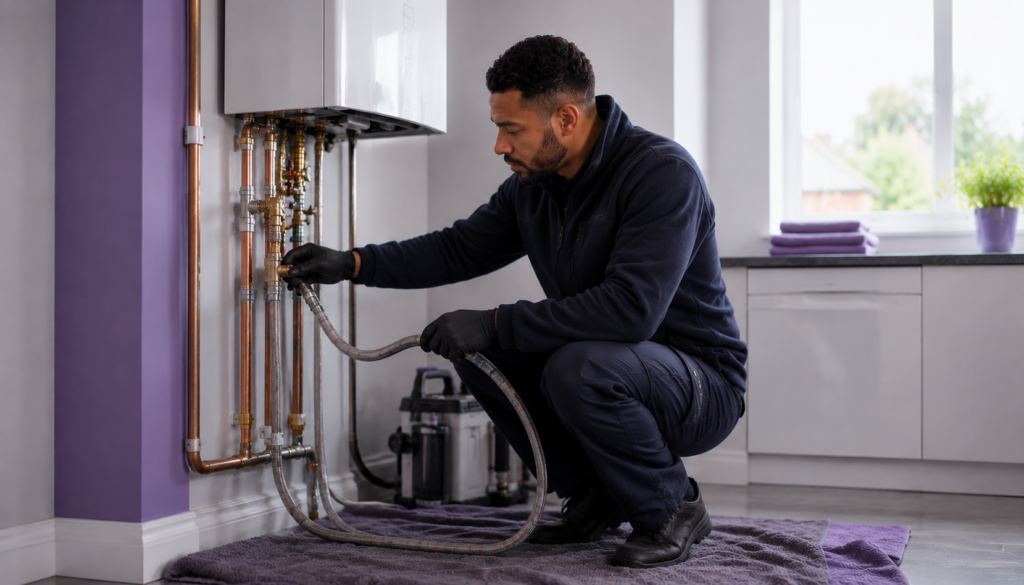
A powerflush is a method of cleaning a wet central-heating system by circulating water and cleaning chemicals through the boiler, radiators and pipework using specialist pumping equipment.
The process is intended to loosen and remove sludge, rust and other debris that can restrict water circulation through the system.
Despite the name, it should not simply involve applying dangerously high pressure to the heating system. Specialist manufacturer Sentinel describes powerflushing as circulating water at high velocity but low pressure, allowing debris to be dislodged without physically damaging the system.
A typical professional job may involve:
- Connecting a powerflushing machine to the heating system.
- Circulating cleaning chemicals through the system.
- Flushing radiators individually or changing the direction of flow to dislodge deposits.
- Removing contaminated water.
- Refilling the system with clean water.
- Adding corrosion inhibitor where appropriate.
- Checking that the system operates correctly afterwards.
Providers usually reserve up to eight hours for the process, depending on the size of the system.
What is the sludge that a powerflush removes?
The black sludge often found in older central-heating systems is largely associated with corrosion.
Oxygen reacting with metals in the heating system can produce magnetite, or rust particles, which become suspended in the system water. Deposits such as magnetite and limescale can eventually contribute to blockages and damage to heating components.
Cleaning the system removes accumulated contamination, but a powerflush does not eliminate the underlying possibility of future corrosion. Good system-water treatment and ongoing maintenance still matter afterwards.
What are the signs you might need a powerflush?
A powerflush becomes worth investigating when there is evidence that poor circulation or contamination is affecting several parts of the heating system.
Possible signs include:
- Radiators that are cold at the bottom
- Several radiators taking a long time to heat
- Uneven heating across the property
- Dirty or very dark water coming from radiators
- Noisy boiler or heating-system operation
- Repeated circulation problems
- Sludge being found elsewhere in the system
A radiator that is warm at the top but cold at the bottom is particularly associated with sludge or poor circulation.
However, these symptoms do not prove that a powerflush is required. Similar heating problems can have other causes, so the system should be assessed before the work is recommended.
When is a powerflush worth it?
A powerflush is most likely to represent good value when there is enough contamination to noticeably affect the performance of the heating system.
- Several radiators have cold spots
If one radiator is affected, the problem may be local to that radiator.
If several radiators are consistently cold at the bottom or heating unevenly, sludge may be distributed throughout the wider system. A whole-system clean then becomes easier to justify than repeatedly treating individual radiators.
- Sludge is causing poor circulation
Accumulated debris can restrict the movement of hot water through pipes and radiators. Removing it can restore more even circulation and help radiators warm properly again.
In this situation, the benefit of the powerflush is not simply a theoretical improvement in efficiency: it is fixing an identifiable problem with how the heating system operates.
- You’re replacing a boiler on a dirty existing system
Cleaning an existing heating system is particularly important when fitting a new boiler.
Approved Document L for England states that domestic central-heating systems should be prepared and commissioned to BS 7593, and that systems should be thoroughly cleaned and flushed, with suitable chemical inhibitor added to protect against scale and corrosion.
Manufacturers also advise thorough system flushing when a new boiler is installed onto an old heating system because magnetite, limescale and other deposits can damage boiler components.
That does not necessarily mean every boiler replacement requires a powerflush specifically. The appropriate cleaning method depends on the condition of the system and the manufacturer’s requirements.
- The alternative is repeated repairs
A powerflush may also make financial sense when sludge is contributing to repeated problems with pumps, valves, heat exchangers or circulation.
In that situation, repeatedly replacing components without addressing dirty system water can leave the underlying cause untreated.
When is a powerflush probably not worth it?
Powerflushing can be expensive, so it should not be treated as routine maintenance that every heating system automatically needs.
- One radiator has a minor problem
A single problematic radiator does not necessarily justify cleaning the entire central-heating system.
If contamination is confined to one radiator, an engineer may be able to remove and flush that radiator separately rather than powerflushing the whole property.
- The problem is trapped air
Cold areas do not always mean sludge.
For example, a radiator that needs bleeding because air has collected inside it requires a different remedy from a radiator whose lower channels are blocked with sludge.
Paying £500 or more for a whole-system powerflush would clearly be poor value if trapped air was the actual problem.
- The system is relatively clean
Powerflushing provides the most obvious benefit when there is contamination to remove.
If the system water is in good condition, radiators heat evenly and there is no evidence of sludge-related circulation problems, there may be little reason to spend hundreds of pounds on an intensive clean.
- Another fault is causing the symptoms
Boiler noises, slow heating and poorly performing radiators can also be caused by faulty components, incorrect system balancing or other problems.
For example, some manufacturers note that boiler kettling associated with limescale may require a chemical clean or powerflush, whereas kettling caused by faulty parts requires those components to be repaired or replaced instead.
The diagnosis matters more than the symptom alone.
Powerflush vs chemical flush: what’s the difference?
A powerflush is not the only way to clean a central-heating system.
There are three broad approaches:
| Cleaning method | How it works | When it may suit |
| Gravity flush | Existing water is drained and replaced with clean water | Lighter contamination |
| Chemical flush | Cleaning chemicals circulate through the system without specialised powerflushing equipment | Moderate contamination or a gentler clean |
| Powerflush | Specialist equipment circulates cleaning solution through the system more forcefully | More substantial sludge and contamination |
A powerflush is more effective at removing sludge but also more expensive because specialist equipment is required.
This is an important distinction when deciding whether the quoted price is worthwhile. If an engineer believes a chemical flush will adequately clean the system, paying for a full powerflush may provide little additional value.
Does a powerflush improve energy efficiency?
Potentially, but it is better to be cautious about claims that a powerflush will automatically produce a particular percentage reduction in energy bills.
Sludge and poor circulation can stop radiators transferring heat effectively. Removing that contamination can therefore help an underperforming heating system work more effectively.
The UK Government’s evidence review of domestic heat-distribution systems identified system cleaning, including powerflushing where appropriate, among measures that can address inefficiencies within existing heating systems.
However, the actual saving in an individual home depends on how badly the heating system was affected beforehand. If the system is already clean and heating evenly, there may be little or no noticeable energy saving.
For that reason, it is safer to view a powerflush primarily as a remedial cleaning procedure rather than as a guaranteed energy-saving investment.
A simple way to decide whether a powerflush is worth it
Ask these questions in order:
- Are several radiators cold at the bottom or heating unevenly?
If no, a whole-system powerflush may not be the first thing to investigate. - Has an engineer found evidence of sludge or dirty system water?
If no, ask what evidence supports the recommendation. - Could the problem be solved by bleeding, balancing or treating one radiator?
If yes, a cheaper repair may be enough. - Is contamination widespread or causing repeated circulation problems?
If yes, a powerflush becomes much easier to justify. - Are you installing a new boiler onto an older heating system?
If yes, proper system cleaning is particularly important, although the installer should determine the appropriate cleaning method. - Is the quotation proportionate to the problem?
Compare at least the scope of work, number of radiators and what chemicals or after-treatment are included rather than looking at the headline price alone.
The key question is not simply whether £500 is expensive. It is whether a £500 clean is solving a £500 problem.
Can powerflushing damage an old heating system?
A correctly performed powerflush is designed to clean the system without damaging sound pipework. Sentinel describes the process as using high water velocity at low pressure specifically so debris can be removed without physically damaging the system (Sentinel).
However, cleaning can reveal existing weaknesses.
For example, corrosion may already have significantly weakened a radiator or pipe. Removing deposits that were masking a deteriorated area can sometimes expose a leak that was already developing.
This is another reason an older or visibly deteriorated system should be assessed before powerflushing begins.
Can you do a powerflush yourself?
A genuine whole-system powerflush requires specialist equipment, suitable chemicals and an understanding of how the heating system operates.
Homeowners may be comfortable carrying out basic tasks such as bleeding a radiator where appropriate, but a full powerflush is better treated as professional heating-system work.
If the engineer will be working on or opening parts of a gas boiler as part of the job, that work should be carried out by someone appropriately Gas Safe registered.
What should be included in a powerflush quote?
Before accepting a quotation, ask what the price actually covers.
Useful questions include:
- How many radiators are included?
- Have you tested the system water or confirmed sludge is present?
- Will every radiator be flushed individually?
- What cleaning chemicals will be used?
- Is corrosion inhibitor included when the system is refilled?
- Is radiator balancing included afterwards?
- What happens if a leaking radiator or valve is discovered?
- Are replacement parts charged separately?
- Approximately how long will the job take?
- Is the quotation fixed or could additional labour be charged?
- Why is a powerflush preferable to a chemical or gravity flush in this system?
A detailed answer is more useful than a recommendation based only on the age of the boiler.
How can you reduce the chance of sludge returning?
Powerflushing removes existing contamination; it does not permanently prevent corrosion.
Modern system-water treatment therefore focuses on both cleaning and ongoing protection.
Magnetic filters can capture sludge and help prevent it from reaching the boiler, while chemical treatment can also be used as part of system maintenance.
After a powerflush, ask the engineer whether the system has been treated with an appropriate inhibitor and whether any existing magnetic filter has been cleaned or serviced.
So, is a powerflush worth it?
A powerflush can be worth £350–£800 when sludge is genuinely restricting circulation through several radiators or putting heating components at risk. In a badly contaminated system, cleaning can restore more even heating and remove material that could otherwise continue circulating through the boiler, pipes and radiators.
It is much harder to justify when there is no clear evidence of sludge or when the problem affects only one radiator and has a simpler cause.
The best approach is therefore not to decide based on the price alone. Ask the engineer to explain what problem the powerflush is solving, what evidence shows contamination is present and why a cheaper cleaning method would not be sufficient.
If those questions have clear answers, the cost can be justified. If they do not, getting a second opinion before spending several hundred pounds is reasonable.
Frequently asked questions
How much should a powerflush cost in the UK?
Current published estimates generally put the cost at around £350–£800, although larger or more heavily contaminated heating systems can cost more.
How long does a powerflush take?
A full powerflush commonly takes most of a working day.
How often should you have a powerflush?
There is no good reason to powerflush a heating system purely because a certain number of years has passed. The need should be based on system condition, contamination and manufacturer or professional guidance rather than an arbitrary timetable.
Does a new boiler always need a powerflush?
No. A heating system should be properly cleaned and prepared when a new boiler is installed, but that does not mean a powerflush is automatically required in every case. The appropriate method depends on the system’s condition and the boiler manufacturer’s requirements.
Will a powerflush fix cold radiators?
It can if sludge or debris is restricting circulation. Sludge and poor circulation are common causes of radiators that are hot at the top but cold at the bottom. Other causes need different solutions, so the problem should be diagnosed first.
Is a chemical flush cheaper than a powerflush?
Generally, yes. A chemical flush is a lighter treatment that does not require specialist high-flow powerflushing equipment and should therefore cost less than a full powerflush.
Sources
- Checkatrade, Power Flush Cost Guide 2026 (https://www.checkatrade.com/blog/cost-guides/power-flush-cost/)
- Worcester Bosch, Radiator cold at the bottom? (https://www.worcester-bosch.co.uk/radiator-cold-at-the-bottom-possible-causes-and-solutions)
- Vaillant, How to flush a central heating system (https://www.vaillant.co.uk/advice/heating-tips/home-advice/how-to-flush-a-central-heating-system/)
- Sentinel, Powerflushing FAQ (https://sentinelprotects.com/ex-en/page/support/faq-s)
- Sentinel, Magnetite, sludge and callbacks (https://sentinelprotects.com/uk-en/pageid/sentinel-news-blog-heating-system-sludge/
- UK Government, Approved Document L, Volume 1: Dwellings (https://assets.publishing.service.gov.uk/media/662a2e3e55e1582b6ca7e592/Approved_Document_L__Conservation_of_fuel_and_power__Volume_1_Dwellings__2021_edition_incorporating_2023_amendments.pdf) — approved source
- UK Government/BEIS, Domestic heat distribution systems: evidence gathering (https://assets.publishing.service.gov.uk/media/606c39c38fa8f515b4067b08/beis-dhds-final-report__1_.pdf)
Accurate as of: 13 August 2026