

Boiler cover can be worth it if you would struggle to pay an unexpected repair bill or prefer the certainty of paying a regular monthly amount. However, it is not necessarily the cheapest option for most homeowners.
People with boiler cover pay an average of £183 a year. Research shows that paying for an annual service and occasional repairs yourself tends to cost less overall. The calculation changes if your boiler develops an expensive fault, of course, which is the main reason some homeowners prefer the security of cover.
Your boiler’s age, existing warranty, the amount of emergency savings you have and exactly what the policy includes are more important than the headline monthly price.

What is boiler cover?
Boiler cover is a policy or maintenance plan designed to cover some or all of the cost if your boiler breaks down.
Depending on the policy, it may cover:
- Engineer callouts
- Labour
- Replacement parts
- Boiler controls
- Central heating components
- An annual boiler service
- Emergency assistance
More comprehensive home emergency policies can extend beyond the boiler to plumbing, drains and electrics.
The important word is may. There is no standard boiler cover package, and exclusions, excesses and claim limits vary between providers. A cheap boiler-only plan and a comprehensive home emergency policy therefore aren’t directly comparable simply because both are described as boiler cover.
How much does boiler cover cost?
Boiler insurance costs around £8 to £30 per month, with an average of approximately £15 per month.
That puts the indicative annual cost at roughly £96 to £360 before taking account of any excess charged when you make a claim.
| Cost | Typical amount |
| Boiler cover | Around £8–£30 per month |
| Average boiler cover package | £183 per year |
| Average boiler repair | Around £300 |
| Boiler service | Around £80–£120 |
| Gas engineer | Around £50–£80 per hour, plus parts/repairs |
These figures are useful for comparing the options, but they aren’t fixed prices. Your boiler, location, provider, level of cover and excess can all change what you actually pay.
Boiler cover vs paying for repairs yourself
The simplest way to judge boiler cover financially is to compare what you would spend on cover with what you are protecting yourself against.
Suppose you paid the £183 annual average and did not make a claim. After five years, you would have spent £915 on cover, assuming the premium did not change.
If instead you put £183 into a boiler fund each year, you would have the same £915 available after five years, minus anything you had spent on servicing or repairs.
The problem is timing.
A boiler doesn’t conveniently wait until your repair fund is large enough before breaking. UK estimates of an average boiler repair are around £300, with repairs potentially ranging from approximately £120 to £750 depending on the fault. A major repair during your first few months of saving could therefore leave you substantially out of pocket.
Boiler cover essentially transfers some of that financial risk to the provider. You may pay more over the long term, but in return you gain greater predictability.
When is boiler cover worth it?
Boiler cover is more likely to be worth considering in the following situations.
You couldn’t comfortably pay for an unexpected repair
This is arguably the strongest reason for buying cover.
If a £300 repair would seriously disrupt your household finances, paying a predictable monthly premium may be preferable even if paying for repairs yourself could be cheaper over several years.
Insurance isn’t valuable only when you receive more in claims than you paid in premiums. Part of what you’re buying is protection against an unpredictable expense.
Your boiler is out of warranty
A boiler still protected by a manufacturer’s guarantee may already have substantial repair protection.
For example, Worcester Bosch requires annual servicing to maintain its boiler guarantee. Paying separately for boiler breakdown cover while you still have manufacturer protection could therefore duplicate some of the cover you already have (Worcester Bosch).
Check your guarantee before purchasing another policy and compare exactly what each one covers.
You value having one number to call
Boiler cover can remove some of the work involved in finding an available heating engineer when something goes wrong.
That convenience is difficult to put into pounds and pence. Someone with a reliable local Gas Safe engineer may place little value on it, while someone who does not know who to call may consider it one of the main benefits.
The policy includes a service you would pay for anyway
An annual service changes the calculation because it has value even if your boiler doesn’t break down.
A typical boiler service costs around £80–£120. If you would have paid for that separately, compare the cost of cover minus the service you would otherwise buy, rather than comparing the entire cover premium with zero.
Always check what the provider means by an included service and whether it meets the requirements of your boiler manufacturer.
When is boiler cover probably not worth it?
There are also circumstances where paying for cover is harder to justify.
Your boiler is new and already under guarantee
Start by checking what protection you already have.
Manufacturer guarantees can cover qualifying faults for years after installation, provided their terms are followed.
Additional boiler cover may provide benefits that the guarantee doesn’t, but don’t pay for overlapping protection without checking.
You already have enough emergency savings
If you could comfortably absorb a £300 repair — or even a more expensive one — you are in a better position to self-insure. You can set aside money each month to cover an upcoming repair.
The advantage is that unused money remains yours.
Your home insurance already provides relevant cover
Check your home insurance before buying a separate policy.
Some home insurance policies offer home emergency protection that can include heating emergencies. The precise protection can differ substantially, so don’t assume that having home insurance automatically means your boiler is covered.
Look at what counts as an emergency, the maximum claim amount, exclusions and whether labour and replacement parts are included.
The excess or claim limits make the cheap premium misleading
The monthly premium is only one part of the price.
For example, a policy costing £10 a month with a £60 excess isn’t simply a £120-a-year policy if you make a claim. One repair would bring your direct annual spending to £180.
Limits matter too. Worcester Bosch’s current Maintenance & Support Plan, for example, covers repairs up to £1,500 for eligible boilers under its plan (Worcester Bosch). Other plans can have different monetary limits, eligibility conditions and exclusions.
Compare the maximum benefit with what you actually pay, rather than comparing premiums alone.
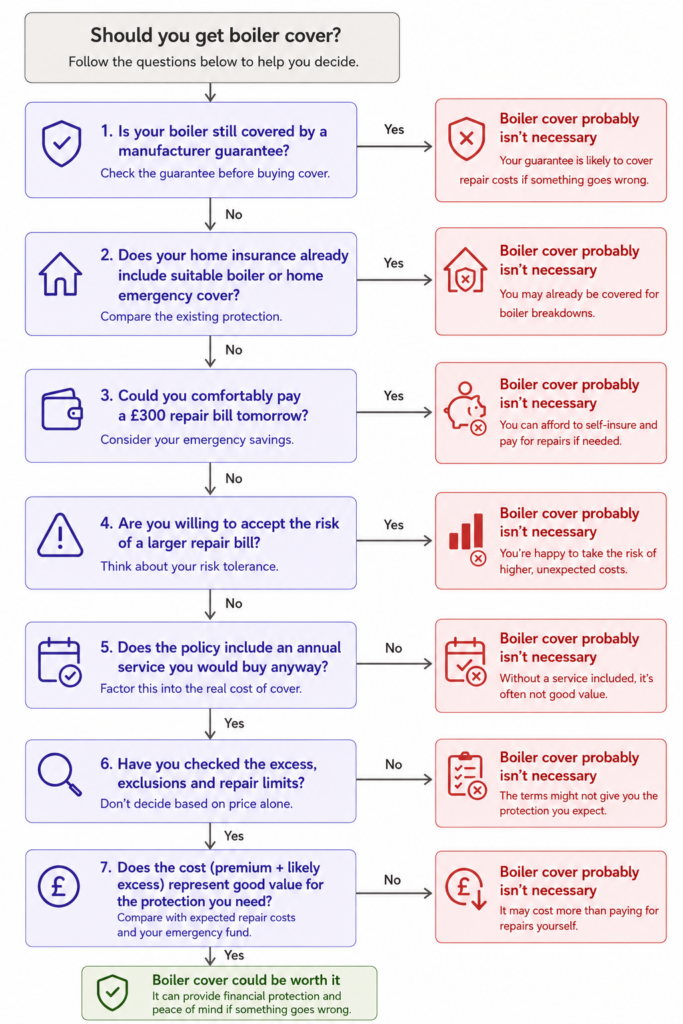
A simple way to decide
Ask these questions in order:
- Is your boiler still covered by a manufacturer guarantee?
If yes, check the guarantee before buying separate boiler cover. Avoid paying twice for substantially overlapping protection. - Does your home insurance already include suitable boiler or home emergency cover?
If yes, compare the existing protection with a standalone policy before buying anything else. - Could you comfortably pay a £300 repair bill tomorrow?
If not, boiler cover may provide useful financial protection. - If you can afford repairs, are you willing to accept the risk of a larger bill?
If yes, paying for repairs yourself and building a boiler fund may be cheaper over time. - Does the boiler policy include an annual service you would buy anyway?
If yes, subtract the value of that service when comparing the real cost of cover. - Have you checked the excess, exclusions and repair limits?
If no, don’t buy based on the monthly price alone.
There isn’t one correct answer for every household. Boiler cover generally trades potentially higher long-term spending for more predictable short-term costs.
What should you check before buying boiler cover?
Two policies with similar monthly prices can provide very different levels of protection.
Before signing up, check:
- Excess: How much do you pay each time you claim?
- Annual service: Is one included, and what does it cover?
- Parts and labour: Are both included?
- Claim limit: Is there a maximum repair cost per claim or per year?
- Boiler age: Are older boilers excluded or subject to different conditions?
- Pre-existing faults: Problems that existed before the policy began may not be covered.
- Initial waiting period: Check how soon after buying the policy you can claim.
- Central heating: Does the policy cover only the boiler or also radiators, pipes and controls?
- Beyond-economic-repair rules: What happens if the provider decides your boiler isn’t economical to repair?
- Replacement: Does the policy contribute towards a replacement boiler, and under what circumstances?
- Cancellation and renewal: Check whether the introductory price changes and what happens at renewal.
Read the policy wording rather than relying on the summary on the sales page.
What about older boilers?
An older boiler might seem like the strongest candidate for cover because it is more likely to develop faults, but that doesn’t automatically make a policy better value.
Older boilers can face additional restrictions. Providers may impose age limits, lower repair limits or decide that an appliance is beyond economical repair.
Manufacturer-backed plans can also have age restrictions. Worcester Bosch, for example, says its Maintenance & Support Plan is available to qualifying boilers under 12 years old that are outside their guarantee.
If your boiler is approaching the end of its useful life, compare the annual cost of cover with putting that money towards eventual replacement. Paying hundreds of pounds for protection that will not fund a replacement boiler may be poor value if replacement is already likely in the near future.
Boiler cover for tenants and landlords
If you’re a tenant, you generally shouldn’t need to buy boiler cover for a boiler supplied as part of your rented home.
Landlords are normally responsible for maintaining heating and hot-water installations. In England, for example, local-authority guidance reflects the landlord’s statutory responsibility for heating and hot-water repairs.
In Scotland, private landlords must keep installations for space heating and heating water in a reasonable state of repair and proper working order under the Repairing Standard.
In Northern Ireland, landlords are responsible for installations for space heating and water heating where repair responsibilities are not clearly set out in the tenancy terms.
Landlords have a different calculation. Boiler cover can help make maintenance costs more predictable across a rental property, but it doesn’t replace legal obligations such as required gas safety checks. Landlords should check carefully whether a policy includes any services or certificates they need rather than assuming that boiler cover satisfies their legal responsibilities.
Boiler cover or an emergency fund?
For homeowners who can afford it, creating your own boiler fund is the main alternative to cover.
Instead of paying £15 per month to a provider, for example, you could put the same £15 into savings. After a year you would have £180; after five years you would have £900 before interest, assuming you hadn’t needed to use it.
The benefit is straightforward: if the boiler doesn’t break, you keep the money.
The disadvantage is equally straightforward: you carry the risk. A £300 repair after three months would arrive when your £15-a-month fund contained only £45.
That makes this as much a question about household finances and risk tolerance as it is about average repair costs.
So, is boiler cover worth it?
For many homeowners with a reliable boiler, an adequate emergency fund and no need for the convenience of a cover provider, paying for an annual service and repairs as required is likely to make more financial sense.
Boiler cover becomes more attractive when an unexpected repair would be difficult to afford, when useful servicing is bundled into the price, or when you place a high value on predictable costs and having a provider to contact when something goes wrong.
Don’t judge a policy by the monthly premium alone. Check your existing warranty and home insurance first, then compare the annual premium + likely excess with the cost of servicing separately and the amount you could realistically keep in an emergency repair fund.
The best option isn’t necessarily the one that costs least in a year when nothing goes wrong. It’s the one that gives you an appropriate level of financial protection without making you pay unnecessarily for cover you already have.
Frequently asked questions
How much is boiler cover in the UK?
Boiler insurance averages at around £8–£30 per month, with an average of approximately £15. A survey found that customers paid an average of £183 per year for a boiler cover package. Actual prices depend on the provider, boiler and level of protection.
Is boiler cover cheaper than paying for repairs?
Not necessarily. Boiler cover can cost more over time than paying for annual servicing and occasional repairs yourself, particularly if your boiler is reliable and rarely needs attention. However, one expensive breakdown can make cover worthwhile in an individual year, while the predictable monthly cost may also appeal to households that want to avoid unexpected repair bills.
Does boiler cover include an annual service?
Some policies do and others don’t. Check the policy terms rather than assuming a service is included. If it is, include the value of the service when comparing cover with paying as you go.
Is boiler cover worth it for a new boiler?
It is less likely to offer good value if your new boiler already has a comprehensive manufacturer guarantee. Check what the guarantee covers and what you must do to maintain it before buying additional protection.
Is boiler cover worth it for an old boiler?
Potentially, but check the small print carefully. Older boilers can be subject to age restrictions, claim limits or beyond-economic-repair provisions. If the boiler is already approaching replacement, saving towards a new boiler may be more useful than paying for cover that primarily funds repairs.
Can I just save money instead of buying boiler cover?
Yes. Building a dedicated repair fund is a reasonable alternative if you can afford to take on the risk yourself. The main drawback is that a breakdown could happen before you’ve accumulated enough money to pay for it.
Sources
- Worcester Bosch — In Guarantee Service — annual servicing requirements and current manufacturer servicing information.
Worcester Bosch in-guarantee servicing - Worcester Bosch — Maintenance & Support Plan — plan eligibility, annual servicing and £1,500 repair limit.
Worcester Bosch Maintenance & Support Plan - Cambridge City Council — Housing repairs for private tenants — landlord responsibilities for heating and water systems.
Cambridge City Council tenant repair guidance - Scottish Government, Repairing Standard: statutory guidance for private landlords — requirements for space-heating and water-heating installations in Scottish private rented properties.
Scottish Government — Repairing Standard guidance - nidirect, Repairing your home: private tenants — repair responsibilities for space-heating and water-heating installations in Northern Ireland private tenancies.
nidirect — Repairing your home: private tenants
Accurate as of: 12 August 2026