

Start with safety, not cost. If your boiler shows signs of corrosion, a leak, or a possible gas concern, get it inspected by a Gas Safe registered engineer before anything else, since that decision isn’t one to make on cost alone.
Once safety is ruled out, the decision usually comes down to three things: how old the boiler is, how often it’s needed repairing lately, and whether this repair is expensive relative to a full replacement.

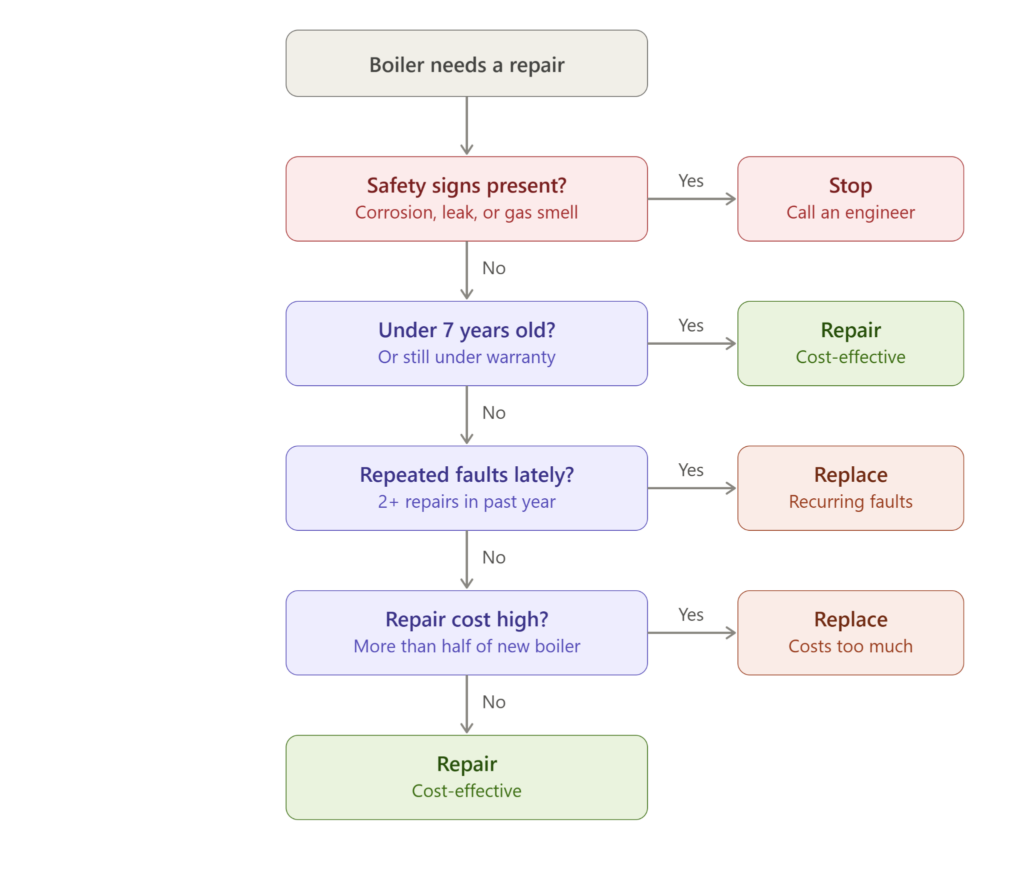
The decision, step by step
- Any safety signs? Corrosion on the boiler body, a leak, or a smell of gas means stop and call a Gas Safe registered engineer before doing anything else. This isn’t a repair-or-replace decision you should make yourself.
- Is the boiler under 7 years old, or still under warranty? If yes, repair. It’s very likely the cheaper option and the boiler has plenty of working life left.
- Has it needed 2 or more repairs in the past 12 months? If yes, replace. A pattern of repeated faults usually points to a boiler nearing the end of its working life rather than one bad part.
- Is this repair likely to cost more than roughly half the price of a full replacement? If yes, replace. Below that threshold, repair is generally still the more cost-effective choice.
There’s no single authority that sets these exact thresholds. Instead, this reflects a widely used rule of thumb rather than a fixed standard, but it lines up with what UK manufacturers say about typical boiler lifespans and what most engineers weigh up in practice.
Signs it’s worth considering replacement
- Age. Worcester Bosch states the average boiler lifespan is 10–15 years, depending on use, maintenance and boiler type. Age alone isn’t a reason to replace a boiler that’s still working well, but it’s worth weighing alongside the other signs here.
- Rising energy bills or a home that’s slower to heat up, even with no other obvious cause.
- Frequent breakdowns. Needing an engineer out more than once or twice within a year or two often signals the boiler is reaching the end of its working life rather than suffering a one-off fault.
- Visible corrosion, or a leak from the boiler body itself (rather than a valve or joint), which is a safety-relevant issue and should be assessed by a Gas Safe registered engineer, not decided on cost alone.
Signs a repair still makes sense
- A single, identifiable fault, such as a faulty valve, thermostat, or pressure sensor, on a boiler that’s otherwise been reliable.
- The boiler is younger than around 7 years, or still under warranty, in which case repair (sometimes at no cost, if covered) is almost always the right call.
- This is the first fault in some time, rather than one of several in quick succession.
Weighing the cost
A commonly used guide is the “50% rule”: if a repair costs less than roughly half of what a full replacement would cost, repairing is usually the better financial choice; above that, replacement tends to make more sense, particularly on an older boiler.
This is a widely repeated industry heuristic rather than a figure from a specific regulator or manufacturer, so treat it as a starting point rather than a fixed formula.
It’s also worth factoring in efficiency rather than just the upfront repair or replacement price. A new heating system with a smart control and system filter could save up to £300 a year on energy bills, which can offset a meaningful share of the replacement cost over time.
If you’re a tenant or landlord
In a rented property, the decision to repair or replace the boiler is the landlord’s to make and pay for, not the tenant’s.
Under Section 11 of the Landlord and Tenant Act 1985, landlords in England and Wales must keep the installations for space heating and water heating in proper working order. Tenants should report a persistent or worsening fault promptly so the landlord can assess whether it needs a repair or a replacement.
(Different rules on repair timescales and enforcement can apply in Scotland and Northern Ireland. This section reflects the position in England and Wales.)
Frequently asked questions
Sometimes, if the fault is minor and cheap to fix. But if the boiler is well past 10–15 years old and the repair is expensive, replacement is usually the better long-term choice.
Corrosion, a leak from the boiler itself, or any smell of gas are the clearest signs. If in doubt, treat it as a safety issue and get a Gas Safe registered engineer to check before deciding anything else.
It can, mainly through improved efficiency rather than avoided repair costs alone.
A safe, working repair is a perfectly reasonable short-term option even on an older boiler, provided there are no safety concerns. It’s worth budgeting for eventual replacement rather than treating repairs as a permanent solution once a boiler is well past its typical lifespan.
Sources
- Landlord and Tenant Act 1985, Section 11, legislation.gov.uk (https://www.legislation.gov.uk/ukpga/1985/70/section/11)
- Shelter England, Heating, hot water and power problems (https://england.shelter.org.uk/professional_resources/legal/housing_conditions/responsibility_for_repairs/heating_hot_water_and_power_problems)
Accurate as of: 10 August 2026