

Your boiler pressure should sit between 1.0 and 1.5 bar when the heating is off and the system is cold, rising to somewhere around 1.5 to 2.0 bar once the heating is running.
If your gauge is well outside that range, you need to take action. It’s usually straightforward to fix yourself, but you should call a Gas Safe registered engineer in a few situations.
This boiler pressure guide covers what the reading on your boiler actually means, how to check it, the symptoms to watch for, when it’s safe to top up yourself, and when it’s a sign of something that needs professional attention.
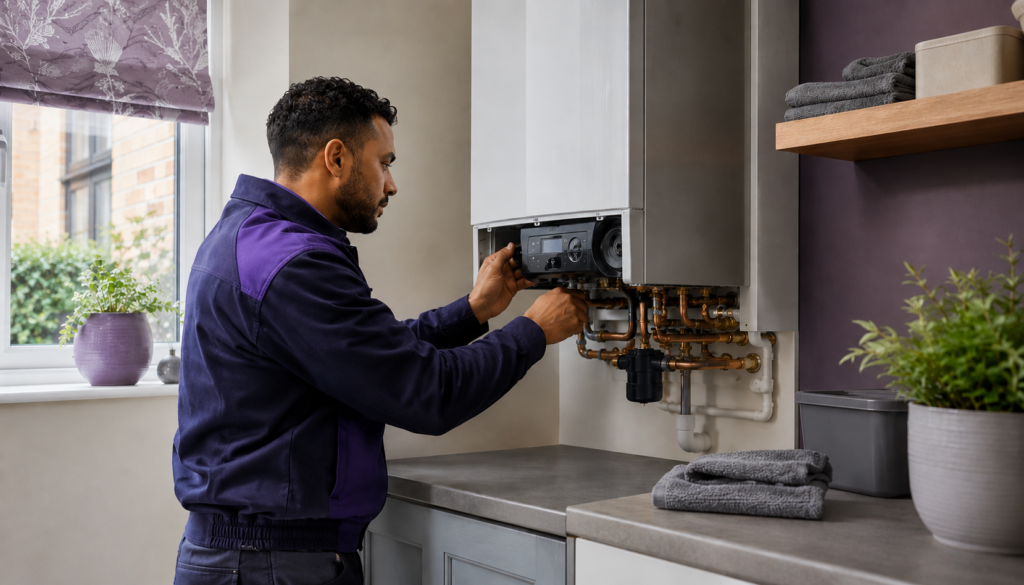
What boiler pressure actually means
Boiler pressure is the pressure of the water sealed inside your central heating circuit: the pipework and radiators, not your mains water supply.
Most homes have a sealed system: a fixed amount of water circulates through the boiler and radiators, and the pressure gauge tells you whether that circuit has the right amount of water in it.
Too little water and the pressure is low; too much and it’s high. A small rise in pressure when the heating switches on is normal and expected, as the water expands slightly as it heats up.
You’ll find the pressure gauge on the front of the boiler (a dial with a green “normal” zone and a red zone at each end) or, on newer models, as a digital readout on the display panel.
This guide applies to sealed central heating systems, which is what most modern combi, system and regular boilers in the UK use. If you have an older open-vented system with a header tank in the loft, pressure works differently and this guide doesn’t apply in the same way. Check your system type if you’re unsure, or ask your installer.
Ideal boiler pressure: cold vs. running
| System state | Typical pressure | What it means |
| Heating off, system cold | 1.0–1.5 bar | Normal resting pressure |
| Heating on, system warm | 1.5–2.0 bar | Normal, pressure rises as water expands |
| Below 1.0 bar | Too low | Likely needs topping up |
| Below 0.5 bar (red zone) | Too low | Water has been lost; top up and check for a leak |
| Above 2.5–2.75 bar (red zone) | Too high | May trigger the pressure relief valve |
These figures are a sensible general guide, but your specific boiler’s instruction manual is the definitive source. Some manufacturers and models specify slightly different ranges, and the manual will also tell you exactly where your model’s filling loop or filling key is.
Symptoms of low and high boiler pressure
Checking the gauge is the most reliable way to confirm a pressure problem, but these are the everyday signs that usually point to it first.
Signs your boiler pressure is too low:
- Radiators that don’t heat up fully, or heat up unevenly
- No heating, no hot water, or the boiler failing to fire at all
- The boiler locking out or displaying a low-pressure fault code
- The pressure gauge needle sitting in the low red zone
Signs your boiler pressure is too high:
- The pressure gauge needle sitting in the high red zone, even when the system is cold
- Water dripping or discharging from the pressure relief valve pipe outside the property
- The boiler shutting down unexpectedly or displaying a fault code
- Leaks at pipe joints or radiator valves, often the weakest points in the system
If you notice signs of a leak alongside either of these, in particular puddles, damp patches, staining, or green deposits around pipework, it’s worth getting a Gas Safe registered engineer to take a look rather than repeatedly topping up.
How to check your boiler pressure
- Make sure the heating and hot water are switched off, and let the system cool if it’s been running.
- Find the pressure gauge: a dial or digital display on the boiler casing.
- Read the needle or number against the green zone. If it’s sitting in either red zone, or below 1.0 bar even in the green zone, it needs attention.
If your pressure is too low
Low pressure is one of the most common boiler issues and is usually something you can fix yourself in a few minutes.
- Turn the boiler off and let it cool.
- Locate the filling loop, usually a braided flexible hose with a valve or lever at each end, connecting the cold mains to the heating system underneath the boiler. Some newer boilers use a keyless or internal filling link instead; check your manual if you can’t find it.
- Open the valve(s) slowly and let water in until the gauge reads around 1.0–1.5 bar.
- Close the valve(s) firmly, then turn the boiler back on.
When to call a Gas Safe engineer instead of topping up yourself:
- The pressure drops again within a few days of topping up (this usually points to a leak).
- You notice damp patches, staining, or green deposits around pipework, radiator valves or the boiler itself.
- You can’t find or safely operate the filling loop.
- The boiler shows a fault code alongside the low reading.
If your pressure is too high
A small rise while the heating is running is normal. Persistently high pressure, or pressure that sits in the red zone even when the system is cold, usually means one of two things: too much water was added during a top-up, or the expansion vessel (which absorbs the pressure increase as water heats) isn’t working properly.
If it’s a simple case of overfilling, bleeding a radiator slightly can release enough water to bring the pressure back down.
If the pressure keeps climbing on its own, or you hear the pressure relief valve discharging water outside your home, turn the boiler off and contact a Gas Safe registered engineer. A failing expansion vessel or relief valve isn’t a DIY repair.
Common mistakes to avoid with boiler pressure
- Repeatedly topping up without investigating. If you’re topping up more than once or twice a year, that’s a sign of an underlying leak, not just “normal” pressure loss.
- Confusing boiler pressure with water pressure. Weak flow from your taps is a different issue and won’t be fixed by adjusting the boiler’s filling loop.
- Ignoring a fault code. Many boilers will display a specific low-pressure error rather than just a low gauge reading; treat it the same way.
- Assuming every boiler follows the exact same numbers. Ranges vary slightly by manufacturer; the figures here are a reliable general guide, not a substitute for your boiler’s manual.
If you’re a tenant or landlord
Boiler pressure problems in a rented property fall under the landlord’s repairing obligations, not the tenant’s. Under Section 11 of the Landlord and Tenant Act 1985, landlords in England and Wales must keep the installations for space heating and water heating in proper working order. In practice, this means:
- Tenants should report a persistent pressure fault to their landlord promptly rather than trying to fix it themselves, especially if it involves the gas supply.
- Landlords are responsible for arranging repairs, and any gas-related work must be carried out by a Gas Safe registered engineer as part of their existing legal duty to have gas appliances safety-checked annually.
Northern Ireland and Scotland have similar regulations.
Frequently asked questions
Once or twice a year is considered normal, largely to compensate for tiny amounts of air or water lost over time. More frequent top-ups usually indicate a leak somewhere in the system.
Yes. Many modern boilers will lock out or refuse to fire if pressure drops too low, as a safety measure.
Not immediately in most cases, since boilers have a pressure relief valve designed to release excess pressure safely. But pressure that’s persistently high, or that keeps climbing, should be checked by a professional rather than left.
Pressure that’s too low can make your system work harder to circulate hot water properly, which can affect heating performance, though it isn’t typically a major driver of energy costs on its own.
Sources
- Landlord and Tenant Act 1985, Section 11, legislation.gov.uk (https://www.legislation.gov.uk/ukpga/1985/70/section/11)
- Shelter England, Heating, hot water and power problems (https://england.shelter.org.uk/professional_resources/legal/housing_conditions/responsibility_for_repairs/heating_hot_water_and_power_problems)
- Northern Ireland Direct, Repairing your home: private tenants (https://www.nidirect.gov.uk/articles/repairing-your-home-private-tenants)
- mygov.scot, Repair standards as a private landlord (https://www.mygov.scot/landlord-repairs)
Accurate as of: 4 August 2026